
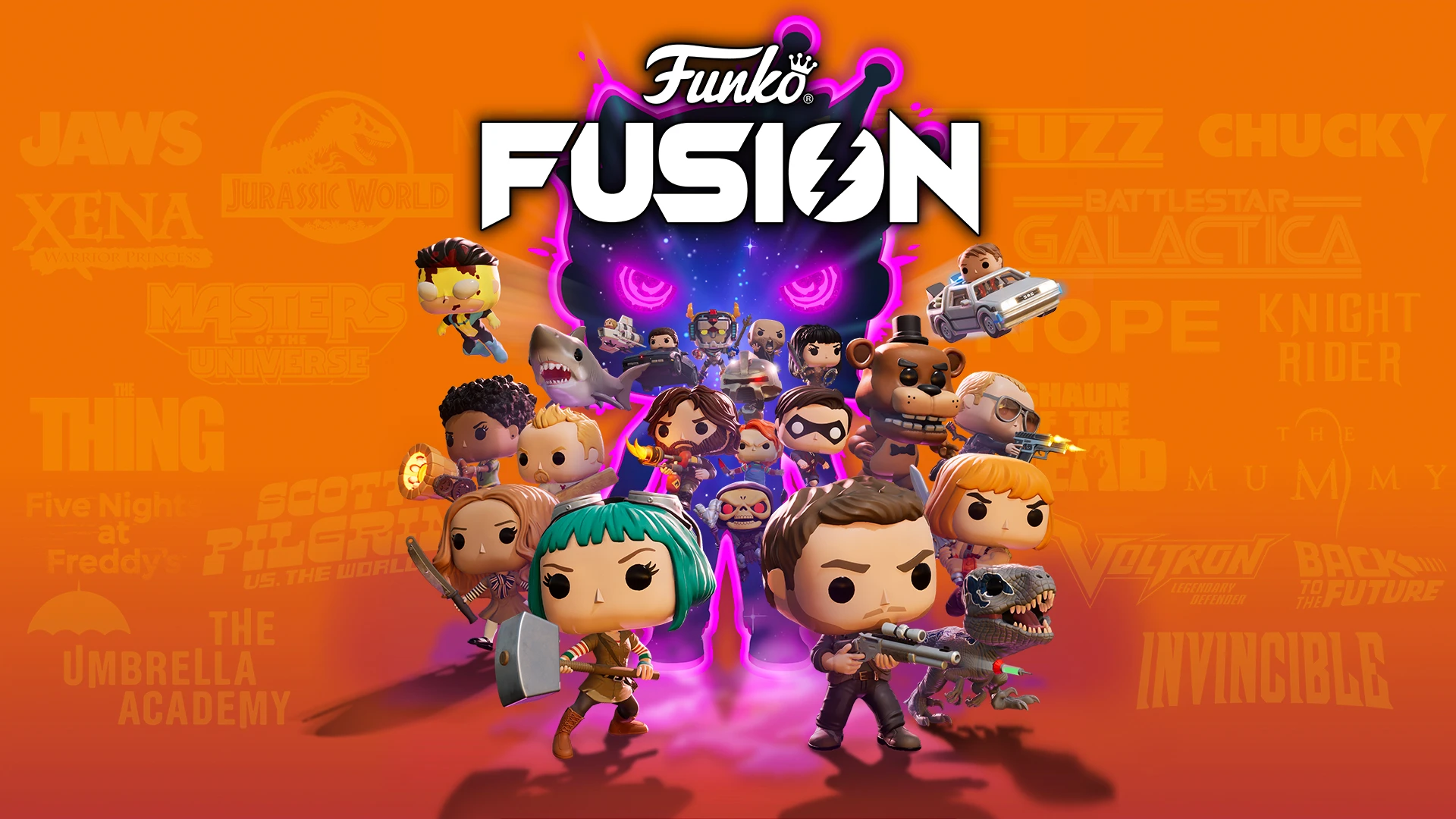
Go into any pop culture merchandise or video game store nowadays, and you’ll likely find some (if not a whole wall of) Funko Pop Vinyl figures available to purchase. With over 10,000 different variants on the market and the offerings seemingly having not shrunk, there is a market ready for them. With the ‘Toys to Life’ craze seemingly dissipating since the 2010s- the days of Disney Infinity, LEGO Dimensions and Skylanders are well behind us. But what if you took the dozens of purchasable figures out of the equation and instead gave media franchises unlikely to receive individual video game adaptations their chance to shine? Uniting a range of franchises from NBCUniversal’s line-up, Funko Fusion from the relatively new developer 10:10 Games sets out to do just that. Does the game accomplish what it sets out to do? Read on to find out.
Funko Fusion unites the realms of the different franchises with a subtle overarching narrative that essentially serves as a beginning and conclusion, then lets players fill out the middle by tackling the worlds they want to explore in whatever order they wish. Essentially the narrative revolves around the characters of the different realms uniting to save the official mascot of Funko, Funko Freddy – who is ultimately taken down by their evil counterpart — Funko Eddy – who subsequently takes over key figures in each of the worlds and sends them down alternate timelines. The storyline had so little bearing during most of the game that I had to replay the intro to remind myself of what it was.
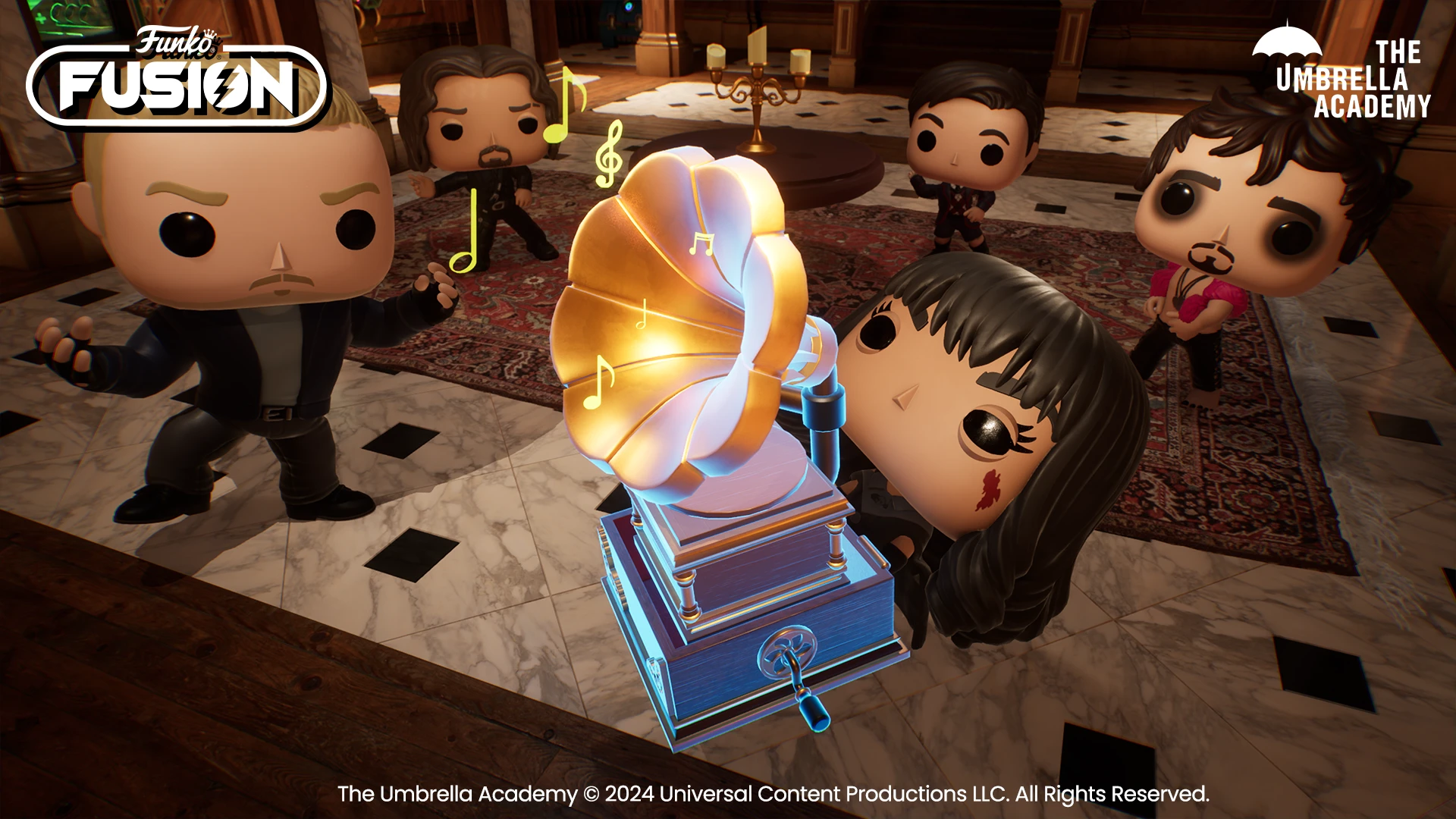
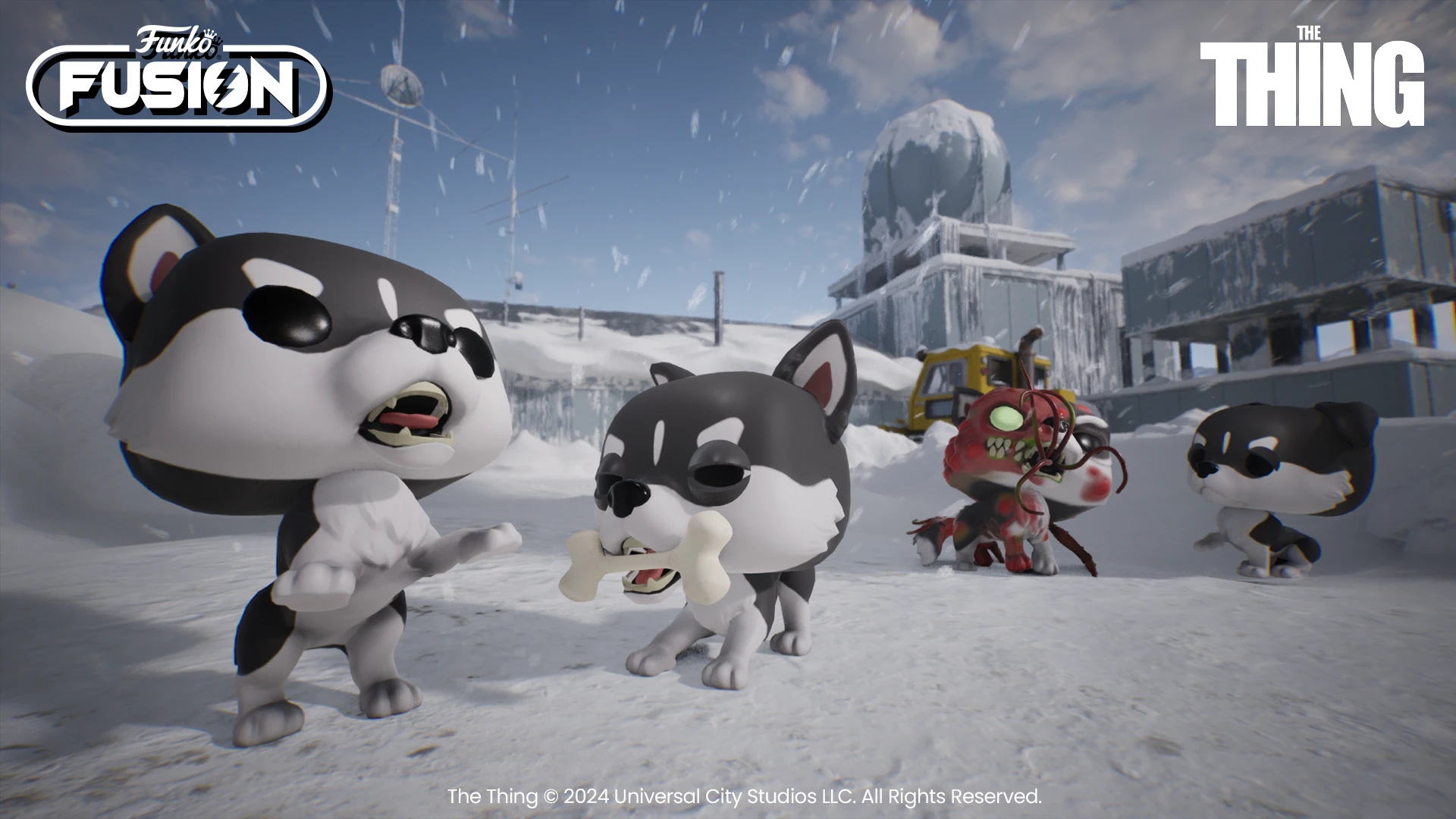
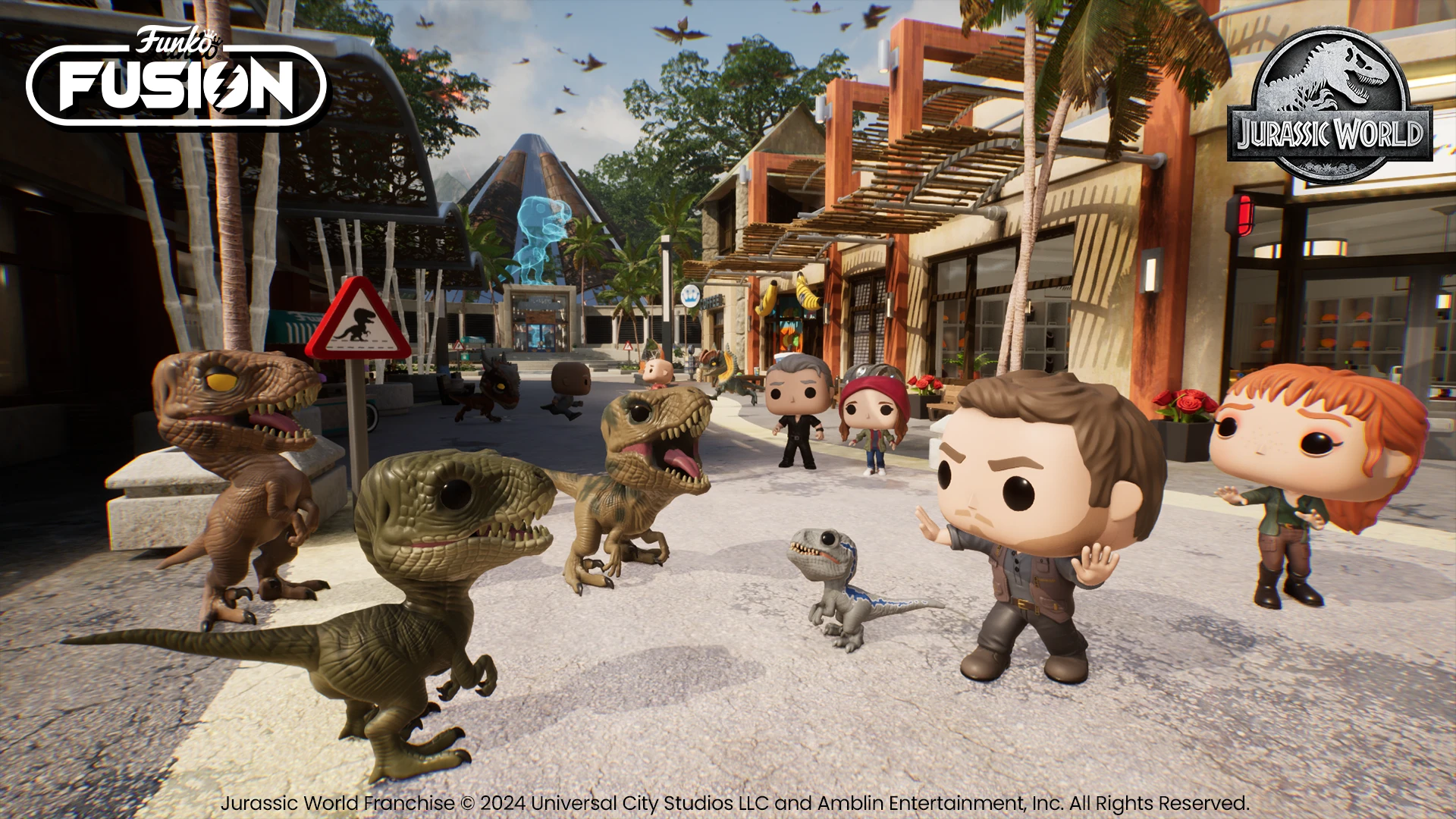
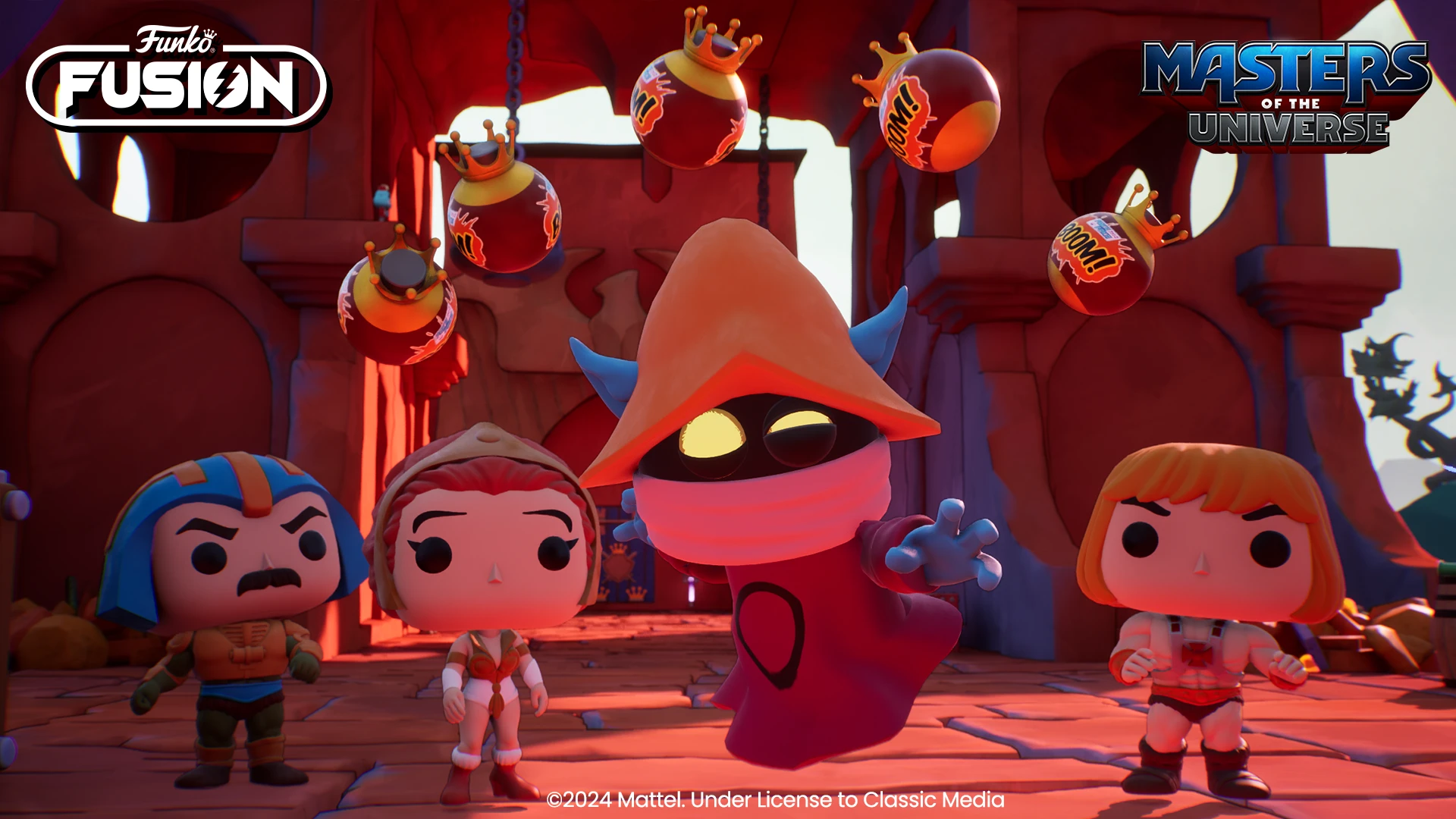
Funko Fusion is spread across seven worlds, each very loosely based on the narrative or at least the setting of a particular franchise: Hot Fuzz, Jurassic World, The Thing, Battlestar Galactica, The Umbrella Academy, Masters of the Universe and Scott Pilgrim vs. The World. As you collect the game’s main collectable (Golden Crowns), you incrementally unlock a new world – each with its own set of playable and NPC characters, unique skills, unlocks and more. Narratively, all the worlds don’t have a solid introduction to them, more or less expecting you to be well-versed with the characters, the setting and everything else. Even if most stages are uniquely crafted based on elements of a series, instead of following specific events, no voiced dialogue, no story summary or even an introduction to the characters meant unfamiliarity made the experience substantially less enjoyable. For example, I could appreciate what they did with The Umbrella Academy – a series I have binged multiple times. Sure it felt like more traversing through familiar environments following a thinly veiled story and generic missions, but I was in familiar territory. On the other hand… I have never watched Hot Fuzz, and being thrown into the mix of things was not enjoyable.
The same can be said for the Cameo Levels, such as Shaun of the Dead, Five Nights at Freddy’s, Invincible, NOPE, The Mummy, Back to the Future and JAWS. With these, true to their name, you make a “cameo” in a scene from the respective franchise. These were arguably much better-curated gameplay-wise with more creative challenges, but if you don’t know about a franchise – Funko Fusion gives you almost nothing to work with.
If there was one highlight of Funko Fusion, however, it was easily the efforts that went into the design and aesthetic effects of each world. Virtually all NBCUniversal licenses featured in the game are notable for their iconic locations, aesthetic, and in some cases music selection. These have been aptly recreated in the game – so even if they are non-canonical in layout and are adapted to suit the video game setting, it still feels like you are wandering around a Funko-ified version of the world it is based on. One such example is the Umbrella Academy-themed areas, which drew from key locations from the first three seasons such as the Umbrella Academy manor, Hotel Obsidian and The Temps Commission. Alternatively, with the Back to the Future cameo world, you get a sense that you are back in 1955 and doing your part to salvage the plan of Emmett Brown and Marty McFly – just with so many more steps involved. As for the character designs, they are very much the designs of the characters in Funko Pop form – with enough uniqueness to make sure every character respects the source material and their respective actor.
Music was also a good element in parts. Referring back to The Umbrella Academy, they drew from licensed music featured in the show, such as Istanbul (Not Constantinople) by They Might Be Giants. The remainder of the music in the game typically suited the vibe of the area but was passable at best. Outside of a few cutscenes, there is no voice acting outside of a few instances of generic-sounding grunts and sound effects. Given the age of some of these licenses, it is understandable that bringing in the original voice actors might have been costly or otherwise impossible. But ‘Kingdom Hearts’ing’ the game with an alternate sounds-alike voice cast would have been nice – at least from my perspective. LEGO Dimensions managing to do this for many of their characters, granted with Warner Bros serving as the game’s publisher, took that game to the next level.
The approach to gameplay in Funko Fusion is in my opinion a bit confusing, as if the development team were uncertain what their target audience was – being simplistic and child-friendly but at the same time featuring many intellectual properties aimed at an older demographic which meant they could have gone much further with the challenges, puzzles and combat than they did. At its core, each area of each of the worlds generally sees you undertaking a pre-defined route to your destination with some quest(s) associated with it – such as routing an NPC character somewhere, collecting a resource exclusive to that area, or taking down bosses/enemies. Combat typically involves basic punch-or-shoot mechanics, as you take down foes without depleting your health bar. Most of the challenges are relatively simple, with the occasional combat moment that may see you overwhelmed or taken down if you go in all guns blazing. However, provided you have enough of the game’s common collectable (vinyl) and hearts, you can resurrect at least three times before having to restart the entire level again. It’s serviceable and an adequate experience overall, yet nothing groundbreaking.
While your destination is pre-defined, each level has a varying degree of openness, allowing you to explore to collect Silver Crowns (which can be traded in for Gold Crowns), more vinyl and tokens that can be put towards new weapons, healing items and combat items. However, not everything is accessible to you immediately. Specific characters and worlds have associated abilities and gear that need to be unlocked to unlock cameo worlds (1x per world), cameo challenges (1x per world which are then rolled out to other worlds once unlocked) and complete side-tasks for silver crowns and other rewards. This is good and encourages you to explore each area multiple times. However, I’d argue it isn’t always clear that this is the case when you are starting – and in the first few levels, I found myself wondering whether I had missed an instruction or step to complete tasks, due to how often it wasn’t clear what I as the player needed to do – and more readily encountered a blocked off side-task than the actual task. Thankfully, much of what is required can be obtained by unlocking each world and completing the first area within them.
Characters can be switched between at any Funko Pop box located in the hub world or each area – initially between just the characters exclusive to that franchise but later characters of any franchise. Each character has their weapon of choice and a distribution of stats which I found gave minimal reason to frequently switch between characters. Instead, some characters have special abilities which make them superior to the others. For example, Number 5 and Allison Hargreaves both retain unique abilities driven by their powers from The Umbrella Academy which are used in multiple worlds – while the other initial playable characters from the series – Klaus and Diego have no such practical application. Other series have characters that can utilise amps to traverse long distances, charge power pads and utilise shields among other abilities – but not every character. This means that while you can play as your favourite character (if they made the cut into being playable), you are ultimately required to use a few specific options to get past certain puzzles. Even if having a more prominent combat effect, it would have been nice to see each of the game’s characters have more utility amongst even just their counterparts.
Funko Fusion utilises a rudimentary inventory system, which you can use to store and use an assortment of items you collect or craft during your adventures – covering weapons, healing/supportive items and combat items. There is a solid variety available from the outset, with each area having collectable items that can be turned in to unlock new options, as well as practical items such as amps (for the amp traversal mechanic), batteries to be charged and then used to unlock new areas and more. Some of the more OP healing items are available almost immediately, such as a 100% healing item. But the options are solid albeit your typical adventure-platformer offerings, and it was nice to have that “aha!” moment when I realised something I’d just unlocked would have a practical application someplace else.
At least at launch, Funko Fusion is prone to a few soft-locking bugs. For example, in one play session, I found myself having to repeat a boss battle a couple of times because the opponent didn’t gain any weak spots I could target, and later that session in another area, my character was hit by a door opening and got no-clipped into the wall. Nowadays every game seems to have some bugs at launch, but during my playtesting, these occurrences felt more regular and not simply once-offs.
10:10 Games’ Funko Fusion unites various NBCUniversal franchises into a single gaming experience, featuring worlds based on properties like The Umbrella Academy, Jurassic World, and more. The game accomplishes this with a nice set of offerings, though these are, for some, much more niche than those in past crossover games. While Funko Fusion shines in its detailed funkoification of iconic locations and aesthetics—effectively capturing the essence of each franchise and showcasing the development team’s passion—the overall experience is hampered by a minimal and forgettable narrative, serving more as a highlight reel of each franchise. Basic combat and puzzles offer little challenge, and the game assumes familiarity with all franchises, making it less accessible to newcomers. Technical issues and underutilized character abilities further hinder the experience. However, what we have here is a serviceable game that is enjoyable in short bursts but doesn’t fully capitalize on its ambitious crossover concept.
Final Score for Funko Fusion
This review was conducted on a digital PlayStation 5 copy of Funko Fusion, provided by Australian publisher/distributor Five Star Games for the purpose of this review.
Funko Fusion is now available to purchase on the PlayStation 5, Xbox Series X|S and Windows PC via Steam, with a PS4 release planned for 15 November 2024, and a Nintendo Switch version set to go live in December 2024.

