
If you ask any millennial or Gen X gamer which Final Fantasy they’re most nostalgic for, you’d probably get one of the early entries in the franchise or one of the 3D entries from the ‘golden age’ of the late 90s. For me, I only really got into the series once it hit double digits with Final Fantasy X-2 on the PS2, and I’ve slowly worked my way back since. I don’t have that nostalgia factor myself, but I do have a great deal of respect for the way the developer (back when it was just Square) managed to squeeze such a complex, challenging game out of the very limited system resources of the time. Today, in 2026, Final Fantasy is still Square Enix’s flagship series, of course, and they’re pushing forward with what’s possible on new platforms and in new ways of playing. But can they still deliver a new classic style Final Fantasy experience? Co-developed by Square Enix and Lancarse and marketed as the first HD-2D game in the series, Final Fantasy Resonance attempts to answer that very question. Read on to find out how it stacks up in my review of Final Fantasy Resonance!
Final Fantasy Resonance takes the opening story of Final Fantasy Brave Exvius, a mobile gacha title that has since gone offline, and reworks it into a standalone console adventure, minus the monetisation. For those who are unfamiliar with the original game itself, it would be fair to be a little sceptical, with the breadth of narrative quality in gacha games ranging widely – especially when the games generally depend on an expansive rather than succinct character cast. However, the premise is about as classic Final Fantasy as it gets. The story follows Rain and his adoptive brother Lasswell, who serve as knights of the Kingdom of Grandshelt. When a member of the mysterious Sworn Six shatters the Earth Crystal before their eyes, the pair sets off to safeguard the remaining crystals. They are soon joined by Fina, a young woman with no memory of her past, and as the journey moves from one continent to the next, the party grows to eight, with each new arrival providing their own personal arc. This ensemble, more than the plot itself, kept me invested. The party’s banter is genuinely funny, the optional conversations you trigger while exploring are worth seeking out, and characters like the level-headed Nichol and the inventor Lid quickly became favourites of mine. Ironically, Rain himself is the least interesting of the lot.
Is the narrative perfect? Not entirely. Final Fantasy Resonance falters in the story it chooses to tell. Endangered crystals, an amnesiac heroine, and villains in imposing armour with grand plans are all present – flagships of early Final Fantasy games almost required for a return to the series’ roots. However, series veterans will likely see most twists well before they land. That said, the game never takes itself too seriously, balancing earnest moments with silliness, and I was happy to go along for the ride even when I could guess where it was heading. The pacing is fairly brisk, though the opening chapter takes a while to find its feet and the final act feels rushed by comparison. Thankfully, the side quests pick up the slack, particularly in the back half of the game, where character-focused missions add much-needed depth to the party and the world around them.
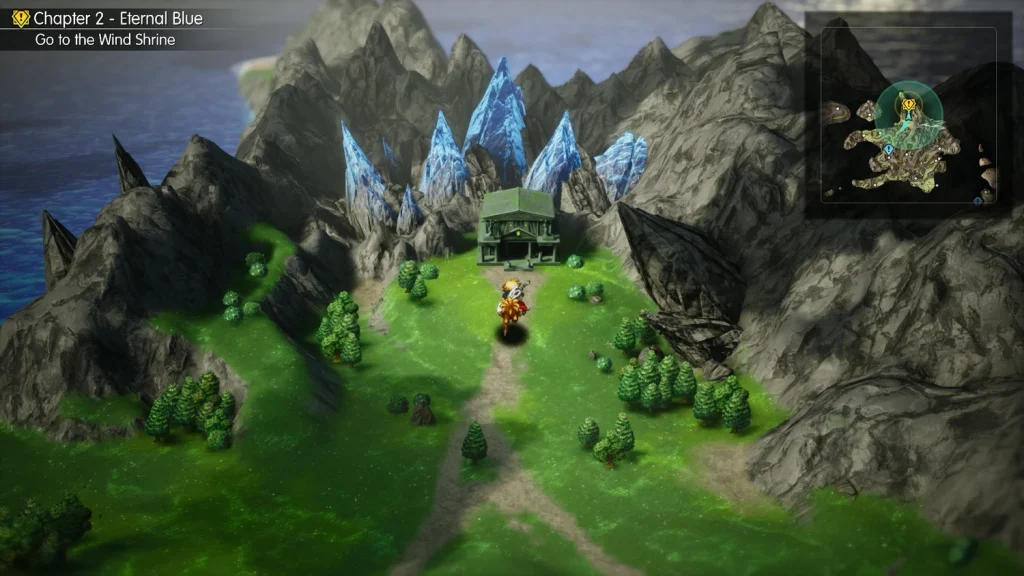
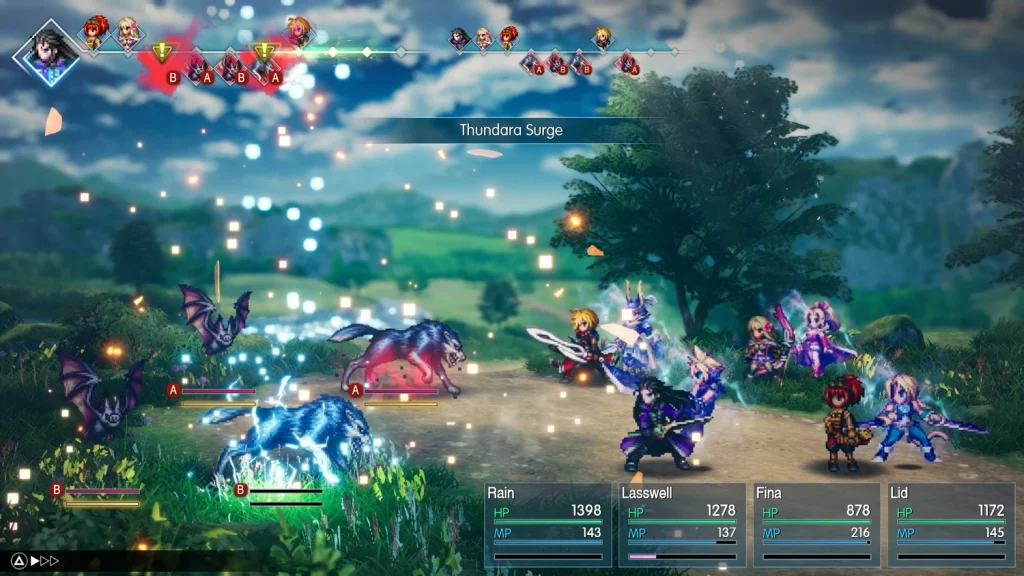
Aesthetically, Final Fantasy Resonance is pleasing to the eye and is by far the most ambitious HD-2D game to date in the Square Enix stable. Rather than using a fixed camera angle for its cutscenes, it lets the camera move around, sweep, and close in on key story moments, giving the sprites a real sense of cinematic drama. Each continent has its own distinct architecture and colour scheme, so getting to a new continent always felt like a real change of scene. The soft lighting and depth of field, as ever, are just as stunning. The sprite work in battle is just as good, with fluid animations that pay full respect to the classic approach while still feeling modern.
Not every visual choice quite works really. Each time a Vision does its Resonance finisher or an Esper is summoned, the game cuts to a fully rendered 3D cinematic, and the jump from pixel art to high-fidelity CG is a bit jarring. They’re pretty impressive the first couple of times, but after that they start to feel more like a ‘skip’. The menus are straightforward to use, but they’re very plain, so a bit more character would have helped. On the technical side, Final Fantasy Resonance ran smoothly on the PS5 throughout my entire playthrough, with no crashes and no real performance issues.
Audio-wise, Final Fantasy Resonance is a treat. The score blends new material with great remixed versions of classic tracks from the series. The boss themes are absolutely fantastic, taking on a variety of styles, while the town themes do a great job of defining each location’s character. The English voice acting is very good, with the party delivering lively, expressive performances and just the right amount of theatricality for the game. The only real downside is the inconsistency: much of the side content remains unvoiced, and the Vision cinematics are in Japanese only.
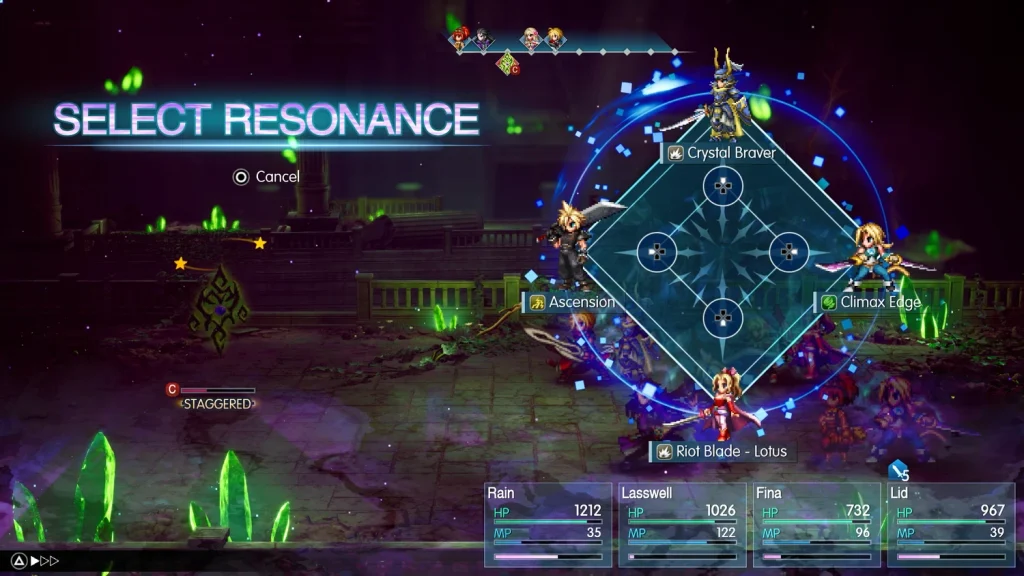
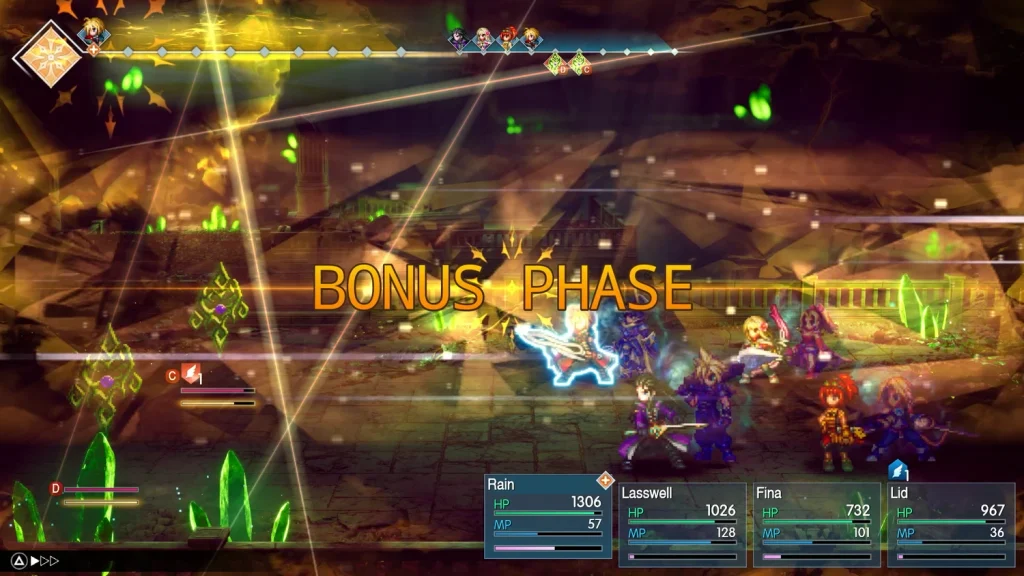
So how does Final Fantasy Resonance actually play? At its core, this is turn-based Final Fantasy in its most traditional form, with a timeline across the top showing who acts next, random encounters in the field, and no auto-battle button in sight. The stagger system gives it a modern edge. Every enemy has a stagger gauge beneath its health bar, and striking an elemental weakness drains it faster than anything else. Once it empties, the enemy loses its next turn and takes extra damage, while the character who broke it earns a bonus action. Stagger every enemy on the field in the same turn to trigger a Sweeping Stagger, giving the whole party another go before one of your equipped Visions unleashes a Resonance finisher. It turns each round into a satisfying puzzle as you weigh whether to chip away at health, line up staggers to land together, or hold back for a nasty attack approaching on the timeline.
Dig a little deeper and the Vision system is where Final Fantasy Resonance really comes into its own. Visions are spirits of heroes from across the series’ history, with representatives from the most iconic Final Fantasy titles joining a handful of original creations. Each can be equipped to a party member as a secondary job. They are sorted into six roles and progress along two separate tracks. Magicite found in the world permanently ranks up a Vision’s abilities, while Mastery grows through use with whichever character has it equipped. This unlocks stat bonuses and skills you can carry over using AP, even after swapping to another Vision. The result is a flexible way to shape your party. But there are, alas, a few snags. Healing-focused Visions are rare; some outclass the rest, and because Mastery is tied to each character, moving a Vision to someone new means starting progress from scratch.
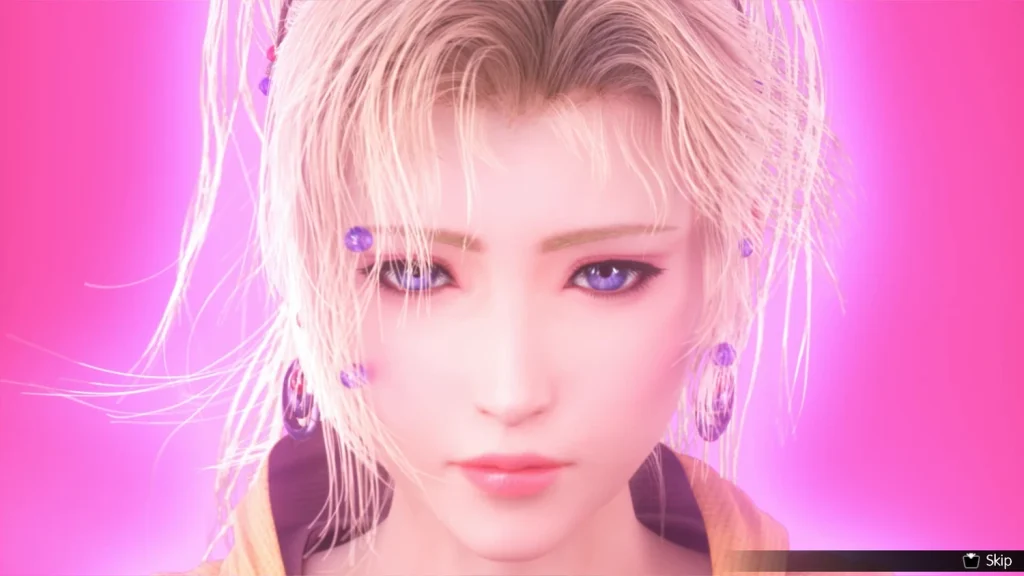
Espers and Limit Breaks round out your arsenal. Rather than appearing for a single flashy hit, a summoned Esper stays on the battlefield for three turns before finishing with a move. Its hefty MP cost means you will want to save it for important fights. Each party member also has their own Limit Break to fall back on. Put it all together, and Final Fantasy Resonance can feel too easy on Normal difficulty, especially in the first half, where a well-built party flattens most encounters. I recommend heading straight for Expert, which pushes back harder and gives extra rewards for each victory. Of course, this may also be your preference if you want to get through the narrative without anything too complex. The late game ramps up the challenge, with optional superbosses demanding preparation. However, a few tougher fights lean too heavily on oversized health and stagger bars, turning tense battles into drawn-out slogs.
Away from combat, there’s plenty to do. Hidden bosses, treasure, Esper locations, and Vision shrines dot each continent. Unlocking a chocobo and later an airship opens plenty of optional corners to explore. As someone who came to the older games in a roundabout way, I enjoyed how each shrine walks you through its hero’s original adventure. Dungeons are the weak link. Most are short, linear paths to a boss, and recycled layouts start to blur together after a while. A few quality-of-life omissions grated: the option to switch off random encounters arrives too late, you can’t save Vision and equipment loadouts, and there’s no full local map to consult. Thankfully, fast travel and adjustable battle speeds ease some of the sting.
So can Final Fantasy still deliver a classic experience in 2026? Based on Final Fantasy Resonance, I’d say absolutely. For someone who came to the franchise late and is working backwards, it’s absolutely fascinating to see Square Enix so willing to embrace the very constraints that Square had no choice but to work within – sprites, turn-based battles, an overworld map, a quest to protect the crystals and all of that without necessarily taking away too much of that classic feel. Within those constraints, they’ve created a really good stagger system and vision system, with some of the most visually stunning HD-2D you’ll see, all underpinned by a fantastic soundtrack. The story is fairly predictable, the dungeons are fairly forgettable, and the CGs don’t really work with the pixel art at all – but none of that was enough to stop me from being absolutely thrilled. I may not have the same level of nostalgia for the early games as many fans do, but Final Fantasy Resonance has definitely given me that same sense of admiration I felt when I first played them. The crystals still have plenty of light in them.
Final Score for Final Fantasy Resonance
A code for Final Fantasy Resonance was provided by Australian distributor Bandai Namco Entertainment Australia to facilitate this review. The review is based on the PlayStation 5 version.
Final Fantasy Resonance is now available to purchase on PlayStation 5, Xbox Series X|S, Nintendo Switch, Nintendo Switch 2 and PC.

