
With technological advances over the years, many developers seeking a space sci-fi experience have adopted a bigger-is-better approach, resulting in games like Starfield and Star Citizen that favour open-world, galactic exploration. This often trades some strong linear storytelling and hand-crafted environments for increased player autonomy. Pragmata was among the first games announced for the then-new PlayStation 5. Its slow progress, marked by numerous delays, left some wondering whether Capcom’s sci-fi adventure, featuring a heavily armoured protagonist and his android companion, would ever see release. Finally, this month, patient fans are rewarded: Pragmata is launching on PC, PlayStation 5, Xbox Series X|S, and Nintendo Switch 2. Was it worth the long wait? Did the recent demo justify the anticipation? Read on to find out!
Pragmata is, to me, one of the strongest exemplars of what made narrative-driven first and third-person shooters on the PlayStation 3 and Xbox 360 so strong back in the day – they struck that balance between storytelling and gameplay, delivering a well-constructed, conceptually coherent experience that immerses players in everything it has to offer. Pragmata is the first AAA game in quite a number of years to truly stand out like the Bioshock’s or Alan Wake’s of the late-2000s, juggling the key elements, and is something I would love to see Capcom and other developers approach more frequently in the future.
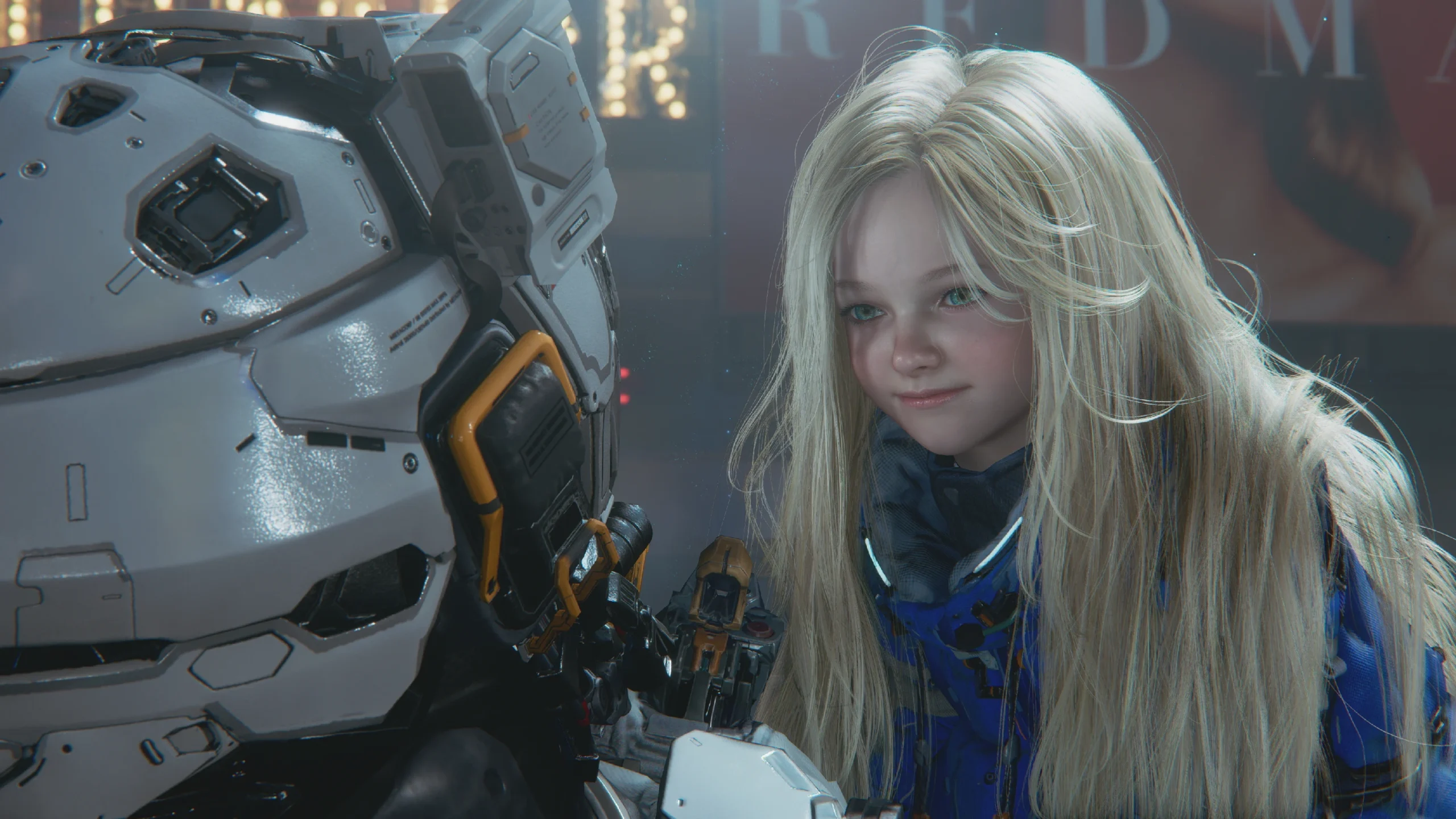
Pragmata puts players in the boots of Hugh Williams, an astronaut dispatched to a corporate research facility on the moon after communications go dark. What begins as a routine investigation quickly spirals out of control when a rogue artificial intelligence, IDUS, seizes control of the station, turning its robotic workforce hostile. Stranded and the only survivor of his crew, Hugh encounters Diana, a childlike android with an extraordinary ability to hack into the very machines trying to kill him. From this point forward, the two are inseparable, and their growing bond forms the beating heart of the entire experience. What makes this relationship work so well is how genuinely sweet it is. While initially apprehensive about being joined on his mission of survival by an android girl who has the mentality of a child, Hugh quickly proves not to be the brooding, reluctant father figure with a tragic family life we have seen in so many similar games. Instead, he embraces his role as Diana’s protector and teacher with a warmth that feels natural and unforced.
Diana, for her part, is brimming with curiosity about life on Earth, a planet she has never visited. Watching her react with wide-eyed fascination to holographic recreations of everyday objects, or receiving one of her hand-drawn crayon pictures as a gift after a particularly tough stretch of gameplay, gives the story a tenderness that never feels manufactured. It is this dynamic that carries you through Pragmata’s campaign and gives you a reason to care beyond the shooting and hacking. The relationship between Hugh and Diana is another exemplar of how strong the father-daughter dynamic can thrive in many forms of media.
The broader narrative of Pragmata around the space station and Diana is arguably less impressive, but that could easily come down to the relationship and character building being just so darn heartwarming between the pair. The overarching mystery of what happened on the lunar station and why IDUS turned against its human occupants leans heavily on well-worn science fiction conventions. If you have seen a film or played a game involving a space facility gone wrong and an AI gone rogue, you will likely see many of the story beats coming from a distance, although there were a few genuine surprises in the mix. While the narrative is mostly linear, Capcom chose to incorporate extensive lore and backstory through optional data logs and holographic recordings scattered throughout the base, with only the key events covered in the cutscenes and main events. Pragmata is one game I implore all players to slow down and avoid speedrunning on their first playthrough, as the backstory of the station’s origins and wider mysteries is genuinely interesting when sought out.
Pragmata’s thematic exploration of artificial intelligence and mass fabrication technology also lands with less impact than it might have several years ago, given how rapidly these topics have moved from speculative fiction into everyday conversation. Still, none of these shortcomings is enough to derail the experience. The story serves its purpose as a vehicle for the relationship at its centre, and that relationship is strong enough to ensure you remain invested from the opening moments through to the credits. Although then I was left wishing for double or triple the playtime….
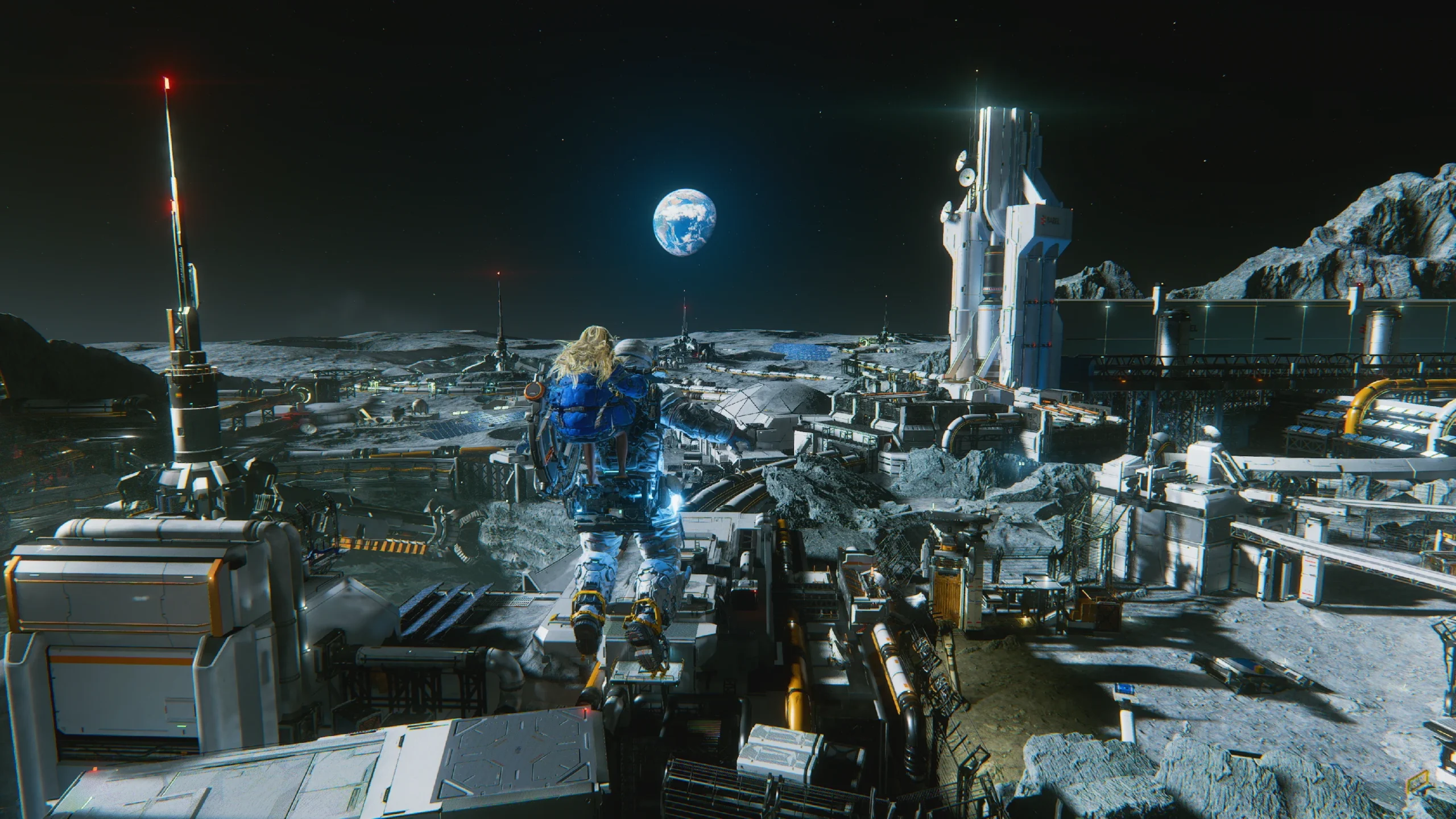
Pragmata could have very easily fallen into the trap of being a visually monotonous corridor shooter set entirely within sterile white walls and grey metal hallways. After all, it takes place on a moon base, and there are only so many ways you can dress up a research facility before everything starts to blur together. Capcom, however, found a clever justification for environmental variety: lunafilament, a resource that enables the station’s systems to fabricate nearly anything through advanced 3D printing. While you do end up with many a general space station corridor (although granted, with great diversity in layouts/designs and many beautiful vistas of space), this narrative element means that tucked within the confines of the facility are fully realised recreations of earthly locations, from the New York street seen in the earliest trailers of Pragmata to a lush indoor forest. These environments feel well established, with each area distinct enough to leave you excited about where you’re headed next. Meanwhile, regarding character designs, while the game’s core cast is pretty limited, those we do see are detailed and expressive, with Diana’s facial animations and flowing hair being particular standouts. And let’s be honest, she is probably one of the most adorable characters in gaming ever! Meanwhile, lighting and environmental fidelity remained consistently strong throughout the game. My only complaint, perhaps, is that at least one of the seemingly pre-rendered cutscenes didn’t live up to the standards of the in-game visuals and was one I would have loved to see in-engine.
On the audio front, Pragmata is not likely to be a game you walk away from humming its soundtrack, but that is not necessarily a criticism. The musical score provides a strong backing for everything the game has to throw at you, whether in an intense fight against a robot towering over you or backing up a warm scene between Hugh and Diana. Voice acting across the board is solid, though Diana’s performance deserves particular recognition. Her voice has a level of authenticity rare for child characters in games, sounding genuinely youthful rather than an adult putting on a higher pitch, which goes a long way toward selling the character’s innocence and curiosity. Hugh, by contrast, delivers a more understated performance that suits his everydayman personality, which lends well to the supportive persona he demonstrates for Diana, while also shining in the more action-oriented scenes. Sound design during combat is punchy and responsive, with each weapon carrying enough audio weight to make every shot feel satisfying, though it never quite reaches the level of being a defining feature of the overall package.
Combat in Pragmata may look like your standard third-person affair at first, but once you have Diana riding upon your back, things get a lot more complicated. When you aim at an enemy, a grid-based hacking puzzle appears alongside your line of sight. Using the controller’s face buttons, you must navigate a cursor from a starting point to a goal node, all while continuing to move Hugh around the battlefield, dodge incoming attacks, and fire your weapons. While the demo has undoubtedly given players some time to get accustomed to multi-tasking in combat, it does feel like a sensory overload for the first two hours, as you may find yourself following the 1-2 of hacking in safe moments, followed by using your weaponry. However, as the game goes on, and you have exposure to the systems (and maybe supported by some of the enhancements as the challenge increases and Diana unlocks new abilities), it becomes second nature, almost instinctual, and really keeps the momentum and fluidity of combat going. Another reason this jacking mechanic works so well is that it isn’t optional – you will need to learn it. Robots on the station are heavily armoured and practically immune to conventional gunfire until Diana successfully completes a hack and exposes their weak points. This means every single encounter forces you to engage with both systems simultaneously, resulting in combat that feels genuinely unlike anything else in the genre right now.
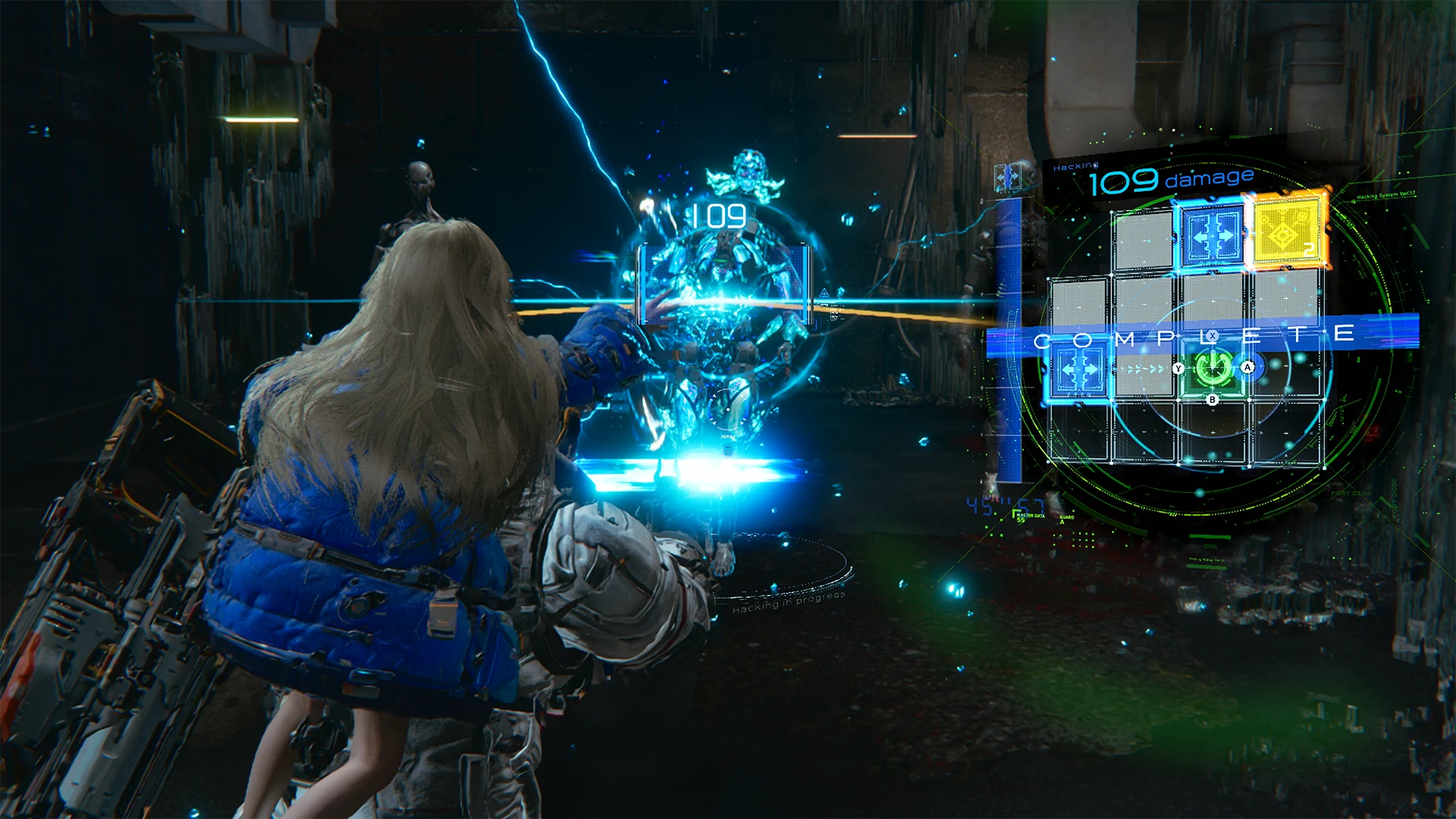
Hugh brings in the big guns, supporting the dual-character approach to combat in thoughtful ways. His standard sidearm has unlimited ammunition but regenerates rather than reloading traditionally, which means you will frequently find yourself running dry mid-fight and needing to swap to something else while it recovers – and even then, it is relatively weak. Heavier weapons, ranging from a satisfying shotgun variant to a grenade launcher that can knock robots to the ground, carry very limited uses and must be scavenged or brought into a mission from your loadout. Where it gets particularly interesting is in how certain weapons interact directly with Diana’s hacking. Tactical options like a stasis net can freeze an enemy in place, buying you precious seconds to complete a hack without dodging, while a sticky bomb can reduce the complexity of an enemy’s hacking grid by removing rows from it entirely. Meanwhile, defensive options allow you to throw up shields or gain access to hundreds of mini-drones to protect you in a pinch. This is all on top of the heavy-hitting items, arguably the most limited in ammo, which keep you on your feet as you plan their usage on the fly rather than going in guns blazing. Choosing your loadout before entering a stage, therefore, becomes a genuinely strategic decision, and one that rewards experimentation as you discover which combinations complement your preferred approach.
Diana’s hacking also has many levels of complexity, with rewards aplenty for mastering it. As you progress, you unlock consumable hacking nodes that populate the grid with additional effects when you pass through them during a successful hack. One might spread your hack to nearby enemies, another might build up a robot’s overheating meter, and another might see their circuits scrambled and detect other robots as enemies. These nodes appear at random positions on the grid, which introduces a layer of improvisation to every hack. Do you take the longer route to grab a powerful node, risking taking damage while doing so, or do you rush straight for the goal and save your resources for a tougher enemy down the line? You don’t have to complete hacking all at once, and you can opt to move, provided that no damage is taken. The depth here is impressive, and I kept discovering effective optimisations well into the post-game content.
There is a rhythm to the combat of Pragmata that emerges once you have internalised the mechanics, a dance of dodging, shooting, swapping weapons, and weaving through hacking grids that is immensely satisfying when executed well. The stagger system reinforces this loop. By building up an enemy’s overheat gauge through sustained hacks and weapon fire, you can leave them open to receive a powerful finishing move – each robot type has a different move, which is oh-so-satisfying to watch. Boss encounters take these systems and push them to their limits, pitting you against enormous machines with complex attack patterns and manipulated hacking grids that demand mastery of everything the game has taught you.
While the game is mostly linear, Pragmata rewards players who take the time to poke around every hidden nook and cranny. Each area of the station is littered with hidden collectibles, upgrade materials, and optional Red Gate challenge rooms that offer tougher combat encounters with meaningful rewards for those brave enough to tackle them. Tying all of this together is the Shelter, a central hub that serves as your home base between missions. It is here where you upgrade Hugh and Diana’s abilities, manage your weapon loadouts, and spend quiet moments watching Diana interact with the Earth memorabilia you have gathered for her throughout your travels. Over time, the Shelter transforms from a bare, functional space into something that genuinely feels lived in, cluttered with toys and trinkets, and full of adorable moments and scenes featuring Diana and Hugh. While the gameplay is primarily about the combat, much of the added richness to the experience comes from these moments of engagement, where over the dozen or so hours of playtime, you do become invested in these two characters.
For those who want more beyond the credits, Pragmata offers a generous amount of post-game content that extends the experience considerably. Challenge missions accessed from the Shelter test your skills in ways the main campaign does not always demand, from restricted loadout encounters to platforming gauntlets. A bingo board system, fed by collectible coins earned through exploration and bonding with Diana, rewards everything from cosmetic outfits to powerful hacking tools, giving you tangible incentives to chase down every last secret. Plus, there are even more challenges that await via dedicated endgame content that throws even more challenges at you – in return for some more goodies. Additionally, there are also higher difficulty options available, with a New Game+ option should you wish to dabble in a second, harsher playthrough than the first. However, I will say on the difficulty front that while you do have the option of a casual mode, the standard difficulty setting is well-balanced and suitable, in my opinion, for those not too familiar with third-person shooter experiences.
In an era where it can feel like many sci-fi games are attempting to capitalise on the emptiness of space for the sake of it, Pragmata is a reminder that a tightly crafted, focused experience can leave a far deeper impression than any sprawling galaxy ever could. Capcom has delivered a game that honours the legacy of the narrative-driven shooters, while introducing a combat system inventive enough to feel wholly its own. While I was left wishing for more in the best way possible, my dozen hours following Hugh and Diana left me continuously immersed with its innovative hacking mechanics, satisfying gunplay, and the genuinely heartwarming character development. After years of delays and uncertainty, Pragmata was absolutely worth the wait, and I sincerely hope this is only the beginning for Capcom exploring this universe… and doesn’t leave fans waiting another six years for it.
Final Score for Pragmata
This review was conducted on a PlayStation 5 digital copy of Pragmata, on a PlayStation 5 Pro retail unit. A review code was provided by Australian distributor Five Star Games together with Capcom to facilitate this review.
Pragmata is set to release on the PC, PlayStation 5, Xbox Series X|S and Nintendo Switch 2 starting 17 April 2026.

