

During The Game Awards 2023, SEGA announced an initiative to breathe new life into some of its classic, beloved early console-era franchises. Among the likes of Jet Set Radio and Crazy Taxi was the hack-and-slash action-platformer series, Shinobi. Just shy of two years out from the original announcement and through a collaboration between SEGA and developer Lizardcube, gamers have received Shinobi: Art of Vengeance for a wealth of platforms. While a revival of a series last seen on a home video game console more than two decades ago is something worthy of celebration, one could easily approach it with apprehension. After all, was this revival just a nostalgia-driven cash grab, or an experience that long-time fans will feel satisfied revisiting? Today, we find out the answer to that question.
Shinobi: Art of Vengeance frames Joe Musashi’s return under the veil of a personal reckoning, with his village reduced to ash, his clan turned to stone, and the blame pointed squarely at ENE Corp and its enigmatic leader, Lord Ruse. The tale is delivered through fully voiced cutscenes across each stage and, while fairly linear, it serves as a short yet compelling plot that keeps the momentum going without stopping for too long or bombarding players with filler content. Joe’s near-silent routine of grunts will land as a wry running gag for some, yet in heavier scenes it can feel at odds with the drama – but for the most part, the balance is there. What does help is the voice cast around him, which injects colour into bosses and allies alike.
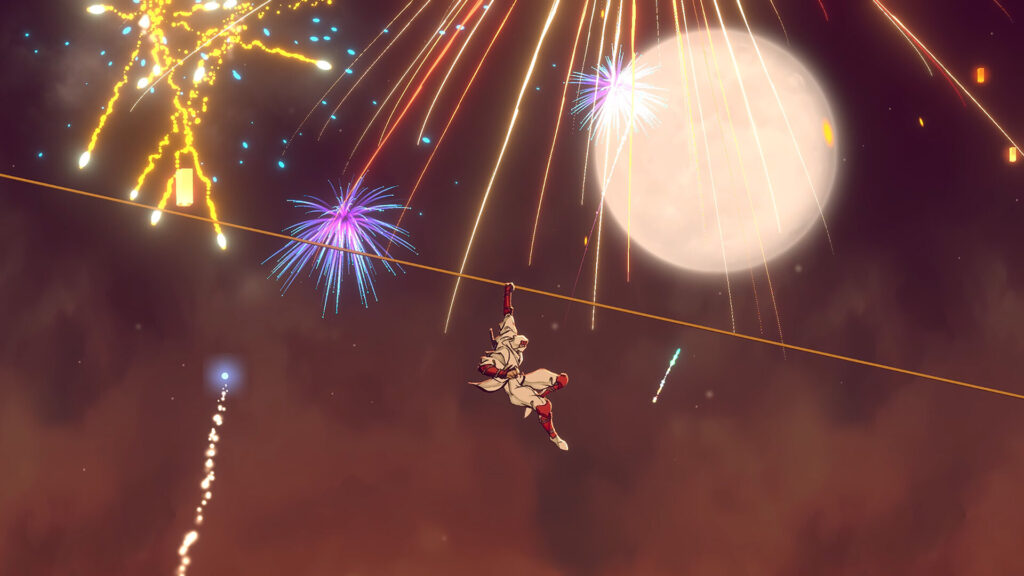
Aligning with the game’s setting, the visuals of Shinobi: Art of Vengeance offer a hand‑drawn 2D presentation that reads like a comic book sprung to life and is lavishly animated. Each stage you explore carves out its own identity: lantern‑lit festivals, neon‑drenched cityscapes, sterile laboratories, wind‑scoured deserts, rattling trains, and rooftop chases – each offering something different, with no design element overstaying its welcome. Dynamic camera work widens to underscore peril and pulls in tight for claustrophobic crawls, all while preserving gameplay clarity. On the technical front, it’s mostly smooth sailing, at least no qualms on the PlayStation 5 Pro. All the visual swagger lands harder thanks to a soundtrack and soundscape that match its stride.
The audio team meets the visuals blow for blow: a propulsive score by Tee Lopes, featuring tracks by Yuzo Koshiro, fuses an EDM pulse with traditional Japanese instrumentation, with engaging stage backings and intense boss crescendos. Effects sell impact without muddying the mix – slashes crunch, supers thunder, and readability holds under pressure. The voice cast adds personality, whether you choose Japanese or English options.
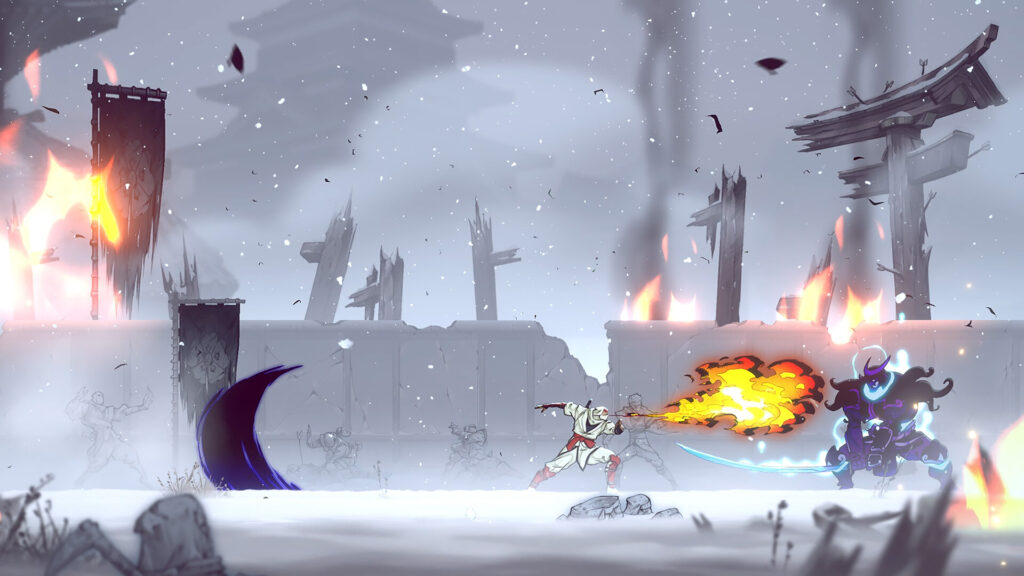
Moment to moment, Shinobi: Art of Vengeance has you constantly moving forward, with fast and fluid movement and combo attacks alike. Cancels and air mobility keep you in motion, while a forgiving roll/dodge lets you thread through danger and recommit to offence without losing rhythm. The mechanics all unify cleanly, with a range of combo strings available, kunais for extra pokes, and snappy gap-closers to stick the landing. Special abilities known as Ninpo serve as your situational power plays. At the same time, Ninjutsu are your AOE room clearers and healers – not always readily accessible, but enough to help you in a bind or to turn the tide of combat in your favour.
Meanwhile, your build can matter. Special obtainable amulets and shop unlocks both add power and steer how you play. You’ll tweak routes, risk, and rewards to suit your style rather than brute-forcing every fight. The overall feel is empowering but fair, and the difficulty remains consistent.
Structurally, Shinobi: Art of Vengeance runs off stages in a metroidvania style, with clear critical paths to follow, but enough variety in optional routes that you don’t immediately feel like you are running from point A to point B. It’s not one giant labyrinth; instead, fast travel between discovered save points keeps revisits brisk and purposeful. Encounters are paced with intention. Elite Squad arenas act as difficult-enough skill checks, while the bosses are the headline bouts with readable telegraphs and escalating patterns that make victory feel satisfying to obtain. Most players will likely enjoy the variety and maps, although it could also be argued that exploration occasionally dilutes the otherwise razor-sharp combat loop.
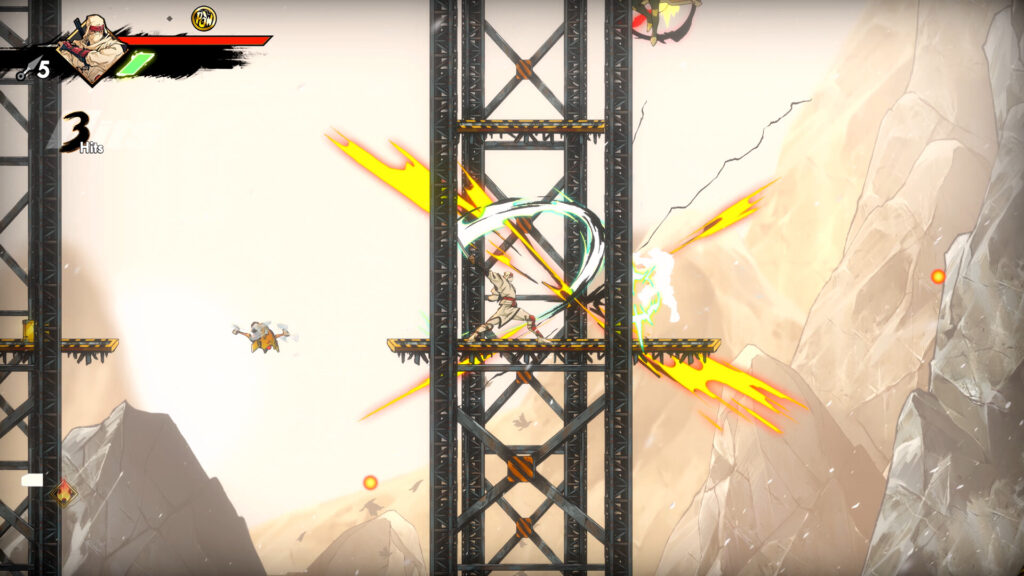
Traversal capacity grows as you progress through the game – from climbing walls and ceilings, to grappling, to gliding from point to point. The challenge comes in tiers: optional Ankou/Purgatory rifts are pretty brutal precision trials, while cinematic escapes can push pure reflex. The baseline curve feels fair, but late-game spikes and the odd hitbox quirk or instant-hazard. On the upside, granular accessibility sliders (enemy damage/health, combo thresholds) let you tune difficulty without gutting systems, and a training dojo enables you to test new tech. Post-game keeps you busy: Boss Rush is a pure pattern exam; Arcade Mode reframes stages around time/kills/no-hit scoring; collectible sweeps reward mastery. For some, that’s delicious score-chasing; for others, it’s the same stages through a new lens.
Returning to the question I posed at the start of this review… is Shinobi: Art of Vengeance an attempt at a cash grab based on nostalgia, or a revival worth celebrating? Thankfully, this new chapter lands firmly in the latter category. The story keeps a lean, revenge‑driven pulse, the hand-drawn presentation is picturesque mainly and, most importantly, the expressive combat and boss fights are rewarding from start to finish.
Final Score for Shinobi: Art of Vengeance
This review was conducted on a PlayStation 5 of Shinobi: Art of Vengeance, with play conducted on a launch retail PlayStation 5 Pro unit. A review code was kindly provided by Australian publisher Five Star Games to facilitate this review.
Shinobi: Art of Vengeance is now available to purchase on Nintendo Switch, PC, PlayStation 4, PlayStation 5, Xbox One and Xbox Series X|S.

