

While I can imagine this being the point at which many reviewers share their experiences in customer service, after all, that is the initial struggle that many teenagers and young adults face before they acquire their first full-time job – I do not count myself among those with such a backstory. Therefore, my impressions of what customer service is like come from my imagination – not that I would imagine it being much better. From the lived experiences of many to a simulation-strategy game format, complemented by a Stardew Valley-esque pixel aesthetic, developer Crinkle Cut Games, in collaboration with publisher PQube, has released Discounty across a plethora of consoles. Putting players in the shoes of a discount supermarket owner in a small town, can players look forward to a fusion of ample challenge and rural-town drama, or a forgettable experience that sets many players’ minds back to their days of being a “checkout chick”? Read on to find out!
Arriving in the run‑down harbour town of Blomkest, you’re promptly drafted by your aunt, Tellar, to steer her newly franchised Discounty store. What a good niece/nephew you are! However, this invitation quickly evolves into a dilemma where expansion is the mandate, and every square inch of growth ripples through the community: locals grumble about monopolisation, posters appear in protest, and even the environment seems to sag under the weight of your success. Discounty wraps these ideas in cozy trappings, yet the subtext can leave you feeling more like a disruptor than a saviour.
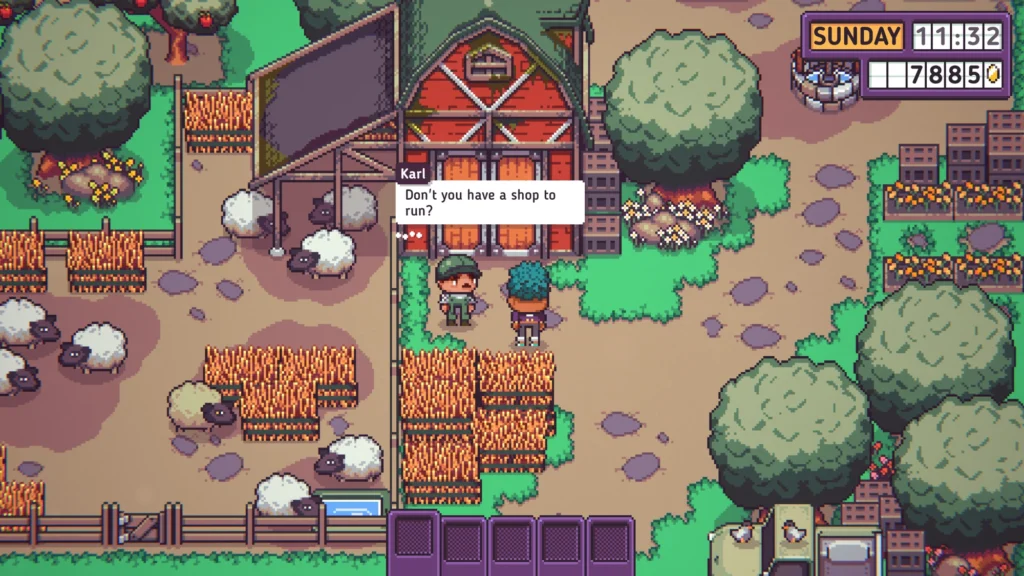
The cast sells that tension: quirky, sharply sketched townsfolk emerge in bite-sized vignettes about messy relationships, small-town feuds, and oddities on the periphery. This is all coupled with the mysteries that are afoot, from the sudden appearance of rats to a mysterious locked shed. Structurally, it’s a brisk three-chapter climb with a free-play epilogue following (always lovely to see this included). Still, it will offer 15 or so hours of fun – more or less, depending on how driven you are to complete the main tasks immediately. The result is an engaging setup that poses thoughtful questions, even if it rarely lands a decisive punch. For a genre like simulation, which isn’t usually too heavy on the story, there is quite a lot on offer to enjoy.
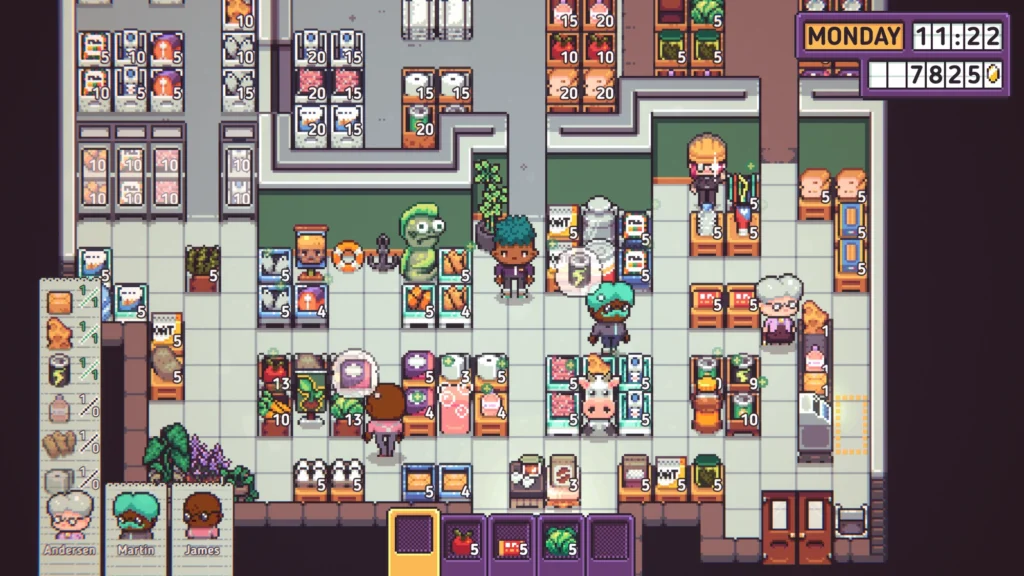
Aesthetically, Discounty uses colourful 32-bit style pixel art. The shop feels warm and cosy, while the town shows its age with boarded fronts, a tired harbour and litter. The art is practical. Tiles are clear, items are easy to read, and the angle helps you judge shelf placement and plan aisles – really, it is everything you would expect from the art style. Customisation is modest, featuring a basic character creator and a small set of décor, primarily consisting of floors, walls, and a few props. The interface is functional and straightforward, with no glaring issues; ultimately, it is more than just functional. Performance was smooth on the PlayStation 5, and given the game’s nature, I don’t foresee any issues with relatively recent PC hardware.
Day to day, Discounty settles into a simple rhythm. The store opens at nine and closes at five. In that window, you restock as shelves empty, mop up dirt that slows customers, keep choke points clear, and jump to the till when a queue forms. Early on, the register is a light test of accuracy as you key in prices by hand. Later, a scanner turns it into a quick rotation puzzle as you find each barcode. It is busy but satisfying – and very rarely monotonous. As layouts improve and queues shrink, the game slips into a familiar loop that offers enough to eke out one day more in your play sessions. The loop is easy to learn and quietly addictive to optimise. Once that rhythm sets in, broader systems begin to build upon it.
Beyond the daily rush, the supermarket grows in ways that change how you play. Each expansion provides more floor space and higher-capacity shelves or coolers, which shifts traffic and increases the pressure on restocking. Daily and weekly goals earn points that unlock new products, functional utility upgrades like the scanner and larger pockets, as well as promotional items that draw attention to specific categories. Layout matters. Group items by type, keep aisles clean, and drop boosters like posters or a coffee station to spark impulse buys and reduce bottlenecks. Trade deals with local suppliers add exclusive goods and small perks on a weekly restock cycle, widening your range without turning it into a spreadsheet sim. New lines arrive at a steady pace, so there is usually something to tweak between story beats. For all that layering, Discounty keeps the pressure friendly and scaleable – but needs a bit more challenge sprinkled in here and there.

Some of that softness is by design. You cannot set prices (the game is called Discounty after all), chase trends, or truly fail at the till. It makes the game approachable, but it also lowers the stakes. Money grows on a slow burn. Happier customers bring more foot traffic, yet the bigger money targets can span several in-game days. The rough edges are primarily related to timing and pathfinding. Shoppers sometimes get stuck, a problem that becomes more frequent after later expansions, and they vent their frustrations at closing. Others wander in just before five, cannot finish their lists, and drag down ratings in ways you cannot entirely prevent. Controls are fine on the mouse and keyboard, while controller inputs can feel fussy, particularly with the hold direction plus press, and occasionally experience a hiccup in rotation when scanning. Sundays and after hours can feel light once you have seen the side scenes. The loop is still great, but many will wish for deeper simulation levers, such as pricing, trends, and clearer consequences.
On the audiological front, Discounty skips voice work, sticking to text bubbles with light bleeps, which suits the scope and is rarely missed. The score leans on breezy and chiptune‑flavoured tracks that shift with time and place, from upbeat shop tunes to moodier cues when the town turns strange at night. Sound effects do the heavy lifting. Scanner beeps and register clicks make repetitive tasks feel crisp and tactile. It is pleasant, fitting and quietly memorable, supporting the loop without crowding it.
Stepping back, Discounty delivers a tidy, comfortably challenging retail loop: delightful pixel art, a town with frayed edges, and systems that grew just enough to keep me tinkering but not overwhelmed. The story nods to corporate creep and community fallout, but mostly lets you keep the scanner humming. The nine-to-five gameplay is the draw, being brisk and satisfying, with steady unlocks, layout tweaks and a soundtrack that makes repetition pleasant. If you want a cosy management sim with clear feedback and light friction, Discounty is easy to recommend; if you desire a tougher economic sandbox, you may want more.
Final Score for Discounty
This review was conducted on a digital PlayStation 5 copy of Discounty, playtested on a retail PlayStation 5 Pro unit. We would like to acknowledge PQube for providing us a code to facilitate this review.
Discounty is now available on the PC, Nintendo Switch, PlayStation 5 and Xbox Series X|S.

