

In the 1990s and early 2000s, schoolyards were divided over which morning cartoon ‘monster’ franchise was the best – Pokémon or Digimon. From a purely numbers standpoint and remaining true to its target audience, I would probably have to say the former. From the genre-defining Game Boy RPGs and an anime spanning 1,300+ episodes to today’s hard-to-grasp TCG craze, Pokémon is the clear frontrunner. However, I wouldn’t say Digimon was down and out; it has truly shone with releases that have grown up alongside its initial demographic (alongside some jumping-on points for younger and older audiences alike). These include the ‘Tri’ OVA series, which followed up with the cast from the original TV series, multiple subsequent OVA releases wrapping up the stories of the original series, and, of most relevance today, the modern-day video game releases.
While there is still the harrowing Digimon Survive, which was not shy of outright killing its main cast, the most prolific games in recent years have been the Digimon Story series, memorable modern-day RPGs’s that have stood out not just in the IP, but as exemplars of great monster-raising RPG design – such as Media.Vision and Bandai Namco Entertainment’s Digimon Story: Cyber Sleuth and Digimon Story: Cyber Sleuth – Hacker’s Memory. While it has been a few years since a new instalment was released in the franchise, just this month, Digimon Story: Time Stranger was released – a chronological sequel that has clearly taken lessons from its predecessors to deliver a new experience for the latest generation of gamers. But is it enough to keep up with trends and expectations of the modern gamer? Read on to find out!
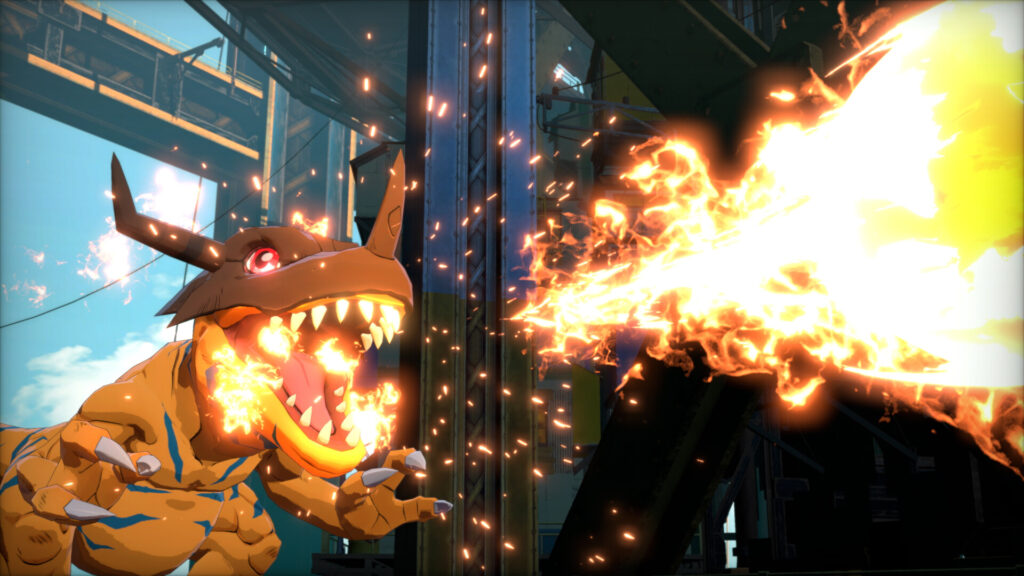
Digimon Story: Time Stranger puts you in the shoes of an agent of the secretive ADAMAS organisation, who works behind the scenes to resolve anomalous incidents that occur in the world. You are tasked with investigating a newly sealed-off anomaly in Shinjuku, also known as “Inferno”, only for the operation to go sideways and sling you eight years into the past, and now you need to put a stop to the incident from there. The narrative shifts between the real-world Shinjuku and the Digital World of Iliad: a lively place centred around Central Town, with distinct regions. As a silent protagonist and more of an observer, the heart of the narrative revolves around Inori Misono and her partner, Aegiomon – their bond shadowed by whispers of a stolen “Great Guardian” egg, and it grows as a broader power struggle between the Titans and the Olympos XII comes into focus. The three narrative threads gradually click together – ADAMAS’s anomaly case, Inori’s past, and the truth of Aegiomon. While the script leans into classic Digimon ideas about bonds, responsibility, cycles of conflict, and the messy consequences of changing time, the silent‑protagonist setup (the unpicked Dan/Kanan acts as your voiced handler) shifts the spotlight to Inori and Aegiomon; you lose a little of your avatar’s voice, but in return the duo and supplementary cast carries the emotional stakes well.
Digimon Story: Time Stranger’s pacing asks for a bit of patience. The opening hours in Tokyo lean heavily on exposition – sewers, errands, slow walks and a lot of back‑and‑forth – and it can feel like you’re being kept at arm’s length. The switch flips once Iliad opens up and Central Town becomes your base; from there, the story breathes, and the three strands start braiding together. The tone shifts between melodramatic anime earnestness and cozy slice-of-life downtime, with the script occasionally dipping into darker beats. Most of what is presented lands, especially regarding the main narrative, while the side missions are slightly less so; however, on average, it is genuinely enjoyable and charming. Crucially, the main plot sticks the landing: the back half clicks into place with satisfying revelations and a late‑game run that delivers the emotional peaks you came for – even if there are the slow points or two to crawl through to get there.
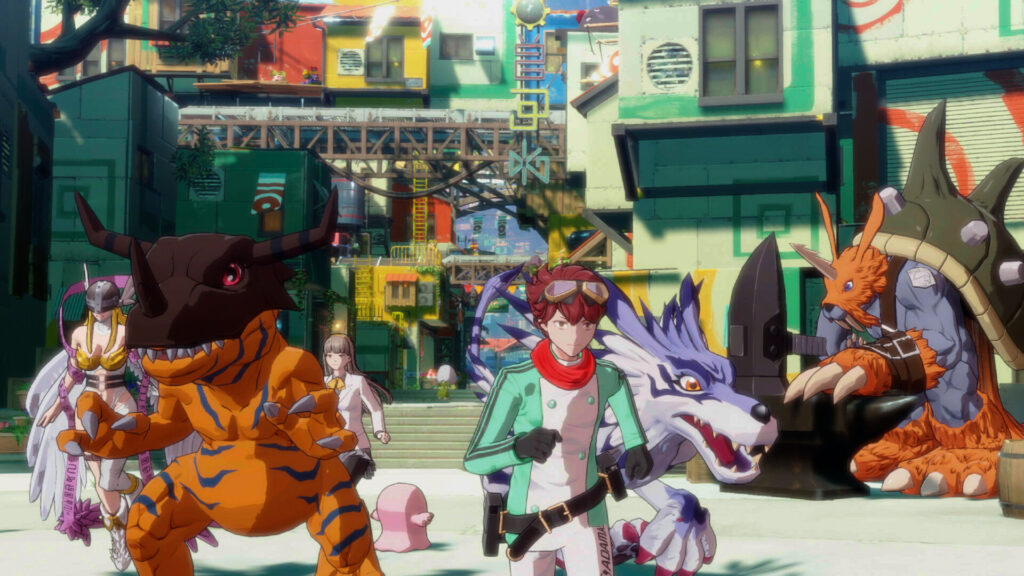
Aesthetically, Iliad itself is the star. Central Town feels alive with shops clanking, a tavern buzzing, Zudomon hammering at an anvil, Pegasusmon ferrying you to the tower – while outlying regions bring variety – all complemented by Digimon designs that look better than they have ever been. Everywhere you go, Digimon chat, argue, fly overhead or work, and the camera sells the spectacle when Titan‑class beings stride into view. Even traversal has personality: you can ride partners like Greymon (perched on the shoulder), Beelzemon (roaring in on a bike) or Witchmon (broom in tow). It’s playful flavour that turns getting from A to B into a little burst of fan service, and a big step up from the sterile dungeons and overworld maps many even AAA RPGs find themselves relying on, on occasion.
Back in Shinjuku, the contrast is stark. Early hours mean lifeless streets and repeated runs through the same sewers (with later, story‑driven returns), and while the time‑loop conceit makes sense narratively, it still feels flat in play. Most dungeons are compact strings of corridors with a simple gimmick or two; they’re functional, but they do blur together. Meanwhile, the user interface is clean and snappy, although it has a few quirks here and there that could have been better delivered.
Audio lands closer to mood‑setting than showboating. The synth‑leaning score gives areas a clear identity and a handful of tracks really pop, but at 5x battle speed, the repeated hit/skill SFX can grate. Dual audio helps: both English and Japanese casts do right by the Digimon, who come across as expressive and distinct.
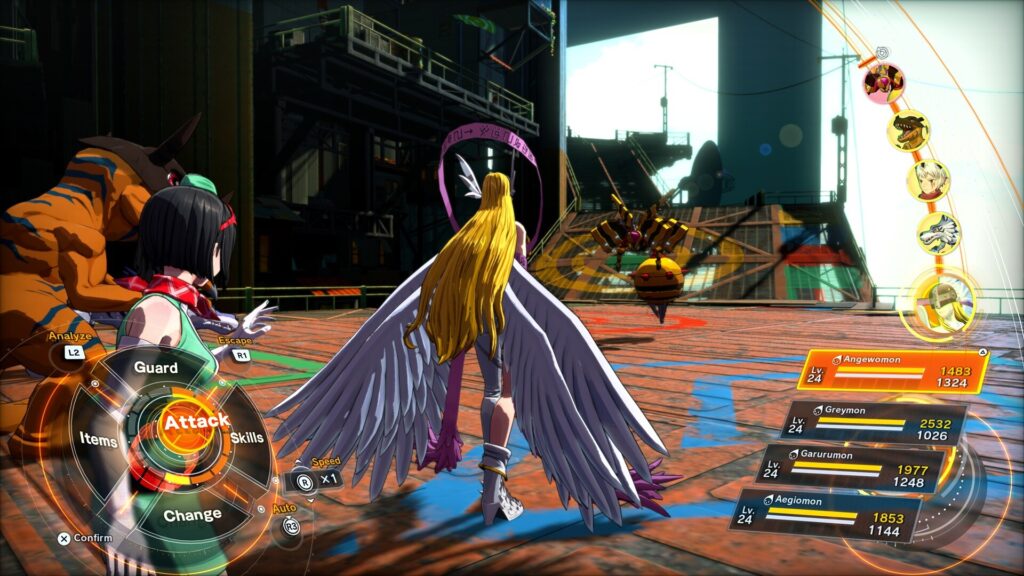
Moment to moment, the gameplay loop of Digimon Story: Time Stranger is fast, flexible and immersive. Enemies roam on the map, and a quick on‑field strike auto‑wins against trash mobs, so you keep moving, and everything else sends you into the game’s turn-based battle system. Fights field three active Digimon with three in reserve, and you can swap mid‑turn for free; guest allies jump in regularly, with Aegiomon fully controllable. Each turn lets you use one item without losing an action, and a tap of Analyse surfaces attributes and elemental weaknesses so you can plan. Auto‑battle and 2x–5x speed options keep routine encounters brisk. Layered on top is Cross Arts: a CP gauge you fill to fire off a big party buff, an all‑hit blast, or a boss‑busting single‑target strike (you equip one at a time), adding a satisfying extra lever in more challenging fights.
Combat has teeth when you lean into its layers. The familiar Attribute triangle (Vaccine/Data/Virus) stacks with elemental affinities and the physical vs. magical split, so identifying the right combo can spike damage into the 300–400% range and flip a fight – either in or against your favour. Bosses push that knowledge hard: many charge telegraphed powerful attacks you can interrupt via break bars, sprout multi‑part targets with different resistances, or shift phases that force you to rotate the line‑up, time guards, and weave in buffs and debuffs instead of brute‑forcing. Regular encounters are breezy by design; ignore counters in boss bouts, and they turn spongy and punishing fast. Difficulty can be changed mid‑run, and New Game+ unlocks Mega and Mega+ modes – the latter disables items entirely – if you want the systems to really bite back.
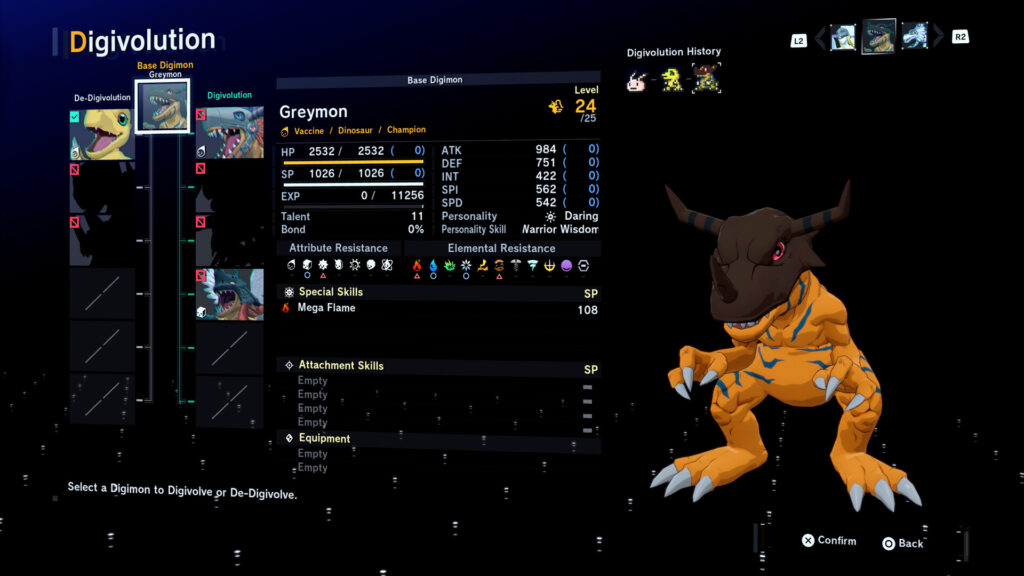
Collection and evolution form a clean, compulsive experience that you would expect a Digimon game to give. Every encounter nudges a species’ Scan %, letting you convert it to your party at 100% (or hold out for 200% to join with better stats and a higher level cap). Duplicates aren’t a waste: allowing you to funnel them into XP fodder or branch them down into alternate evolution lines. Digivolution is non-linear, with frequent De-Digivolution loops, and the UI clearly indicates stat requirements while logging a handy evolution history, making planning a route through the potential routes less painful. The big gate is Agent Rank: spending Anomaly Points from main missions and side quests raises your rank and, with it, access to Champion/Ultimate/Mega tiers.
Team‑building is where tinkering pays off. Sixteen Personality types shape stat growth and, for some late lines, even satisfy specific trait checks; you can steer these via quick field chats or targeted training, but the depth behind the system is perhaps a little underexplained at the start. Attachment Skills work like open‑ended TMs – no species restrictions – so any digimon can pick up off‑kit heals, debuffs, or other skills to diversify their kit a little bit. DNA (Jogress) moves let specific pairs fuse for a one-turn super evolution, trading both SP and their actions for a big situational swing.
Progression stays lively between set‑pieces. The DigiFarm lets benched partners passively gain XP or train specific stats using reusable sets; if you’re impatient, you can burn in‑game money to finish timers instantly. Outer Dungeons are bite‑sized challenge riffs with bespoke rewards, and while a few are tied to DLC, they’re fun palate cleansers. The Jogmon card game is stylish fan service but mechanically thin – friendly to dabble in, easy to ignore. Overall, the grind is light in regular play, with spikes at boss walls or Rank gates; generous speed‑up and auto options keep experimentation flowing instead of bogging you down.
More than two decades after the schoolyard debates, the Digimon series may have deviated in its path as a mainline ‘morning cartoon’ series, but it shines in its own right. Digimon Story: Time Stranger exemplifies just why this is the case, offering an extensive and heartfelt time-twisting tale with memorable characters, a vibrant world, and a smart, speedy RPG loop that features numerous systems to reward experimentation and exploration. It isn’t a spotless experience; the early hours can drag on, for example, but those who put in the time will have much to sink their teeth into. As a long-awaited successor to Cyber Sleuth and Hacker’s Memory, it’s a confident, often spectacular return.
Final Score for Digimon Story: Time Stranger
This review was conducted on a digital PlayStation 5 copy of Digimon Story: Time Stranger, with all testing conducted on a PlayStation 5 Pro retail model. A review code was provided by Bandai Namco Entertainment Australia to facilitate this review.
Digimon Story: Time Stranger is now available to purchase on PlayStation 5, Xbox Series X|S and PC.

