

My first experience with a golf-themed video game was with Nintendo’s 1999 release of Mario Golf, and as a tiny tacker who enjoyed playing games quickly and enthusiastically, taking the time to work through the intricacies of such gameplay was of little interest to me at the time. This was to the point where, after months of trying to play the game, I had unlocked a total of zero characters beyond the four initially unlocked. This changed in 2012 with the release of Everybody’s Golf: World Invitational on the PlayStation Vita, where, among the launch games for the portable handheld, it managed to hold my attention for many play sessions. While the series fell off the radar in 2018 with the release of the series’s last instalment, developed by Clap Hanz, Bandai Namco Entertainment, and Hyde, the franchise has been revisited and arguably rebooted with Everybody’s Golf Hot Shots on the PlayStation 5, Nintendo Switch, and PC. Is this instalment just continuing a relic of old game design or offering something fresh… or at least fun? Read on to find out!
Everybody’s Golf Hot Shots remains faithful to the series’ identity in many ways, including its approach to gameplay. The three-press swing mechanics popularised by the series are still at the heart of the experience and remain quick to learn, while also leaving room to improve and reduce reliance on handholding throughout the experience. While you may just aim and shoot to begin with, there is a solid richness to the mechanics that turn your swings from bogeys to pars, from lining up against wind and slope, choosing a club, and then nailing that third press. Rounds move briskly thanks to short animations and the option to skip ball flight, which makes it easy to fit in a nine-hole round in 15 minutes, or chase a rematch straight away. It is arcade golf at its most approachable, even before you start poking at the optional systems layered on top.
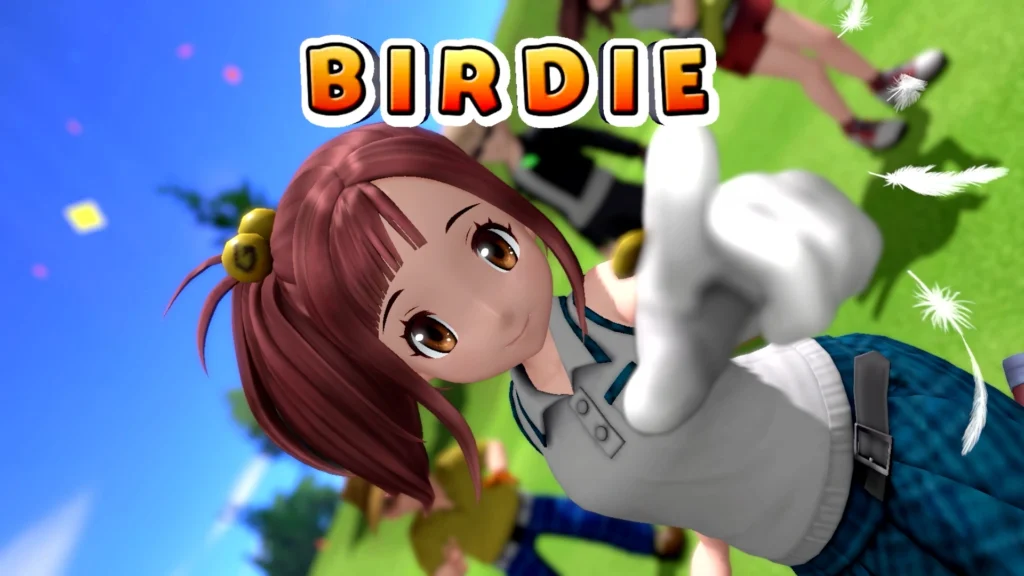
That accessibility does not mean forgiving. Impact timing feels exacting, and even a slight miss can send a drive veering far from the intended line, particularly when you try to add spin. Your opening hours can feel spiky, as you are overcome by par and below, because basic clubs and starters leave little margin for error, so perfect impacts matter more than they should. Things settle once you begin unlocking stronger golfers, buying gear, and learning when to play safely versus committing to power. Early courses are friendly in layout, yet the shot model still demands you respect the window between a great stroke and a painful one-way trip to a sand bunker. While hitting the ball long distances can be fulfilling, a lot of the time, it is the putting component that trips you up. Putting asks you to read a grid that conveys slope and pace. It does the job, although it lacks the granularity you might want.
One of the issues you will encounter is the view before you swing. The default camera can obscure tree hitboxes and near‑fairway hazards, and cycling angles rarely produce a clean scouting line. A dedicated drive camera would solve most of it. Granted that, through practice, you will find yourself leaning on the overhead map, conservative lay-ups and basic course management will enable you to make fairly educated guesses as to where the ball will end up… at least, if you make the shot correctly.
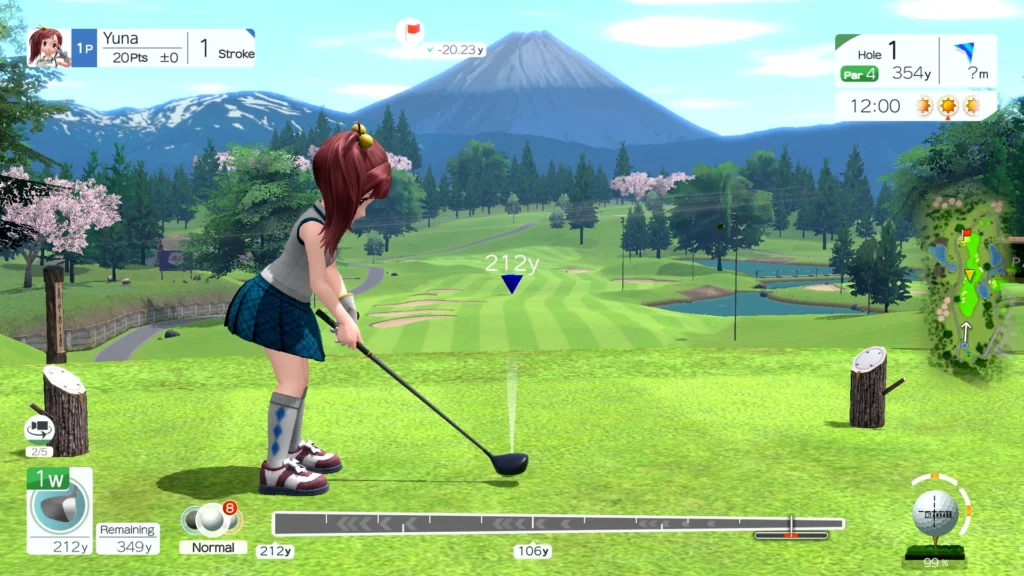
Beneath the pick‑up‑and‑play surface sits a web of tools that reward practice and add challenge where you might need it. Stamina rules can hide the impact gauge at intervals, which prods you to learn rhythm by feel. Power Shots extend maximum carry by a small but meaningful margin, so you save them for pivotal carries or par fives. Spin shaping, elevation reads, and wind tuning never outstay their welcome, yet they matter. Characters grow through stat‑boosting foods, while caddies add passive or triggerable perks. Signature special shots are limited and situational, from sand‑saving chips to cheeky putter tricks. None of this is compulsory, but it gives dedicated players real headroom to improve.
In terms of single-player offerings, Challenge Mode is the workhorse. Short tournaments and duels build steadily in difficulty, introduce rule variants, and pay out currencies and unlocks at a reliable clip. World Tour supplies seven short chapters per character. For the lounge room, local multiplayer is the sweet spot. Wacky Golf turns a casual round into party chaos with oversized cups, tornado holes, explosive tiles, and other modifiers. Online play functions well enough, with room creation and timed tournaments, but the feature set is relatively basic, and the skill gap can be sharp without cross‑platform matchmaking.
If you are someone who needs rewards to progress through a game, there is a lot to earn throughout your playthrough. New golfers, caddies, clubs, balls, outfits, courses, and special shots arrive over the course of many hours. You sometimes don’t know what to expect until you receive the alert that it is now available to access or purchase. However, it is enjoyable if you enjoy a long-term climb… less so if you want everything right away. Characters often need both challenge clears and World Tour milestones to be fully usable, and loyalty ranks gate their best tricks. The shop matters. A few well‑chosen clubs, balls, and stat foods can tame early difficulty spikes and let you chase riskier lines. The opening roster is thin, and repetition does creep in; yet, the long tail will suit players who prefer settling into one sports game for a season.
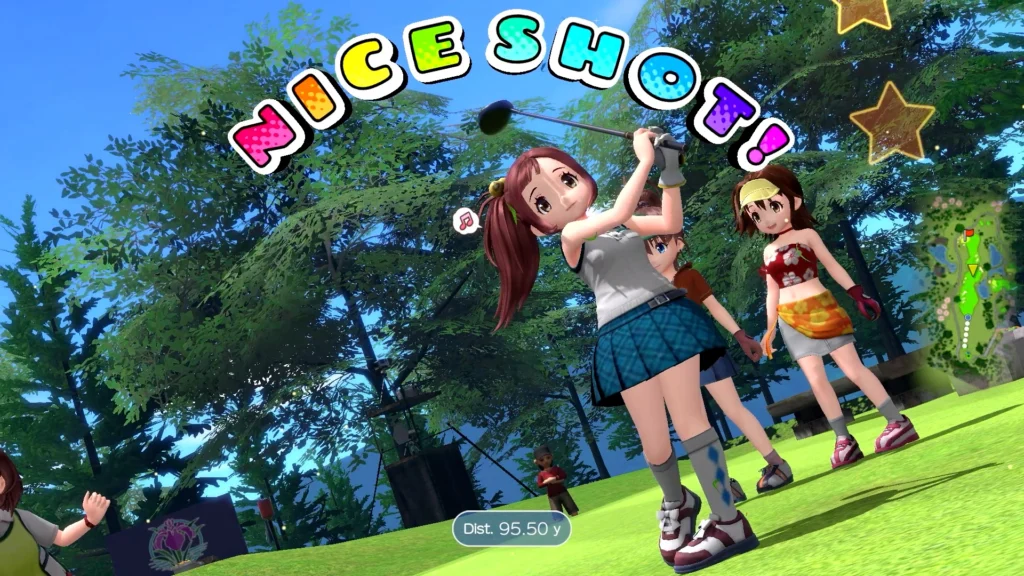
Everybody’s Golf Hot Shots maintains a bright, anime-esque look that suits quick-fire golf and retains the design language that has carried across the entire franchise. Characters are readable at a glance, and their reactions land cleanly, even if some animations repeat. The course presentation is less convincing, yet it is adequate. Fairways and rough often appear flat, foliage can seem procedural rather than lush, and several locales can visually blur together. Menus and UI get the job done, and a few camera transitions are clunky but again, servicable. It is not a current‑gen showpiece, yet it stays clear and colourful enough to keep the focus on shot‑making.
Voice work sits behind the action rather than carrying it. Many characters loop a small set of quips; it is cute at first, but then it repeats too quickly, becoming irksome after a few tournaments. The soundtrack keeps a breezy, upbeat tone that suits brisk rounds and rarely intrudes. Effects carry the authenticity of the experience, from clean impact thwacks to putt rolls, and they are still satisfying. Overall, the audio complements the play without stealing focus, although a larger pool of voice lines would help during longer sessions.
After hours back on the fairway, Everybody’s Golf Hot Shots proves the series can still hook me much like its predecessors, even if it is more of the same rather than a modern interpretation of the franchise’s gameplay loop. The three‑press swing remains instantly readable and satisfying, rounds clip along, and there is genuine depth if you choose to master its tools. The trade‑offs are clear: early timing windows feel unforgiving, camera and readability quirks get in the way, and the strongest golfers and caddies – who you may or may not want – sit behind a long, sometimes repetitive unlock path. So, returning to the question that opened this review: is this a relic or something fresh, at least fun? For me, it lands closer to the latter: a likeable, content‑rich arcade golfer that rewards patience and play with friends, even if it never quite sinks the putt for series‑best status.
Final Score for Everybody’s Golf Hot Shots
This review of Everybody’s Golf Hot Shots was conducted on a PlayStation 5 digital copy of the game, played on a retail PlayStation 5 Pro unit. A review code was kindly provided by Bandai Namco Entertainment Australia to facilitate this review.
Everybody’s Golf Hot Shots is now available to purchase on the PlayStation 5, Nintendo Switch and PC.

