
One appeal of Danganronpa: Trigger Happy Havoc from Spike Chunsoft and Nippon Ichi Software America to me was that not all of its characters were guaranteed to survive the game – and that players had considerable opportunity and power in leading culprits to their often over-the-top executions. One limit both Danganronpa visual novels were that, because they were heavily storyline based, it was not possible to alter the victims and culprits of each playthrough. Therefore, any control players thought they had was little more than cleverly scripted storytelling to ensure both user engagement and the effective delivery of a genuinely interesting storyline.
Also using the idea of having party members as “traitors” that players must identify and unwillingly have destroyed, Lancarse developed Lost Dimension – a new PlayStation 3 / PlayStation Vita RPG which has been published in the Americas by ATLUS USA and soon in PAL regions by NIS America. Rather than presenting a carefully a scripted experience, Lost Dimension shakes things up considerably by randomising its traitors with each playthrough. Therefore, there is a chance that some of the party members you had been using since starting the game could turn traitor. Although not executed flawlessly, this system becomes the one thing that sticks with you upon completing the game.

The Storyline
With no prologue to speak of prior to the world coming under siege, Lost Dimension begins with the antagonist known only as “The End” wrecking havoc and threatening to soon destroy the planet unless someone manages to take him down. With the world’s military seemingly ineffective at facing against this seemingly all-powerful enemy, world leaders send in a team of supernaturally gifted youth into the tower that “The End” has taken up residence in. With many of his memories missing, you take control of Sho, one of the eleven youth sent to tackle the tower and the only one which “The End” seems to incredibly loathe. From this point, the group begin to ascend the tower.
In order to ascend from one level to another however, the surviving party members are forced to knock-off one of their own, who according to “The End” is a traitor to the group. Although it isn’t made entirely clear what each character’s motivations are for becoming a traitor or what exactly being one entails (As they never attempt to kill fellow party members mid-battle), every floor causes a particular party member to identify themselves as a traitor. Because these traitors are randomized and no character other than Sho is guaranteed to make their way to the end however, it came across to me that the storyline was only a shadow of what it could have been. Dialogue seemed to just be a whole lot of responses to events which were presented if a particular character were still alive or a member of your immediate battle party – and there were not a whole lot of major events that required too much dialogue. Ultimately, the game pretty much came down to climbing the tower and killing off traitors after X number of battles.
Using a rudimentary “social link” system, after every battle Sho is able to engage in dialogue with his fellow party members with the goal of improving their affinity towards them. With the exception of a few moments with each character where they share a little bit about their backstory or personality – the dialogue during these scenes were bland in my opinion. This system has little to do with the traitor system, and having a good relationship with each character is only really beneficial with regards to battle support. That being said, completing each characters social route (Which can be done across multiple playthroughs) is key to unlocking the true end.
The Design / Music / Voice Acting
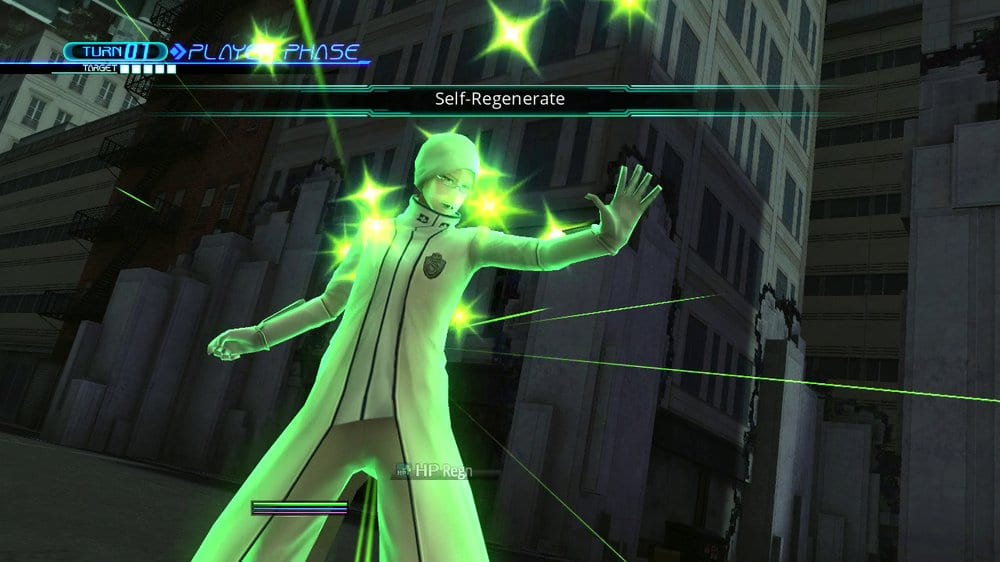
The design quality of Lost Dimension was average. While there were a couple of well animated anime cutscenes and the character portraits were good, these were complemented by some average character designs and environments that were pretty lackluster and bland. Although bland in design, I will say that the actual level structure was really good – requiring a good amount of strategy to navigate around when hunting down enemies.
Lost Dimension features a strong opening theme, which was complemented by solid animation. Asides from the opening theme, I wouldn’t say there were any notable highlights, but overall players are presented a decent compilation of songs which suited the moments they were used in.
In terms of voice acting, ATLUS USA surprised me by opting to commission a new English dub for Lost Dimension. What may come as a disappointment to some however is that the Japanese dub is not available, meaning all players are locked into using the English dub. Overall the voice acting is pretty good, with each voice actor/actress providing a voice which suited each respective character. The main issue is that a good portion of the game’s dialogue comes down to the usual assortment of one/two word phrases or grunts instead of being fully dubbed.

The Gameplay
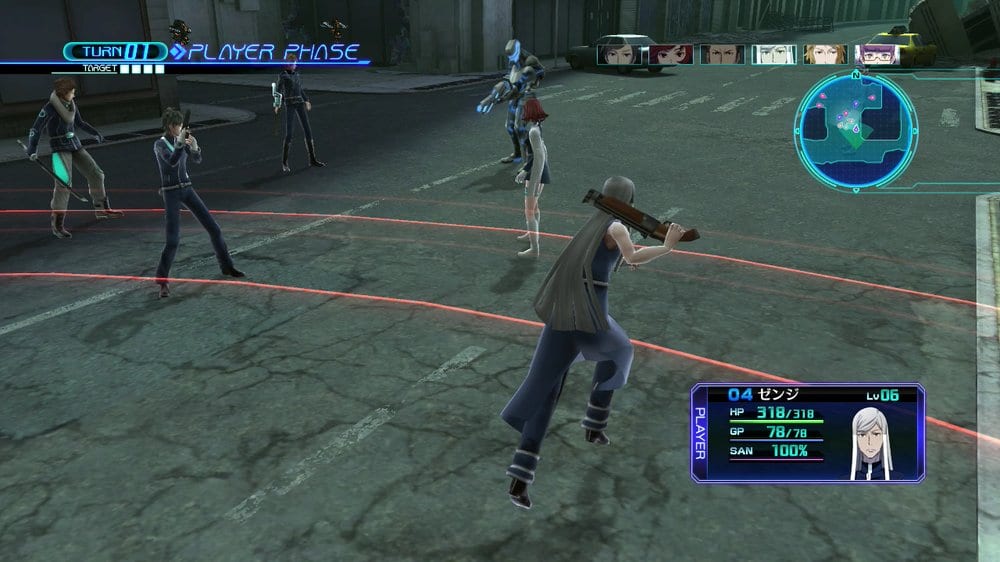
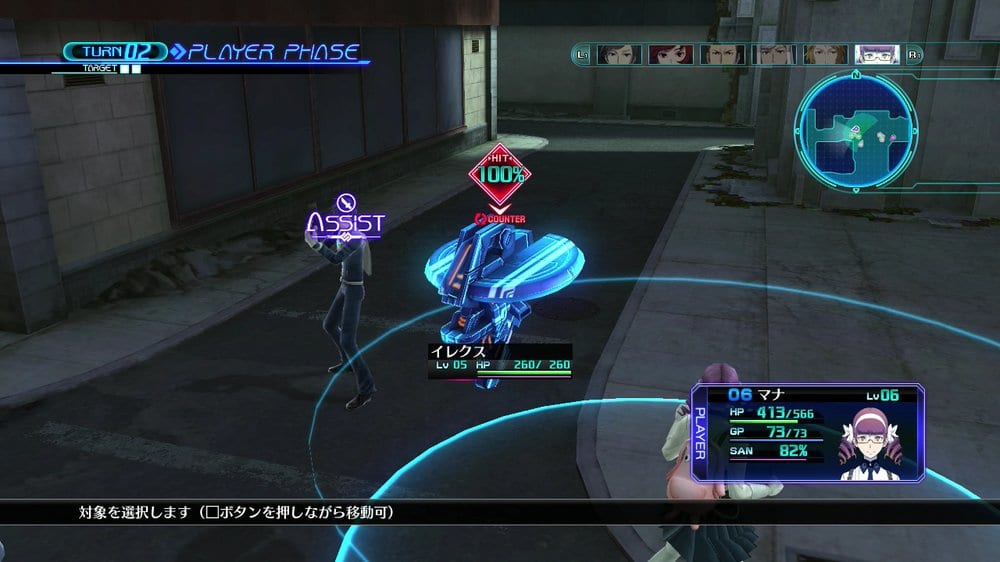
Although the characters are tasked with navigating their way through a large tower, Lost Dimension does not actually require you to run around corridors as you would a dungeon-crawler. Instead, each floor is broken up into a number of major (progression-important) and minor (optional) levels – where up to six party members can tackle a stage in tactical turn-based RPG style (With allies and enemies taking it in turns to attack). As mentioned previously, stages are cleverly laid out so that it isn’t always possible for all six party members to take out one enemy at a time. In some cases it is possible that some or all characters could be left solo or in small groups at different sides of the map. Through a combination of using each characters distinct abilities, current equipment and knowing the relationship held between team members, the battles are surprisingly complex and can prove challenging at times.
The most distinct feature about the battle system is that all eleven party members have their own unique gifts, providing them a variety of different attack and on-field skills. Especially nifty are the two characters who have the ability to levitate / teleport, allowing them to avoid obstacles and occasionally making them much harder to hit. Other characters have different attack abilities, with some being skilled in different types of magic, some preferring ranged attacks and others who’d rather get up close and attack physically. Each characters attacks and skills work well with there particular gift, although it would have been nice to see even more distinction between them.
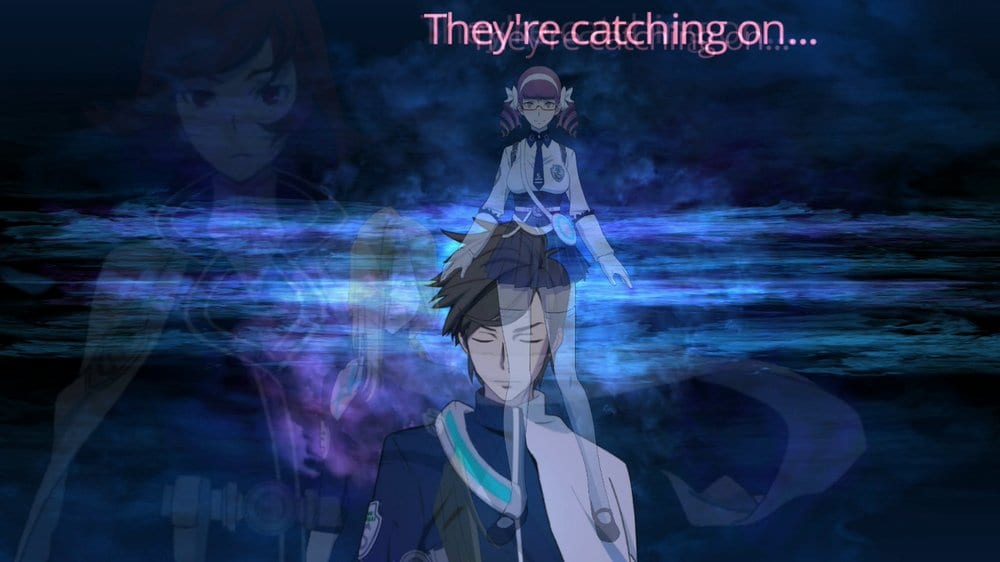
As has been mentioned several times already in this review, one of the big draws to Lost Dimension is its traitor system, where you must identify whom among your party members is a respective floors “traitor”. These traitors are randomised each game, and it is very possible to lose half or possibly more of your favourite party members to this system. While there is nothing more exhilarating than desperately trying to figure out if you will lose another one of your key fighters – the systems surrounding were a mixed bag and could have been more in-depth in my opinion.
After completing each battle, Sho is able to read the thoughts of the five other characters who joined him in battle – with any red, distorted dialogue indicating that one to three party members could potentially be a traitor. This system is actually pretty clever, and encourages you to enter battle with different groups to identify who could potentially be a traitor.
Once you have narrowed down your suspicions to a smaller number of people, you can trade in “Vision Points” to dive into each character’s thoughts to identify if they are actually a culprit. The Dive system is tedious and bland at best, little more than a mini-game involving a lot of running around chasing after text. As you only slowly unlock Vision Points, they are a precious commodity, and does involve more than just playing the same mini-game over and over to identify the culprit. Should you be unable to identify the traitor once spending all your points, you may have to nominate someone at random – who may or may not be the guilty person.
While the game doesn’t end should you fail to identify the traitor, it can make things a little more challenging later on. However, your vote is not the only one that matters – as each character receives one or two votes to nominate someone with dependent on how well they perform in battle. On multiple occasions, you are required to present your opinion to remaining party members about who the traitor is. This could encourage them to also vote for who you think is the culprit – regardless if your assumption is correct. Just don’t tell someone you think they are the traitor… Sho’s relationship with that character takes a large hit doing that.
During my playthrough, I was pretty lucky with my initial party choice, and only made one incorrect traitor selection near the game’s end. I originally started out with: Sho, Yoko, Himeno, Mana, Sojiro and Marco. By the end I was forced to identify Mana and Marco as traitors and failed to identify Sojiro as a traitor. Therefore, when it came down to battling “The End”, my party was down to Sho, Yoko, Himeno, Nagi and Agito. Although there are perks with retaining your favourite characters, losing them does not mean losing access to all their abilities. When killed, each party member drops their Gift in a tangible form. Up to two of these gifts, based on skill trees which were completed while its owner was alive (Most characters have three coloured trees), can be equipped on each character. Therefore, the longer a character remains alive, the more skills they can pass down. In my playthrough, Toya was killed off pretty early on so he passed down only one gift item, while Marco (Who died near the end) managed to pass on a lot more of his skills. Unfortunately as neither Nagi or Agito were traitors in my incidence, I am uncertain if their teleportation/levitation skills can also be passed on.
While I still believe that the traitor system deserved something a bit more in-depth, especially with regards to identifying the traitor, it contributed a lot to the battle system and overall experience delivered by Lost Dimension.
The Overall Score
Overall, I think there were several areas where Lost Dimension could have delivered a lot better, particularly with regards to its storytelling and handling of how a player discovers a traitor. But that being said, it was nevertheless a competent and overall enjoyable JRPG that a player could easily put a good 20-30 hours into completing.


