

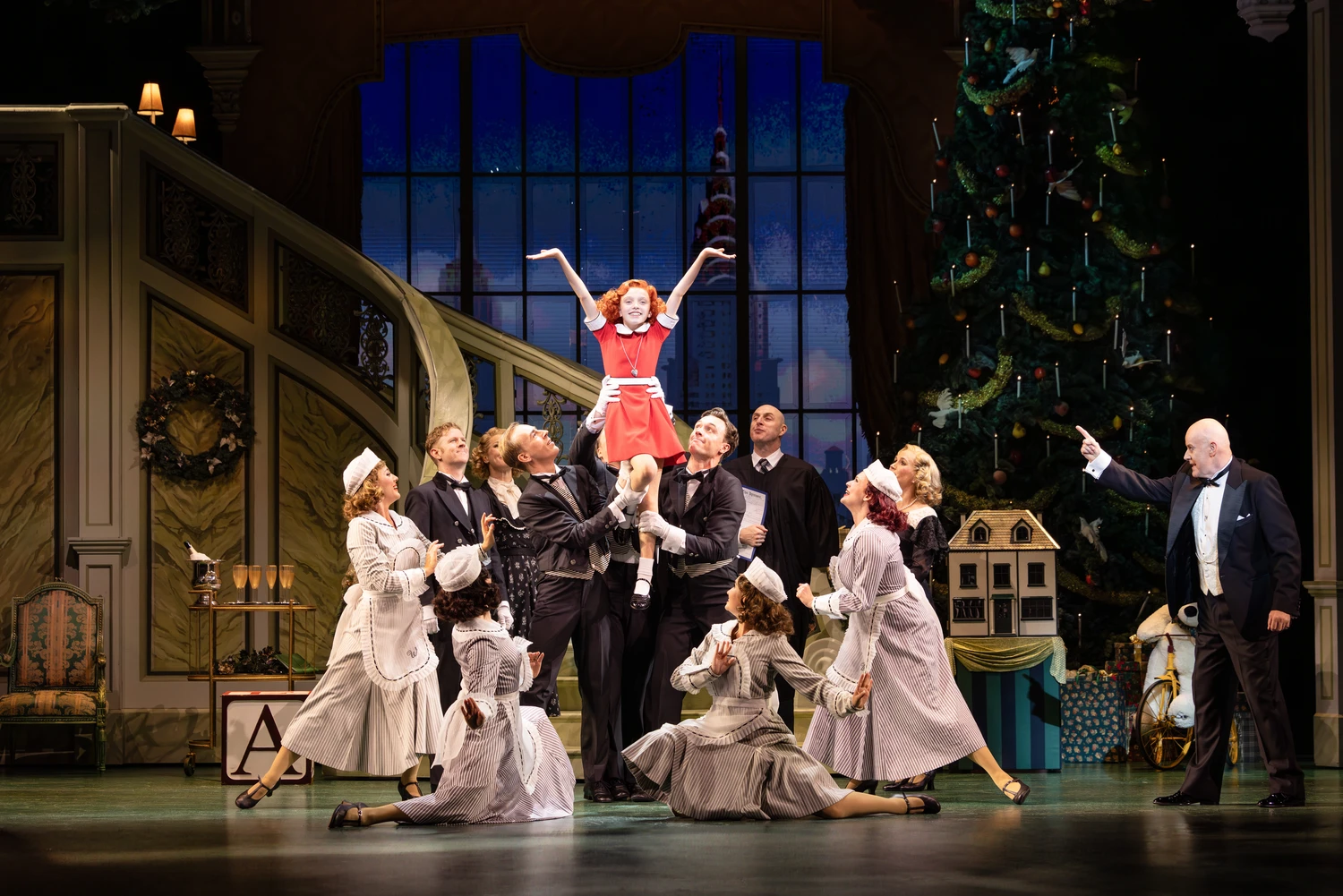
While it is an iconic musical theatre work that has been adapted into multiple films over the years, I have never seen any performance or rendition of Annie. Even as a kid growing up, I had seen much heavier works such as West Side Story, Les Misérables, and Jesus Christ Superstar, rather than this children’s classic. However, this all changed last night, when Australian producer Crossroads Live Australia officially opened Annie the Musical at the Queensland Performing Arts Centre (QPAC) Lyric Theatre for what is looking to be the final leg in its national tour, which commenced last year at Sydney’s Capitol Theatre. Therefore, this review covers not only how the producers treated the work, but also how the work holds up in the modern musical theatre landscape. Therefore, if you have been pondering whether taking your family to see Annie the Musical as a summer school holiday treat is worth the money, scroll down to read my thoughts!
If you have read even a synopsis of Annie in the past, you will go in pretty much knowing what to expect. The plot is clear from the outset, the stakes are easy to follow, and the show never pretends to be anything other than an earnest crowd-pleaser. Set against Depression-era New York, or rather, despite the setting, audiences are showered with bright, slightly stubborn optimism set against the backdrop of hardship. Beneath the red curls and the familiar catchphrases, there is a story about wanting to belong, about being seen, and about the strange ways money can both solve problems and fail to fix what matters. It is also a musical that understands its own intention: send you out the doors feeling lighter than when you walked in.
This production leans hard into that brief and generally makes smart choices about what to emphasise. The direction keeps the tone buoyant, often finding laughs in physical business and quick visual gags, and it rarely lets the darker implications linger long enough to sour the mood. There are many relationships that are explored – Annie and her orphan friends, Miss Hannigan and her brother Rooster, and so forth. But Annie’s central relationship with Warbucks still has the built-in challenge the piece has always seemed to carry: it develops too quickly, is subject to a weeklong time jump that should have at least been depicted in an orchestral montage, and ultimately, the script does not always give it the breathing room it deserves. The bond between the orphan and the billionaire stems from the performers’ warmth and the small human moments that the structure sometimes rushes past. But that sudden time jump feels quite abrupt.
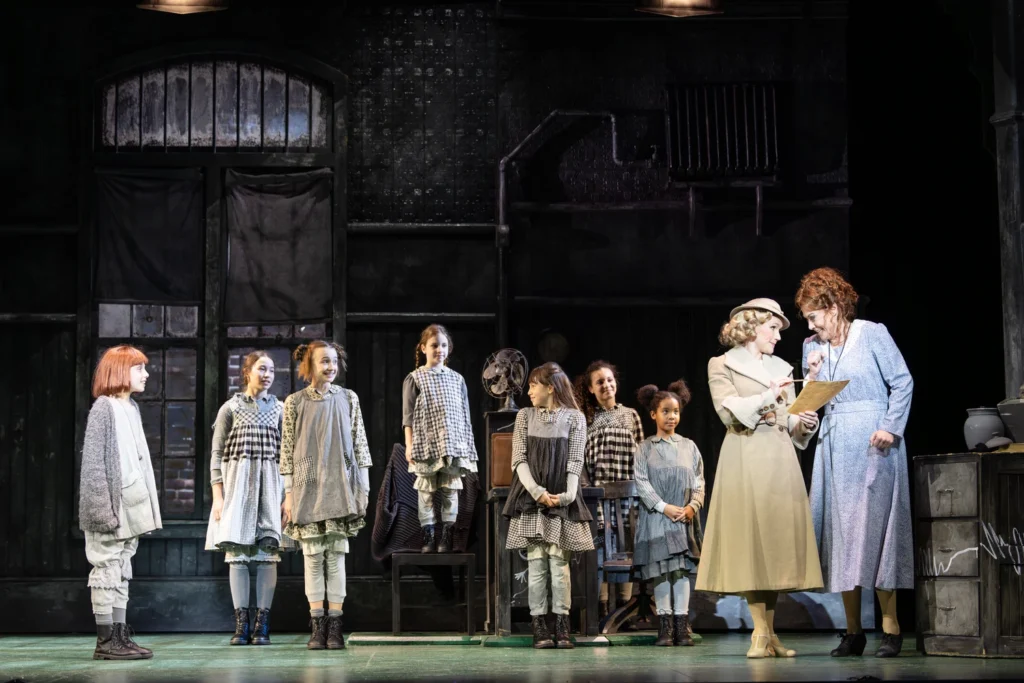
The night’s biggest weight, of course, sits with Annie herself, and the young performer in the role on opening night – Isabella Hayden – carried herself impressively. As someone who gets the shakes even thinking about performing on a stage in my 30s, the first thing that struck me was how confident she was in her delivery. There was plenty of spark and stubbornness, yet it was matched with a believable longing that kept the character from feeling invincible. Furthermore, the role calls for a lot of vocal work – both in dialogue and song – and she had the degree of clarity that cuts through a big theatre without sounding forced.
Just as important, Annie is never alone for long, and the production is wise enough to treat the orphanage kids as more than adorable window dressing. The group of orphans was genuinely impressive in terms of energy, vocals, and choreography. “It’s the Hard Knock Life” landed as a proper showpiece, full of punchy attitude and clean unison, and it set the tone for how high the standard is for the rest of the night. A testament to the book is that it would have been easy to have the children kept in the wings for most of the night, but the narrative finds small ways – even single songs – to keep them engaged in the scene. They also play beautifully off Miss Hannigan, with a cheeky, combative rhythm that keeps the orphanage scenes brisk and funny rather than repetitive or drab.
Once Annie steps into Warbucks’ world, the production gains a different kind of shine, and Anthony Warlow gives it a centre of gravity. His Warbucks begins as a man of routine and authority, but the performance lets the softness arrive gradually through small reactions rather than grand declarations. As someone who last saw Warlow perform in The Wizard of Oz, a role which critically underutilised his talents as an actor, you can see his genuine talent shine through – and he plays off the character of Annie well… even if, again, that relationship should have been better developed narratively.
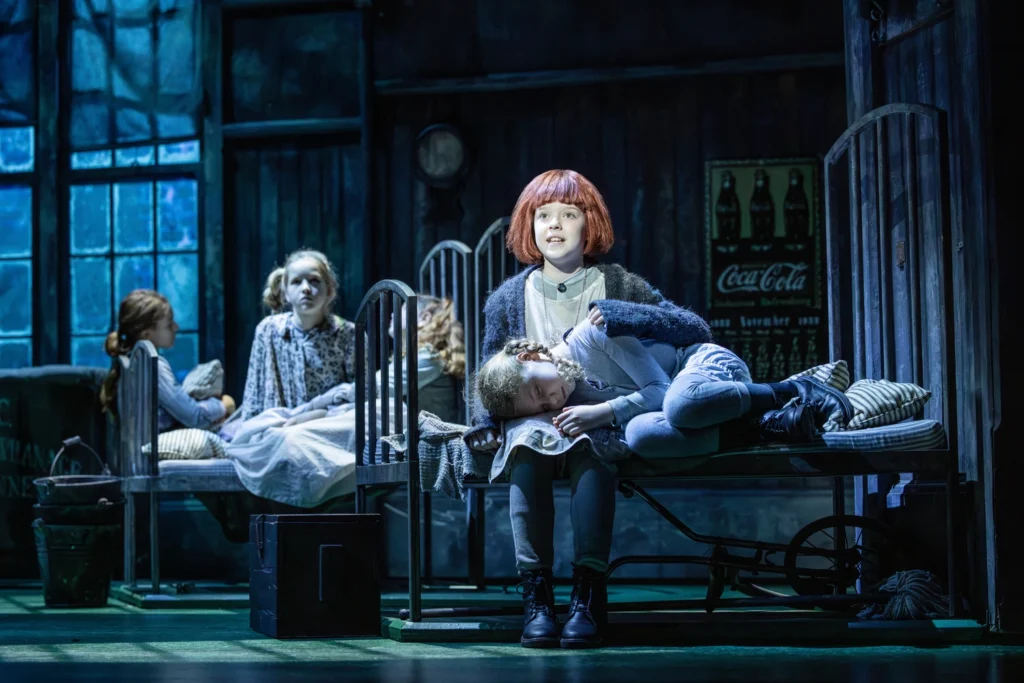
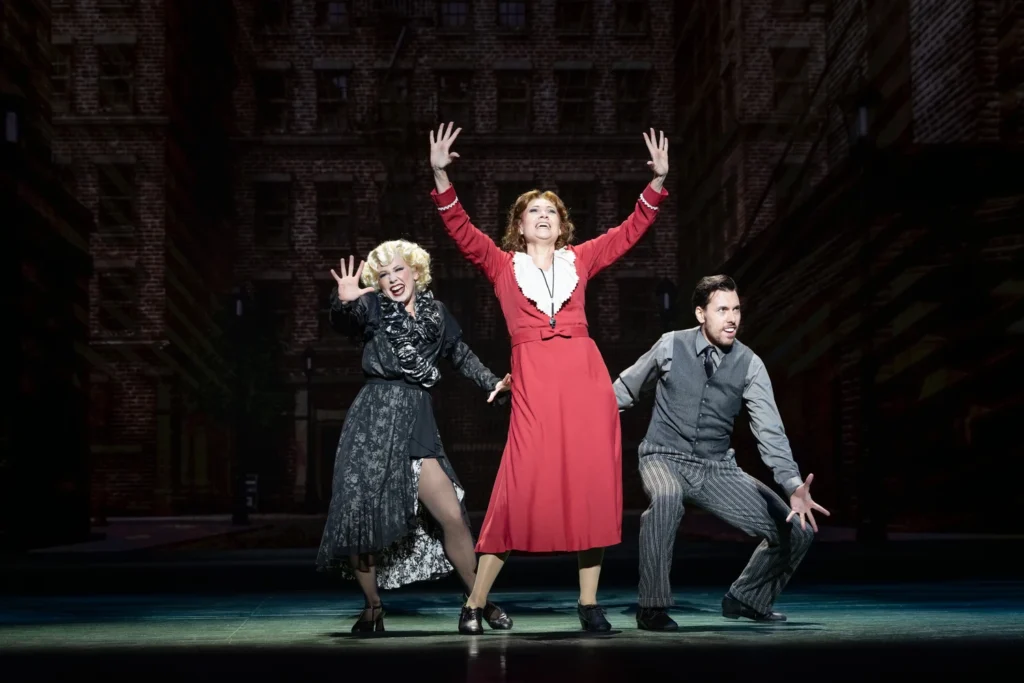
Around that central pairing, the adult cast brings a level of polish that keeps the show from leaning too heavily on its child-friendly reputation and adds much for the adults in the audience alongside the kids. Debora Krizak’s Miss Hannigan is a particular delight because she is not merely a cartoon villain. She is messy, sharp, and physically expressive, firing off jokes with precision while still feeling like a person trapped in the job she hates. Then, when Rooster and Lily arrive, the temperature lifts again. Keanu Gonzalez and Mackenzie Dunn make an excellent double act, equal parts slick and ridiculous, and their scenes have the kind of comic snap that makes you wish the story gave them a little more time. Their big moment, Easy Street, is one of the flagship experiences of the first act… and I am pretty sure I could have watched them perform an encore of the song. Amanda Lea Lavergne brings warmth and steadiness as Grace Farrell, offering a nice contrast to Warbucks.
Having attended my first concert of The Wiggles in 1993-4, having Greg Page perform on-stage, making his musical theatre debut as President Roosevelt, was simultaneously nostalgic and surprising – namely because you go through life primarily hearing him with one tone of voice, only to hear him pull off a flawless 1930s American accent. While he could have just been an actor brought in for some name recognition for those of my generation, and there was some marketing to that effect, he genuinely shone on-stage, and while I appreciate there could be some reasons prohibiting him from taking on a full-time leading role 8 shows a week… I am already eager to see Page take on future musical theatre roles well beyond a few second-act appearances, as he has in Annie the Musical.
Musically, Annie is built from the kind of score that embeds itself in your head whether you want it to or not, and that is why even if you haven’t seen any production of Annie, you will undoubtedly know many of the iconic songs – from It’s a Hard Knock Life to Tomorrow. The famous tunes are familiar for a reason, but the lesser-celebrated songs also shine – particularly We’d Like to Thank You, Herbert Hoover, which has stuck around as an earworm. The vocals across the company and instrumentals by the band were both strong, and for the most part, the clarity of the audio within the QPAC Lyric Theatre was decent – a little muffly at times, and sometimes a little sharp to the ears, but otherwise one of the stronger performances audio-wise I have seen at QPAC in the last year or so.
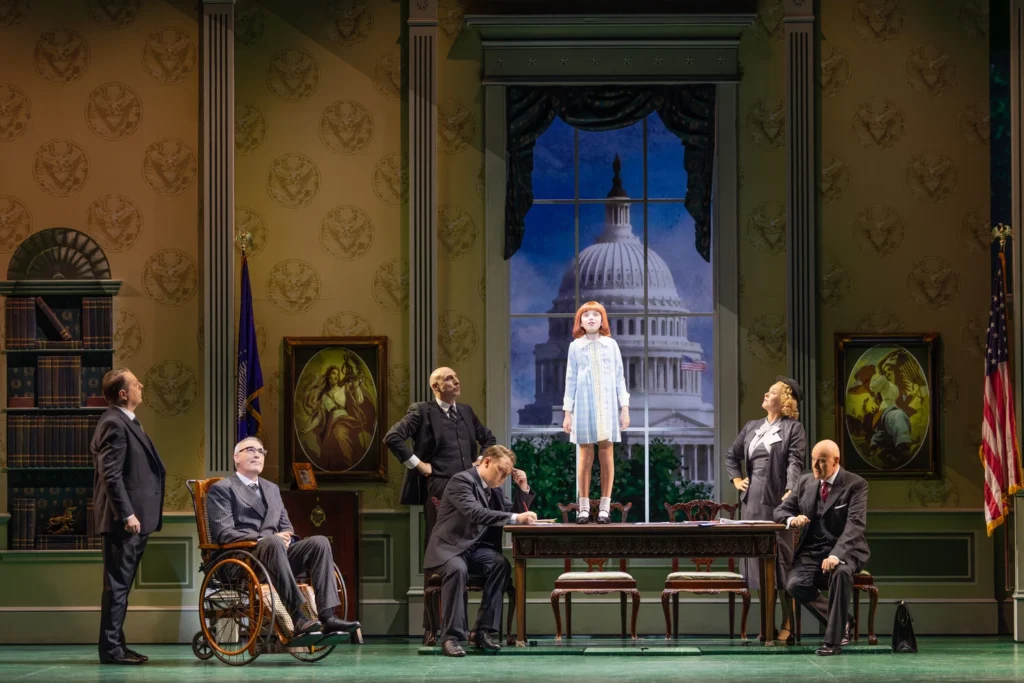
Sticking with the time the musical was originally produced in, Annie the Musical doesn’t have expansive or overly intricate set designs, but offers more than enough to whisk audiences away into each of the settings in which the narrative takes place. I am not usually fond of digital projections in standard musical theatre that purely replace settings that could otherwise be replicated through staging, choreography or another element of stagecraft – especially when the replacement is technologically lacking. The projections and screen imagery helped quickly establish the pace and period, taking you through digital renditions of certain areas of New York as if you were watching a ’90s sitcom. It was fine enough, but having the musical interludes at the beginning of each act overlaid by projections that, in my opinion, were showing their age a little, could have been handled differently. But that is just from my perspective.
Meanwhile, lighting supports the palette rather than fighting it, shaping a warm, nostalgic atmosphere that suits the piece’s romantic view of 1930s Manhattan. The overall effect is a production that comes across as both traditional and refreshed, with smooth transitions that keep the story rolling and enough visual detail to reward anyone who enjoys watching the world-building as much as the performances. The costuming, meanwhile, has a strong period identity, providing a deep contrast between the orphanage’s worn practicality and the gloss of Warbucks’ world, while still keeping everything within the show’s storybook frame. It is especially effective in the character work, with Hannigan dressed in ways that reinforce their vanity against the wards under their care.
Choreography is the other major rejuvenation point. The dancing is sharp and character-led rather than decorative, and it has enough punch to make the show feel current without pushing it out of its 1930s setting. Whether it is the kids attacking unison movement with attitude or the adults switching into sleek, showy dance phrases, the movement vocabulary keeps the momentum high and makes the night feel like a proper musical theatre event. But it does so while also feeling natural.
Finally, there is Sandy, whose entrance reliably triggered a wave of delighted noise across the auditorium. Again, as someone who has never watched Annie prior to this production, I was under the illusion that for an iconic companion to the main character… the doggo would have had a more prominent role on stage – especially for the effort that would have gone into training the (adorable) Sandy and Daisy. But the audience loved them, and after travelling with the company for the best part of a year, they looked comfortable on stage, so that is the main thing.
So, did Annie the Musical’s 2025-2026 Australian season convert a first-timer who grew up on the heavier end of the musical theatre spectrum? Absolutely. This QPAC season proves that, even in 2026, this little red-haired optimist can still hold a room, provided the production delivers scale, polish, and heart. With some incredible children in lead and secondary roles, complemented by talents by the likes of Warlow, Krizak and Page – the score, choreography and enjoyability of the musical’s book all shine. Even with a few quibbles, including the script’s rushed emotional leaps and some projections that show their age, the overall result is bright, cohesive, and unapologetically feel-good. If your summer school holiday budget allows for one big family outing, as an afternoon or evening out at the theatre is not always cheap, Annie is a strong option for a day out in Brisbane.
Final Score for Annie the Musical’s 2025-2026 Australian Tour
Ticketing information for Annie the Musical can be found via the musical’s official Australian website.
We would like to acknowledge Crossroads Live Australia and the show’s Queensland publicity team at Cinnamon Watson Publicity for providing review tickets to facilitate this review.

