Title: Super Scratch Programming Adventure!
By: The Lead Project
Published by: No Starch Press
Release Date: Out Now
Language: English
Pages: 260 Pages
Cost: $24.95 with E-Book or $19.95 for E-Book Alone
Special Thanks: No Starch Press for providing me with a copy of the book for review.
Scratch is the wildly popular educational programming language used by millions of first-time learners in classrooms, libraries, and homes worldwide. By dragging together colorful blocks of code, kids quickly learn computer programming concepts and make cool games and animations.
In Super Scratch Programming Adventure!, kids learn programming fundamentals as they make their very own playable video games. They’ll create projects inspired by classic arcade games that can be programmed (and played!) in an afternoon. The book’s patient, step-by-step explanations of the code and fun programming challenges will have kids creating their own games in no time.
– Official Blurb
My very own programming adventure began when I was in Grade 10 at school, where I took up the subject all the way until I finished High School. While I won’t deny it was an interesting topic, as my school only offered it in the later years, the curriculum didn’t leave any room for the enjoyable aspects of programming – game creation or the production of anything overly creative. As I followed up with science instead of information technology at University, I never really paid much attention to anything that might make programming more accessible to the more lay user/programmer.
I attended a couple of University open days this year, and one of them rather than simply showcasing their students work invited attendees to head down to their labs and in one hour… produce a game of their own. In the last few years… while programming still comes with a steep learning curve, simple programming has become more accessible to classrooms and for general use. While I have reviewed game design software in the past such as RPG Maker (Which has spawned professional game releases), these require varying levels of scripting knowledge to do anything outside of the built-in mechanics and are generally a bit more complex to use.
The Scratch Programming Language developed by the MIT Media Lab is one such tool which has seen success in fostering an interest in programming and introducing gamers of all ages to the world of game creation, and providing many of the tools to create them. To use Scratch, all someone has to do is come up with a simple genre, drag and drop coloured blocks that carry commands and go from there. The Scratch website as well as external groups already have a wealth of guides, resources and downloadable projects available for you to jump into and let your imagination run wild…
BUT if you want a helpful and pretty full-colour guide to step you through Scratch from the basics to creating one of several different game titles… you cannot go much better than Super Scratch Programming Adventure.
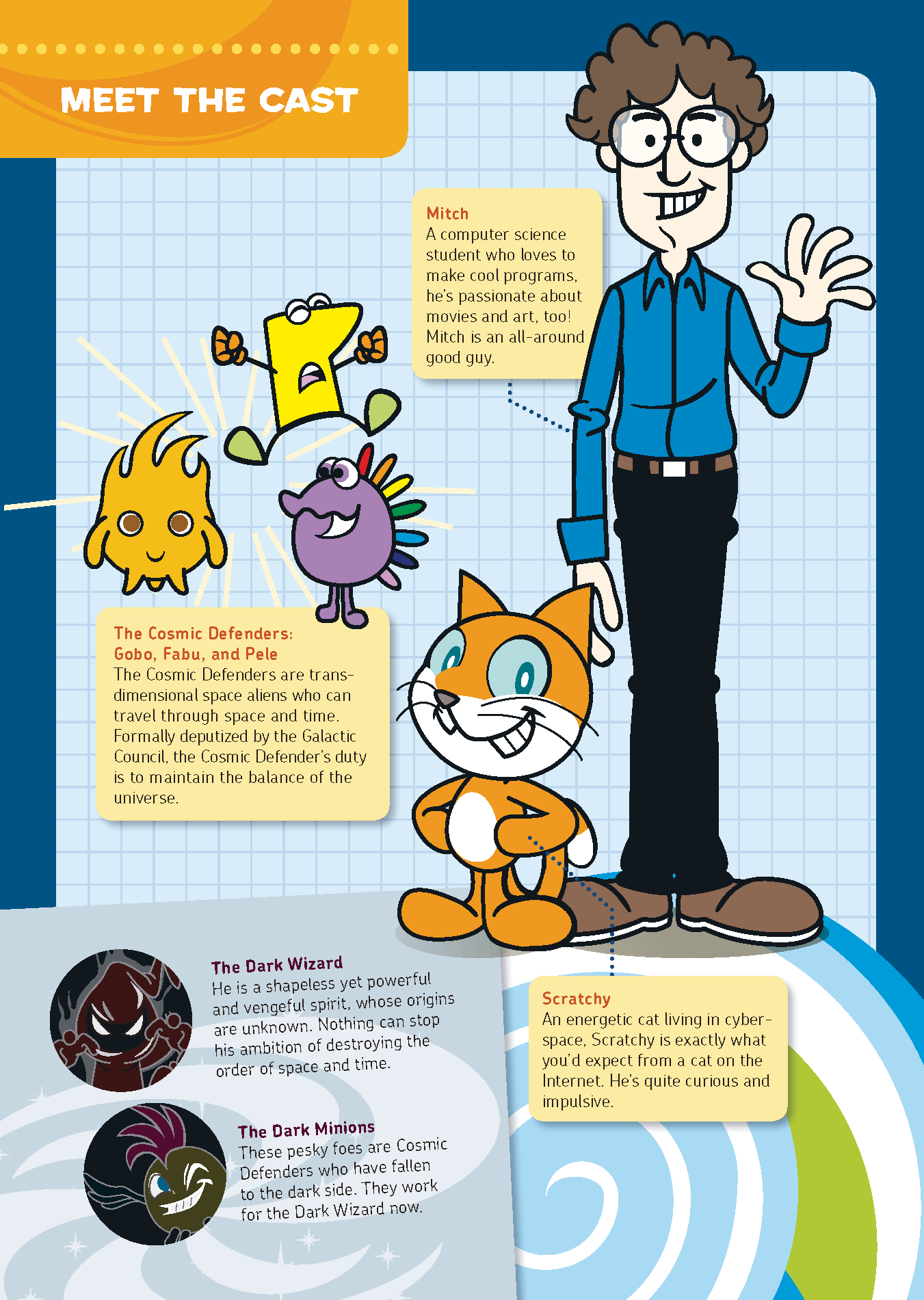
The book is targeted towards the younger programmers, and is similar to the “Manga Guide” series which No Starch Press have been publishing for a few years now by incorporating comics and storyline with learning. The storyline follows Mitch, a computer science student who after a solar flares on the sun and directly hits Earth, wakes up to find Scratchy the Cat (Who originally resided in Cyberspace) in-front of him. Through the power of Scratch programming language, they embark on a quest against the Dark Wizard and his minions and restore the balance between the Digital World and the Real World.
The storyline itself is very simple but serves its purpose well because what you program is directly related to that storyline – so when the pair end up at Rio de Janeiro they must save a guy trapped in a Goalpost via a soccer game, when they end up in the Sahara Desert you are made to develop a desert racing game and so forth. While not completely sensical it serves its purpose.
The book is split up into 10 primary chapters or “stages”, 9 of which contain a focused guide on a particular element of or genre developable in Scratch. Each of these “stages” contain a 2-3 page comic setting the scene, followed by however many pages of instructions on how to develop or utilize the software to continue the storyline. Despite experience with programming before receiving this book I had 0 experience with using Scratch – so working my way through the book I have to say they did a brilliant job of writing it up, with plenty of screencaps and with plenty of clear and concise annotations for all of them.
The book doesn’t hold your hand and completely guide you through the projects, although gives you the freedom to experiment on your own or replicate what they show on the screens and provides additional challenges at the end of each stage to also help you extend your knowledge.
[youtube YHrwwPziUJA 530 335]
An example of the games you would have built after finishing the book
So after you have finished your way through the book and hopefully developed some of the games on offer, The Lead Project also throws in three ‘Bonus Stages’, taking you through the sharing process to share your games online, the PicoBoard which allows you to produce programs that react to light, sound and movement in the real world (I was not able to test this as I do not actually own a PicoBoard – but why not complement software development with hardware development?) and online resources, which as the name suggests provides you with some sources to get started and where to find resources for your next game. Super Scratch Programming Adventure is a perfect companion for your first experiences with Scratch.
The book is well designed and of good quality, with all screencaps being well sized and above all else clear and easy to read, the comics while not contributing to the overall programming experience itself is fun and gives a sense of plot to the games and the pages themselves are not dull, being full of colour with occasional imagery.
While I have had limited experience with programming textbooks, from what I have seen they are generally complicated and long in length… neither of which would go well with an all-ages tool like Scratch. Super Scratch Programming Adventure won me over as a learning guide with its creative approach towards the Scratch tool. Given a bit of time and imagination, the book should have gamers, students or anyone else developing their own games in no time.
For more information and to purchase Super Scratch Programming Adventure, check out the No Starch Press page HERE.