
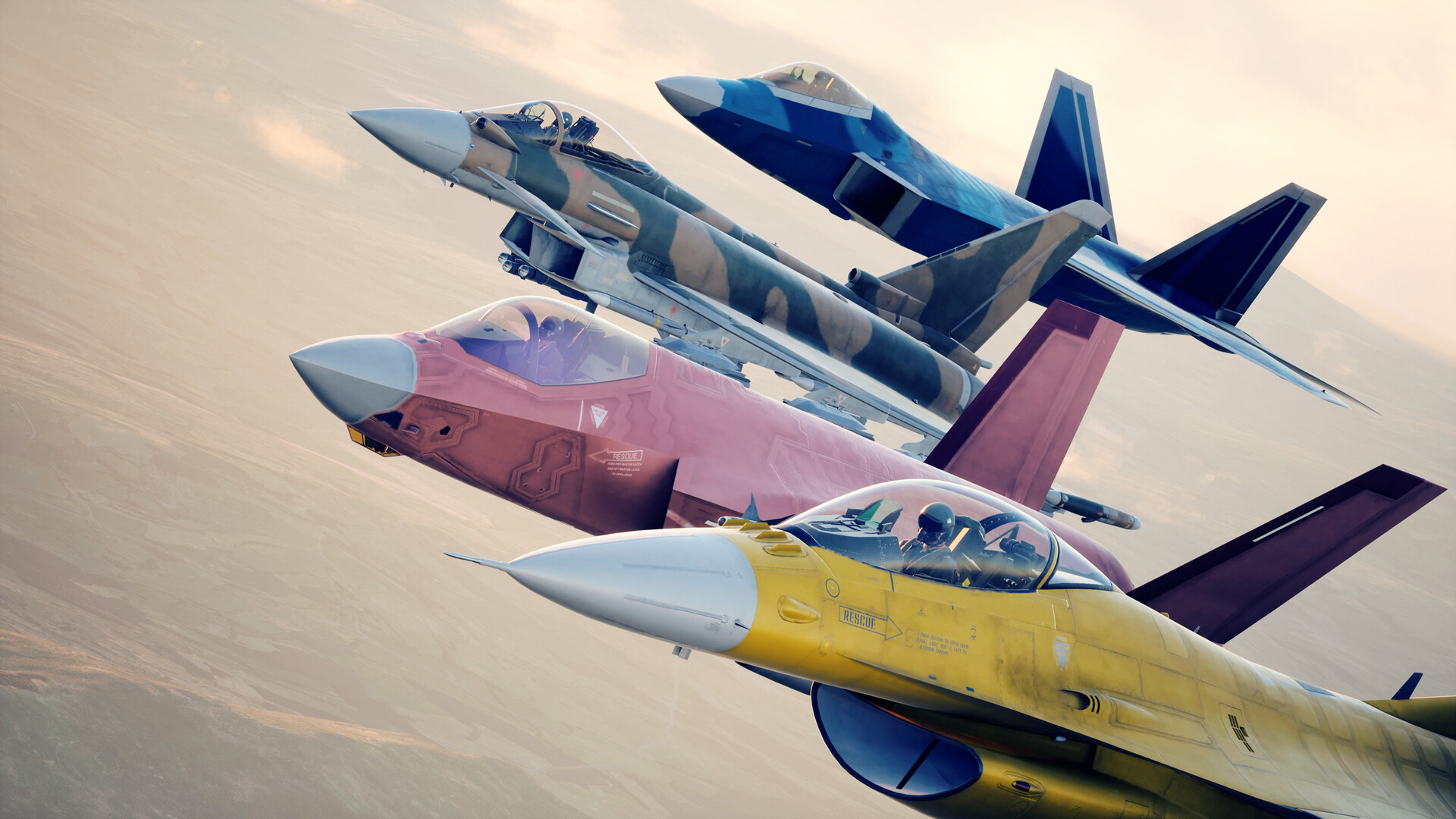
While many long-running game series enjoy numerically incrementing titles, few manage to make it to a number as high as eight, and fewer still get there on the strength of a devoted following that’s less about mass appeal and more about a particular niche done particularly well. More than 30 years after the series’ PlayStation debut, Bandai Namco Entertainment’s Ace Combat 8: Wings of Theve is out now on PlayStation 5, Xbox Series X|S and Windows PC, bringing its own style of air combat to the masses and once again proving that its gameplay loop holds up into its fourth decade. But let’s not get too far ahead of ourselves; read on to see why Ace Combat 8: Wings of Theve is another strong entry in the franchise:
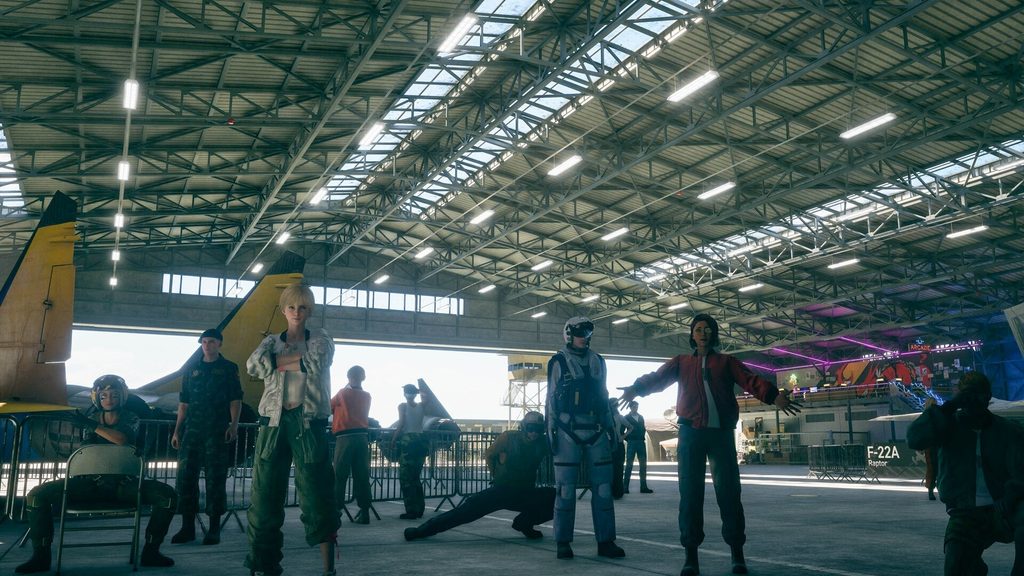
Set roughly a decade after Ace Combat 7: Skies Unknown, Ace Combat 8: Wings of Theve tells a self-contained story, so new players won’t need to do any prior research. The Republic of Sotoa has overrun much of the Federation of Central Usea, including its capital. After being retrieved from the sea by the run-down carrier Endurance, your silent protagonist is assigned to the back seat of Jan “Rex” Cope’s jet. Cope is the Wings of Theve, the FCU’s most celebrated ace. The catch? His legend is largely a fabrication, crafted to give a nation on the ropes something to believe in. When he is shot down and killed early on, you take on both his call sign and his legend. Throughout the game, themes of propaganda, manufactured heroism and misinformation are explored. The storytelling is by no means subtle, but its sincerity is touching. The true heart of the game, however, lies in Joker Flight: Baxter, who gave up his classroom for a cockpit and keeps the team grounded; Tasha, a civilian stunt flyer who strongly dislikes taking a life; and Coster, whose love of rock music often spills over onto the radio. Cope also sticks around in spirit (quite literally), offering weary asides as you fly. It’s the kind of idea that would sink a lesser series, but Ace Combat has always been happy to get a little strange, and here it works. It all builds towards a finale well worth the journey.
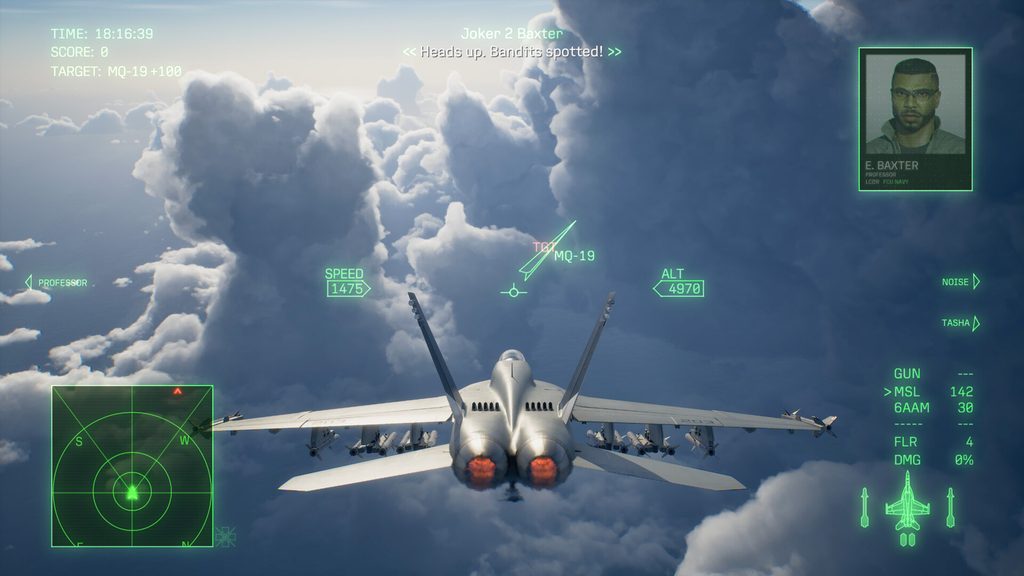
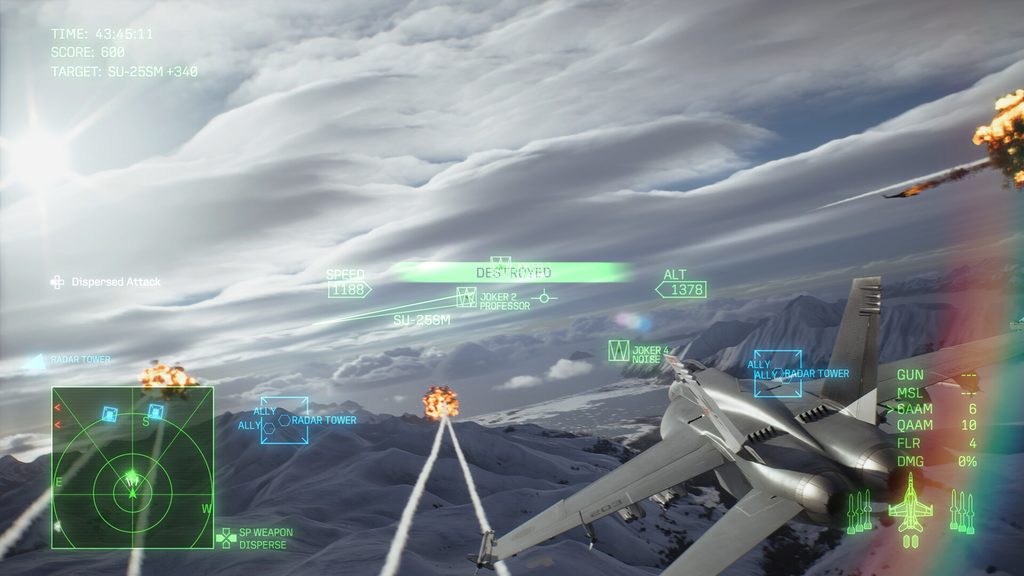
It comes as no surprise that a series centred on flight should make a great deal of effort to produce impressive skies, and Ace Combat 8: Wings of Theve is its best effort yet in this regard. The volumetric cloud system is the clear highlight and goes well beyond mere decoration: heavy weather rolls in over the battlefield, lightning flickers through the murk, and rainwater streams down the glass of your cockpit as you pass through. There’s a real excitement in breaking out of a cloud bank to see the entire battlefield spread out below like a diorama. The ground fares well too, whether it’s dense cities, rough coastlines or the enormous war machines moving across them. Dropping to treetop height reveals a level of detail that is easy to miss, since you spend most of your time several kilometres up.
The aircraft are carefully detailed, with attention given to the fine features of each airframe and cockpits with live, moving instruments. Unless you wash them, the jets also gradually collect the scuffs and stains of each sortie as the campaign goes on. The game has also greatly improved how it presents the scenes between missions. The largely static approach of the previous game has given way to properly animated cutscenes, many of them seen through your pilot’s own eyes, although being asked to press a button for something as simple as a handshake still feels a bit odd. Is it perfect? No, it isn’t. While performance on PlayStation 5 is solid overall, there are occasional brief drops when a large number of explosions go off at once.
Ace Combat is just as acclaimed for its music as it is for its dogfights, and the soundtrack for Ace Combat 8: Wings of Theve truly sets a benchmark, even by the series’ own high standards. It covers a lot of ground stylistically, with choral pieces and hard-driving rock sitting comfortably alongside the big orchestral numbers and some lovely Spanish guitar work. The piece that stands out to me is the Shadows’ theme, a chant Sotoa’s elite squadron broadcasts over the radio as they arrive. Hearing it come through your headset is the surest sign a mission is about to get a lot harder, and it’s one of the series’ most effective uses of music. Coster’s in-flight playlist provides an enjoyable in-world element. The sound design is just as refined, featuring genuine jet engine recordings, distinct sounds for different missiles and ordnance, and a satisfying boom when you break the sound barrier. The voice cast is solid throughout, with Cope’s quietly haunted performance the clear standout, and they do a lot to lift a script that doesn’t always match their efforts. My only real complaint about the audio is that the radio can become crowded when the action is at its peak.
So how does Ace Combat 8: Wings of Theve actually fly? At its heart, it’s still the arcade-style air combat the series is famous for, borrowing from simulation without ever fully committing to it. This time around, the difference is in the handling. The jets feel heavier than they did in Ace Combat 7, so you can’t simply yank the stick and expect the nose to snap round; sharp turns and steep climbs now need a little planning. There’s a new physicality to the whole thing, too, with the controller, the camera and the sound all working harder to sell each manoeuvre. Newcomers can stick with the simpler default control scheme, which handles the finer points of flight for you, while veterans will want to switch to Expert, which hands every axis of movement over to the player. Missiles do most of the work, while the machine gun is a harder but satisfying choice for confident pilots. Staying alive comes down to managing your speed, picking the right moment to commit to a hard turn and making smart use of the clouds, which can hide you from a pursuer long enough to shake a missile off your tail.
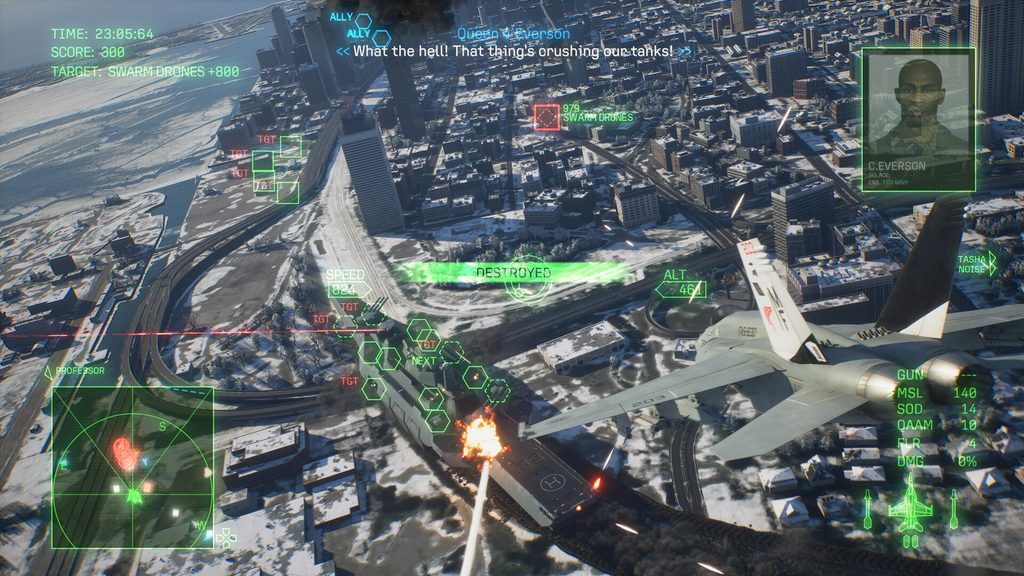
The mission design in Ace Combat 8: Wings of Theve really stands out. Across 30 sorties, the objectives seldom stay the same for long. You might take off expecting a routine escort and, partway through, find yourself torn between several fronts at once, each with a good case for your attention. Some objectives demand more than quick reflexes, like tracking stealth targets by the vapour trails they leave behind or hugging the terrain to stay under enemy radar. The best part is fighting a massive land battleship armed with a railgun, something that is every bit as absurd as it sounds (in the most enjoyable way possible). The new Annihilation missions are also a pleasant addition: they give you a score to hit against the clock and leave the order of business entirely up to you, with the option to pull back mid-mission to rearm and repair when you’re running low. That said, not all sorties reach the same level of excitement, with a few of them feeling like filler set between the major actions. Target selection can also be a chore in the busiest battles, when the threat that actually matters is buried among dozens of low-value markers you couldn’t care less about.
A well-developed range of support systems rounds out the moment-to-moment gameplay. Squad commands are back, letting you send Joker Flight after a target, keep them close to watch your six, or have them unload their special weapons. The commands earn their place rather than feeling like a token feature, though your wingmen can occasionally be a little too eager. Because their kills don’t count towards your own score, watching them pick off targets you needed can be frustrating when you’re chasing a top rank. Loadouts are more flexible, too, with the option to take two different special weapons into a sortie, although you’ll need to be more careful with how you spend them. Every mission pays out points to spend in the Aircraft Tree, a branching unlock system that eventually offers over 30 jets, both real and fictional. Air superiority fighters, ground-pounding attackers, all-rounder multiroles and electronic warfare planes are all represented, and each has a distinct feel in the air. Parts offer modest stat boosts rather than dramatic changes, and unless you’re playing on one of the harder settings, you’ll rarely feel pushed to upgrade. Yet there is a certain satisfaction in customising your loadout to the task at hand, right down to the aircraft your wingmen take into the fight.
The campaign of Ace Combat 8: Wings of Theve runs to 12–15 hours, which arguably makes it the longest the series has ever gone. It’s also far from lacking in replayability, offering plenty to bring players back after the credits roll. For completionists, there are mission rankings, medals and several difficulty levels to keep them occupied, with enemy aces showing up on the more advanced settings for those who are looking for a real challenge. Players can also revisit cleared maps for a relaxed free flight. Your purchase also includes Ace Combat Online, which centres on a shared airbase where up to 100 pilots can hang out between sorties. The main modes cover both co-operative and competitive play, and rotating limited-time events include eight-player raids on superweapons from the series’ past. It keeps its progression entirely separate from the campaign and supports cross-play across all three platforms. There’s also a battle pass, the Ace Pass, alongside loot boxes. From what’s been shown so far, they lean mostly cosmetic, though the Ace Pass does include some upgrades and consumables, so it’s worth keeping an eye on how that balance settles over time. The basic structure seems promising, but as with any game offering a fully fledged online mode, the real test isn’t the initial implementation, but whether pilots keep queuing up months after launch.
So, does that gameplay loop still stand up in the series’ fourth decade? Certainly. Ace Combat 8: Wings of Theve does not attempt to reinvent a formula that has been refined since the days of the original PlayStation, and it is all the better for it. Almost everything that was already good has been pushed a little further. Dogfights have more heft and are shaped as much by the weather as by the enemy, missions rarely play out quite as briefed, and Joker Flight finally feel like people you’ve spent time with, on the carrier as well as in the air. When you add to that a remarkable presentation and a soundtrack that you’ll find yourself playing over and over again long after the last mission, it’s easy to overlook the occasional turbulence. That turbulence might be a script that sometimes trips over itself, a handful of filler missions, or an online mode that still needs to earn its place. Very few series make it to an eight on the box, and even fewer manage to do so while maintaining such strong service to their niche… given this performance, I would be happy to get ready for a ninth.
Final Score for Ace Combat 8: Wings of Theve
This review was conducted on a PlayStation 5 version of Ace Combat 8: Wings of Theve, with all playtesting conducted on a PlayStation 5 Pro retail model. Bandai Namco Entertainment Australia provided a review code to facilitate this review.
Ace Combat 8: Wings of Theve is now available to purchase on PlayStation 5, Xbox Series X|S and PC.

