
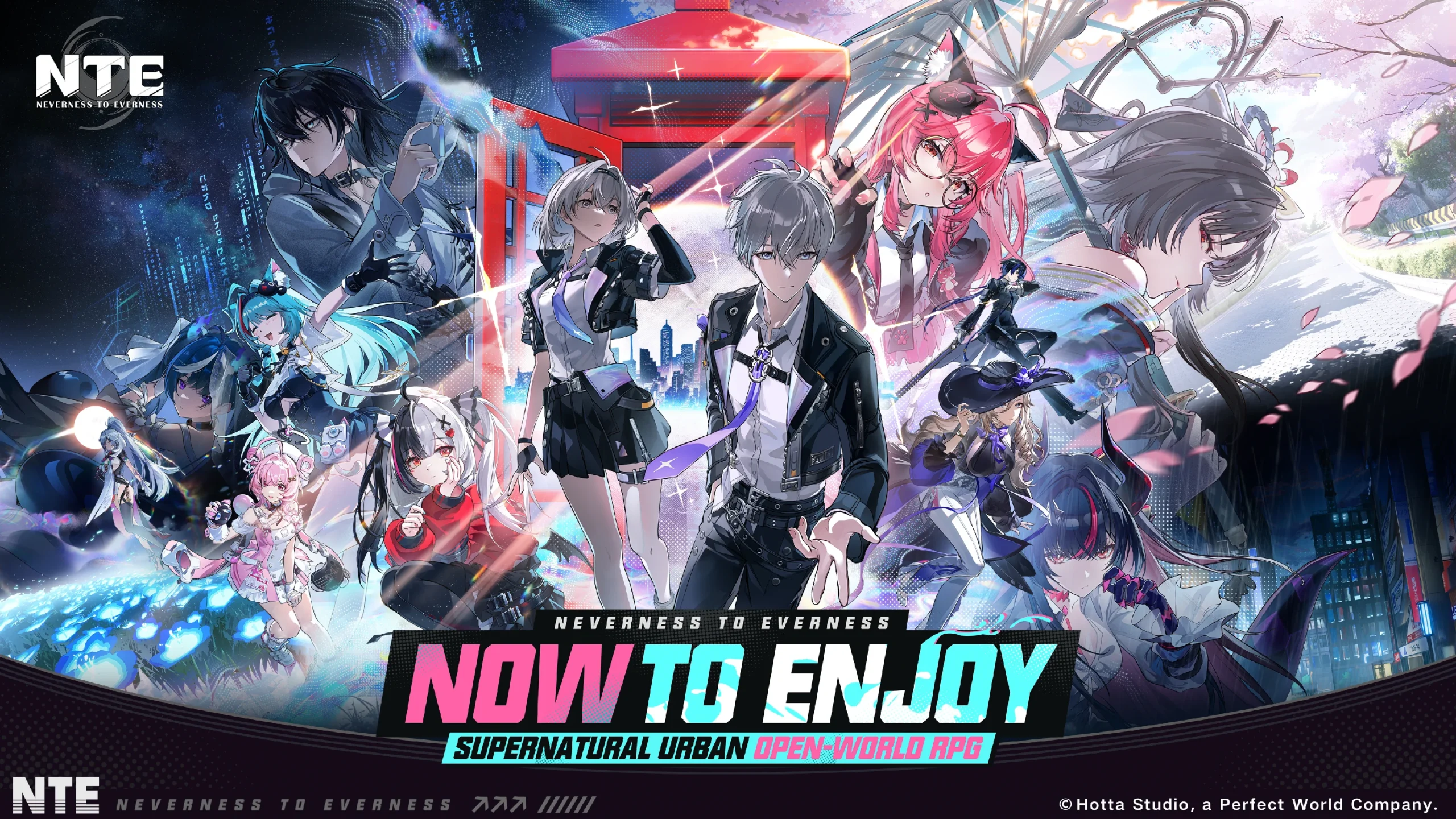
Let’s be up front and honest. There is absolutely no shortage of anime-style action gacha games out there. A bad launch has the potential to kill a game out of the gate, and even an average title with moderate staying power will likely fall to the big players in the market after a few months to years – unless there is some major brand power, development support or niche community behind it – meaning a players time and investment into a world could be rendered moot as story arcs go unexplored, and any financial contribution rendered inaccessible as games become locked behind an End of Service screen. I say that to put into perspective how I approach gacha games going forward, and whether any game is worth more than an hour or two of playtesting. And in recent days, I have cast that eye over NTE: Neverness to Everness.
Thankfully, NTE: Neverness to Everness from the development team at Hotta Studio (Who also previously developed Tower of Fantasy) is shaping up to perhaps be one of those exceptions that – while experiencing some at-launch rockiness – has the foundations of something that breaks from the mould every other anime-style gacha game has to offer – as yes, we “Got anime gacha GTA before we got GTA VI”. If the developer plays their cards right, this could definitely be a game I’d see myself playing months, if not years, from now. But perhaps that is getting a bit ahead of myself. Scroll down to see why NTE won me over, albeit with some caveats.

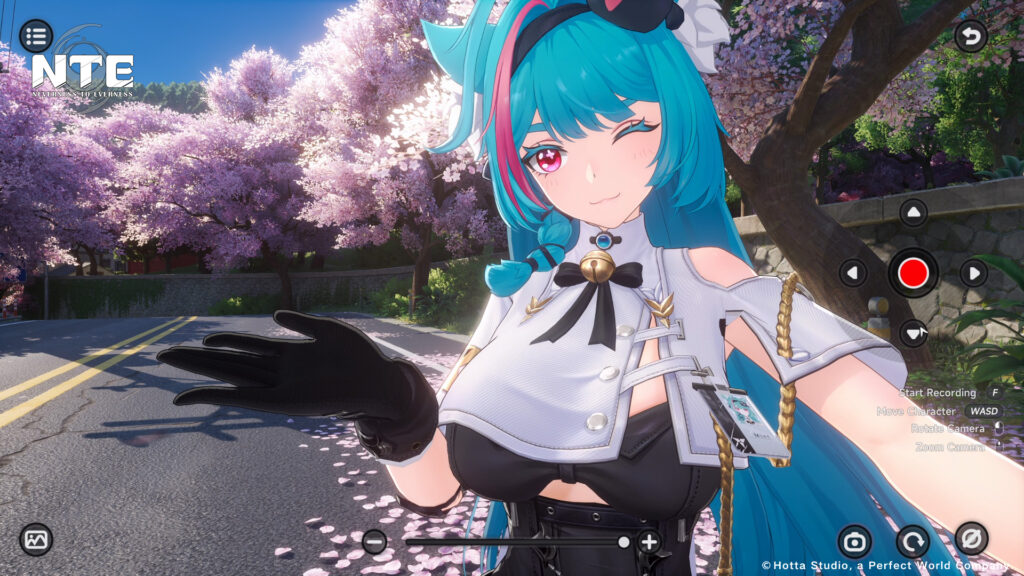
NTE: Neverness to Everness opens up in familiar territory, with a few tweaks to align with the game’s concepts. You commence the game as an amnesiac protagonist who stumbles into the Hypervortex anomaly, tearing open the skies above Hethereau gets recruited by the Bureau of Anomaly Control off the back of a convenient sixth sense, and ends up bunking down at the antiques shop turned investigation agency Eibon as a new anomaly hunter – this time known as the Apprasier in lieu of your chosen character name. Then the grandiose opening prologue leaves you with substantially less hand-holding, as you are not immediately the chosen one to save the world, but rather just another anomaly hunter among many, albeit with the skills and team to make an impact. The cast carries a lot of the goodwill here, too. Mint is an immediate standout as your first proper companion, and the broader roster has real personality across the board, with enough anime and gaming references buried in the dialogue to keep genre-literate players grinning.
The trouble is that NTE: Neverness to Everness cannot quite sustain that early hook. While on their own, the main storyline and even some of the sub-scenario quests are genuinely enjoyable, some parts do sag – partly because the writing leans too hard on its anime quirkiness when the world-building needs to do the heavier lifting, and partly because progression is locked behind character levels rather than story beats. If you are here purely for the narrative, expect to be pulled out of it repeatedly to grind side content before the next case unlocks. Character distribution also feels more than a little wonky, and it seems some of the scenarios may have had their questlines changed late in development, which were not yet factored into the narrative. Character distribution also feels uneven once you are past the opening arc. Mint, despite being the face of your introduction to Hethereau, drops out of the spotlight almost entirely, while Taygedo (clearly being positioned as the title’s mascot) shows up across an outsized share of the side-stories. While I do genuinely enjoy the dynamic between the members of Eibon… having whole questlines dedicated to a character who can only say its name is a bit grinding – especially when there is a cast of 15 playable characters (and more) open to explore further.

The city of Hethereau is where NTE: Neverness to Everness makes its strongest case. The city is condensed rather than sprawling, and that focus works in its favour. Every district feels deliberately placed; the streets are dense with small interactions rather than empty filler, and the anomaly events bleed naturally into the cityscape rather than being walled off in their own instances. The GTA comparison is unavoidable, but it is GTA in service of a life-sim sensibility rather than crime-sandbox chaos, and the result is a world that genuinely rewards slowing down. Art direction punches well above what you expect from a free-to-play title, and the supernatural set-pieces in particular look striking enough to justify just stopping to take in the view. Additionally, it is just nice to be able to walk into so many different buildings with at least subtle design changes, rather than remaining outside aside from a few rabbit holes. That said, the launch period has not been kind to the technical side. Softlocks, looping visual effects and elevator doors that simply refuse to spawn are all things I have run into in my first stretch with the game, and the occasional immersion stumble does show that there is more work to do by the development team. Performance on the PlayStation 5 Pro also holds up well, although a few more graphical settings would have been nice.
The audiological backing of NTE: Neverness to Everness is also strong. Ambient sound design is detailed and atmospheric, rewarding players for stopping to enjoy the sights and sounds and doing a lot of unspoken work to sell Hethereau as a place rather than a backdrop. Both the English and Japanese dubs are strong, with some genuinely big names lending their voices across both. The English cast does lean heavily on talent recognisable from Genshin Impact, which is either a comfort or a distraction depending on how much of that game you have played. It feels like, rather than exploring a different character, they were running with voices almost identical to their GI counterparts. The one consistent weak spot is the in-car radio, which has a small enough rotation of tracks that it wears thin within your first few drives, especially since I found the PS5 controls do not make it intuitive to switch songs.
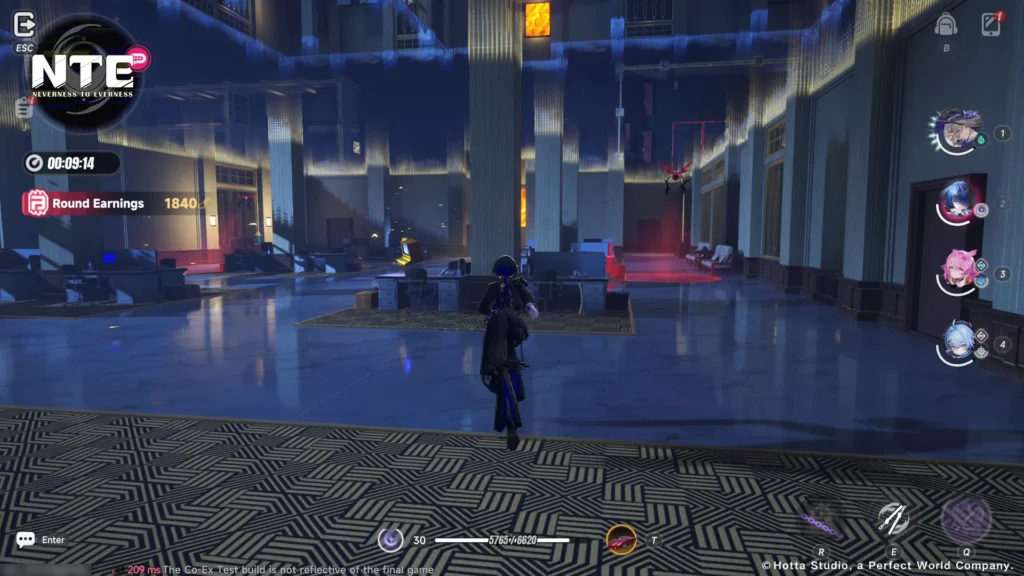
Combat isn’t revolutionary in NTE: Neverness to Everness, and, granted, it draws on decades of experience with action RPGs, which in the gacha-game space could be compared to Zenless Zone Zero or Wuthering Waves. The team-switching, parry windows and elemental synergy of the Esper system will feel immediately familiar to those who have played either title. The moment-to-moment feel is responsive and flashy enough, and each character feels diverse enough that you don’t have a party of four all comprised of the same attack style and skill, although there is a notable difference between those top-tier characters and the A-Rank characters, at least in my opinion. Where the system genuinely earns its keep is in boss and anomaly encounters that force you to break rhythm, parrying projectiles back at distant enemies or adapting to platform shifts mid-fight. This is especially true during the early to mid-game, where you haven’t min-maxed your entire party. There is ultimately a strong level of challenge that kept me hooked for lengthy play sessions, although, as with any game with an eventual level cap, I’d expect it to peter out over time as your characters get stronger and can take down foes much more quickly. The artifact system is the other real bright spot, ditching the usual substat grind for a Tetris-style console mini-game where you slot block pieces to optimise stat bonuses. It is a small thing, but it turns gearing into something you actually engage with… even if you may just hit the auto-add button after the first couple of times.
The life-sim layer is where NTE: Neverness to Everness separates itself from the pack, and where most of your time will quietly disappear. The City Tycoon menu offers café management, housing, deliveries, fishing, casino games, street racing, and bonding events with characters, and almost all of it is well-built enough to justify the time investment rather than feel like padding – enough functionality for both those who wish to dive into a system wholeheartedly, and those who just want the rewards. Driving is also solid for the genre, albeit nothing groundbreaking, and the progression loop of buying better cars, taking on taxi work and competing in races gives the city a parallel career track that complements the main story rather than competing with it. The public transit option deserves a mention, too. Being able to hop on a bus or train and just watch Hethereau roll past is the sort of small touch that reinforces the sense of inhabiting a place rather than traversing a map. Random encounters keep even routine trips unpredictable, and the wanted system is a genuinely funny addition for anyone who fancies misbehaving in front of the wrong NPC – maybe even ending up in prison – although you really need to go out of your way to be an ass to build a wanted level.
Movement is inconsistent at times, with climbing and wall-running occasionally refusing to engage on surfaces that look perfectly viable, though I will give NTE: Neverness to Everness credit for making it generally clear what you can and cannot scale. Coming off Genshin Impact, where a poorly judged cliff and a spent stamina bar could end a character’s day, NTE’s characters have a lot more range with their stamina, which makes it less of a barrier to navigation. Vehicle interaction is rougher. Entry prompts can be slow to appear, and it isn’t too difficult to get your vehicle (whether two- or four-wheeler) stuck in geometry that forces you to pop out of the car to respawn, if not softlocked entirely. Controls on PS5 are workable but never quite natural, and the mouse-and-keyboard setup remains the more comfortable option by some margin. The contrast against something like Arknights: Endfield, which feels purpose-built for a controller, is a little hard to ignore – I never felt completely comfortable with it.
In terms of replayability, the standout in Version 1.0 is the Pink Paws Heist. The framing is simple enough; you are invited along to rob a bank in a limited-time environment, but the escalating pressure of extraction points being deactivated as you linger and high-value foes and loot being thrown your way as you venture lower down into the depths of the vault offer a perfect combination of risk and reward. It is comfortably the most fun mode in the game, and the kind of set piece I want more of as new versions roll out. Beyond the Rail handles the combat-focused endgame for those who want to push their builds, and the housing decoration system ties anomaly drops back into your living space, giving even casual combat a tangible reward.
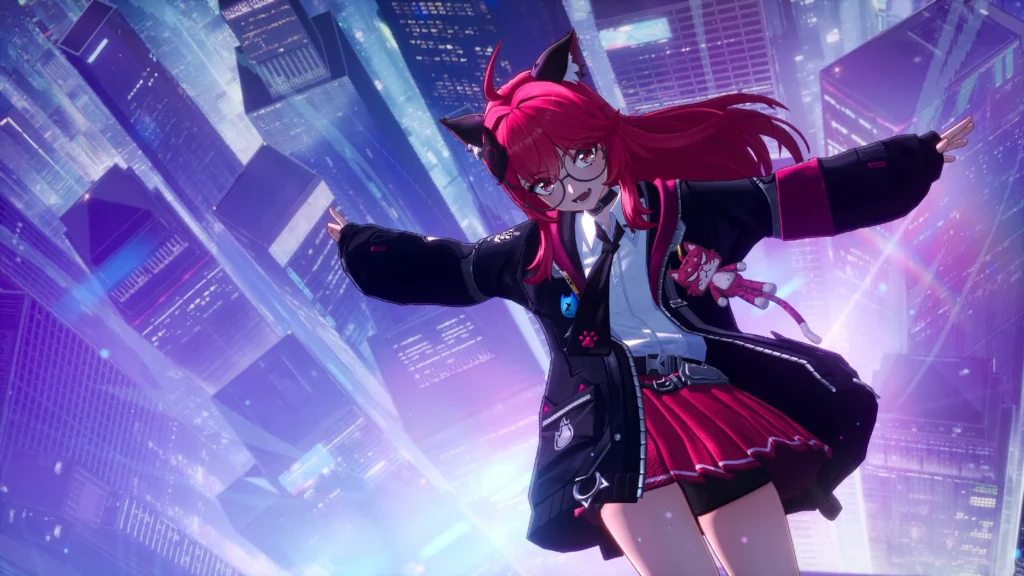
But let’s not beat around the bush here… NTE: Neverness to Everness is a free-to-play gacha game. Therefore, one of the goals of having players is to have as many of them part with their funds as possible. I’d argue that, at least at launch, the game is quite generous with what it provides players and how it has approached monetisation in general. The headline feature is the absence of a 50/50 on limited banners. Hit pity, and you get the character you were pulling for, full stop, and that single design choice removes a very specific kind of gacha frustration that the genre has trained players to expect. The 70-pull soft pity and 90-pull hard pity sit in familiar territory, and there is a bonus free S-rank selection from the standard pool after the first fifty rolls (5x 10 pulls at 20% off) that gives newcomers an added foothold alongside the other S-rank character selectors being offered as part of Version 1.0. Resource generation from regular play is steady enough that most players will field a credible team within their first few hours, and the gameboard pull presentation, complete with a festive board upgrade once you have spent enough, is a nice piece of flair.
While monetisation concentrates on unlocking new characters, it also focuses on outfits and cosmetics – some linked to how many pulls you make on each special banner (in a double-edged sword for those who pull early for featured characters), and others as part of just a standalone purchase. However, a good chunk of the character outfit wardrobe can be earned through in-game currency from life-sim work if you are patient. Time will tell whether it stays relatively free-to-play friendly (unless you absolutely want every character) or goes down the route of overmonetising, but as it currently stands, it is one of the more approachable gacha games on the market.
NTE: Neverness to Everness is not perfect in every area, with its uneven character distribution, sagging mid-story pacing, and the usual launch-window technical wrinkles all keeping it from greatness out of the gate. But between the genuinely lived-in city of Hethereau, a life-sim layer that respects your time, set-pieces like the Pink Paws Heist and a gacha system that has actually thought about player frustration rather than weaponising it, this is one of the few anime-style gacha games I can comfortably see myself returning to months from now. Hotta Studio still has work to do, and the next few versions will tell us whether they can hold the line on the goodwill they have built.
First Impressions Score for NTE: Neverness to Everness
All playtesting was conducted on the Version 1.0 post-launch build of NTE: Neverness to Everness on the PlayStation 5 Pro.
NTE: Neverness to Everness is now available as a free-to-play, gacha-supported action RPG on PC, PlayStation 5, iOS and Android.

