

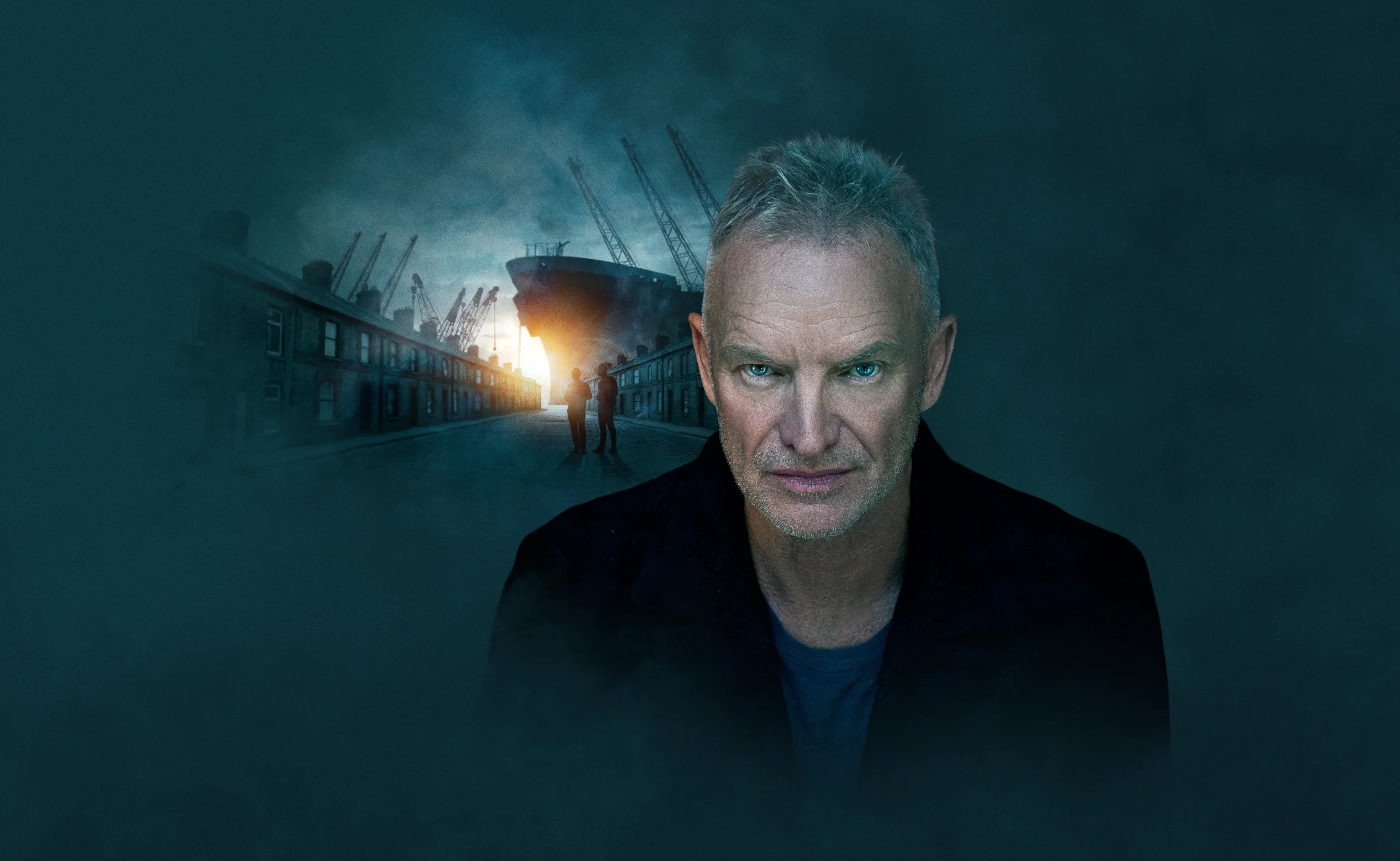
When a major production typically makes a single stop on an international tour, it is usually Sydney or Melbourne that gets the billing alongside the world’s biggest cities. But for the 2026 world tour of Sting’s musical The Last Ship, the billing instead lists AMSTERDAM, PARIS, BRISBANE, and NEW YORK. In what has been described by many, understandably, as a coup for the city to mark the opening of the new Glasshouse Theatre at QPAC, not only has the state of Queensland earned a southern hemisphere exclusive production, but the world tour cast – including Sting and Orville Richard Burrell (aka Shaggy) – is along for the month-long stint. While the season initially came in at arguably cost-prohibitive prices, a series of discounts (and a free livestream on opening night) enabled many audiences to see the musical for themselves. But… an exclusive is one thing, was it actually worth attending a performance of to begin with?
At its heart, The Last Ship is clearly a deeply personal work, drawing directly from Sting’s own upbringing in Wallsend, a shipbuilding town in north-east England, and serves as a tribute to the community that shaped him long before he became a global rock icon. Set in the 1980s, the story traces a government-owned shipyard’s fight to complete one final vessel under the looming threat of Thatcher-era closure, with themes of labour, identity, mortality and collective resistance running throughout. The musical’s book has undergone multiple cycles of refinement since its 2014 premiere, and the result is closer to a drama with songs than to a conventional song-and-dance musical. That distinction matters. Audiences arriving expecting Broadway gloss or a jukebox-style romp through the Sting back catalogue will find themselves on entirely different footing.
And yet, for a work so explicitly built around storytelling, The Last Ship has a curious relationship with its own narrative, one that, from my perspective, is more of a hindrance. A narrative-driven musical should see the songs working in service of the plot – propelling characters forward, sharpening stakes, illuminating motivation. And to a degree, they do, but the relationship feels inverted at quite a few points: the narrative seems to exist primarily to support the songs, rather than the other way around. The consequence is storytelling that feels reactive rather than purposeful, with plot beats and character developments often surfacing only when a number demands them. It also leaves the production’s central focus adrift – is this Jackie White’s story, Gideon’s, or the community’s collectively? The answer can shift depending on the scene rather than through clear narrative beats, and the show is poorer for it.
This is most evident in the second act. The first act is slow and weighed down, and at least retains a consistent tone. After the interval, however, plot threads are introduced and resolved with a haphazardness bordering on whiplash, most conspicuously the rekindled romance between Gideon and Meg, which asks the audience to invest in a man who vanished for seventeen years without so much as a letter, then expects emotional closure within a couple of scenes. A tighter, more disciplined approach, one that trusted the core shipyard story of workers, closure and collective fight to carry the weight unaided, would have served the production far better. There is more than enough drama in the foreground to fill the runtime without the romantic subplot or the various tangential threads orbiting it. The refusal of a neat resolution is emotional and realistic… the cluttered path to it, less so.
The casting of The Last Ship is, on the whole, one of the production’s more reliable strengths. Sting himself takes on the role of Jackie White, the ailing shipyard foreman, with an understated authority that suits the character well – he anchors the stage simply by standing on it, never overplaying his hand, and his voice retains its distinctive textured quality even if it no longer carries the power of his Roxanne-era prime. Annette McLaughlin as Peggy White is arguably the production’s most quietly commanding presence, grounded and warm but with a steel that surfaces at exactly the right moments; there are stretches where she holds the stage more firmly than her famous co-star. Lauren Samuels brings vocal control and emotional intelligence to Meg, particularly in her fiery rendition of If You Ever See Me Talking to a Sailor, while Declan Bennett‘s nuanced Gideon makes the most of underwritten material, especially in Dead Man’s Boots. Joe Caffrey is fully convincing as union representative Billy Thompson, and Hannah Richardson makes a vivid impression as Ellen. Across the ensemble and the local chorus, with some big names in both, the work is committed, disciplined, and feels very authentic – this doesn’t feel like people acting out their characters so much as audience members getting to peer into their lives. Furthermore, these are some substantial names in the international performing arts space who may not typically be seen performing in musicals within Australia, so you are genuinely getting some unique talent.
Not necessarily an exception to this, however, Shaggy is more underutilised in his role. Cast as the Wallsend Ferryman and marketed as a co-headliner alongside Sting, his presence is undeniably a drawcard, and there is real warmth and pleasure in seeing him onstage. But for a globally recognised musician with a distinctive voice, his actual singing time is startlingly minimal. Instead, Shaggy spends much of the production as a watchful, almost spectral figure, drifting through scenes and observing what takes place. To be fair, this passive quality fits the role itself, and altering it would distort it, as the Ferryman is conceived as something between a Charon-like guide of souls, a pseudo-narrator, and an angel of death, so detachment is part of the brief. The question this raises is less about performance and more about casting logic: hiring an artist of Shaggy’s calibre and then keeping his vocal contributions to a handful of moments feels like a missed opportunity.
Musically, The Last Ship leans heavily on Sting’s 1991 album The Soul Cages, with familiar tracks such as Island of Souls, All This Time, and When We Dance woven into the score. The music draws on Northumbrian folk, sea shanties, Celtic rhythms, choral writing, and lyrical ballads, with traces of jazz throughout arrangements. The traditional elements of songs are quite unlike anything many mainstream musicals offer, and for that, it is a delight. The folk roots are where the score is most convincing, capturing the working-class grit and regional specificity the story demands.
The writing is the score’s greatest strength, and it’s no coincidence that the production’s most genuinely stirring moments come when the full ensemble unites. Numbers like Shipyard, We’ve Got Now’t Else (especially the incredible reprise near the end of Act 2), and the title song, The Last Ship, muster real collective power, tying the music directly to the show’s central theme of community solidarity. The catch: it loops back to the structural concerns flagged earlier – is that several of these songs, beautiful in isolation, don’t advance the narrative as much as they could. They sit as set-pieces for an audience to admire rather than as load-bearing dramatic moments, which is precisely what creates the sensation of a story built around its songs rather than the other way around. All that said, however, with the musical changes between the original Broadway debut and how the production stands today… they really need to release another cast soundtrack… it is distinct, unique and would be oh so bingeable.
If there is one element of The Last Ship that earns perhaps the highest praise, it is the staging. The set and props have transformed the new Glasshouse Theatre stage into a fully-realised industrial dry dock – a working shipyard rendered in steel scaffolding and gantries. Dominating the entire space is the massive bow of the unfinished ship, looming over the action and giving the production a sense of scale that few musicals attempt – all supported by the theatre’s vertical scale.
What elevates The Last Ship’s staging from impressive to genuinely disorienting is the integration of digital design, which, for the most part, is strong. The video design and projections blend so seamlessly with the physical scenery that the eye genuinely struggles to identify where the solid set ends and the projection begins. Terrace houses, scudding clouds, the machinery of construction and the texture of metal all flow across the stage with a fluidity that deepens rather than distracts from the storytelling – combined with the lighting, which also incorporates with the scenes almost flawlessly. My only quip is that a few of those digital projections around the industrial work being done on the ship were very choppy and low-res, drawing me out of the scene, which otherwise looked genuine… and realising that “oh no, it’s a digital effect”.
Returning to the original question posed at the beginning of this review – was The Last Ship a Brisbane exclusive worth attending? On balance, yes, though saying this comes with caveats. The Last Ship is buoyed by a genuinely committed cast, a richly textured musical backing, and a staging spectacle that properly showcases what the Glasshouse Theatre is capable of providing creatives and audiences alike. Where it falters is in a narrative that tries to do too much within its near-three-hour runtime, splitting focus across plot threads the show doesn’t have time to honour and leaving the core shipyard story competing for oxygen with subplots that needed either more room or none at all. For Brisbane audiences, the chance to see Sting and Shaggy onstage in this venue is itself a moment worth showing up for. Just don’t expect The Last Ship’s storytelling to be as heavy-hitting and as rich as all the other elements behind it.
Final Score for The Last Ship the Musical
The Last Ship the Musical is set to be performed at the Queensland Performing Arts Centre’s Glasshouse Theatre until 3 May 2026, with tickets now available from $99 excluding transaction fee. Ticketing information can all be found via the official QPAC website, or by calling their box office team on 136 246.

