

In addition to being one of the defining RPGs of the fifth generation of video game consoles, Final Fantasy VII set the standards for RPGs and 3D gaming in the years following its release. It had a mammoth impact when it was first released, and let’s be honest: more than two and a half decades later, a simple re-release with new visuals and loosely integrated gameplay mechanics wouldn’t suffice. With its creative narrative changes that framed the ‘Remake’ saga in a different light to its original counterpart, opting to focus on only the first arc in the game’s broader story, not to mention amazing visuals, music, voice acting and innovations in the gameplay department – Final Fantasy VII Remake set a high bar for its next chapter. After almost four years of waiting, the second installment in the trilogy, Final Fantasy VII Rebirth, is now available. It follows the members of the “eco-terrorist” group AVALANCHE as they venture beyond the walls of Midgar. Their mission against Shinra, Sephiroth, and the mysteries introduced in the first chapter continues. Does it continue to meet or hopefully exceed the standards set by the first chapter? Read on to find out.
The most substantial change between Remake and Rebirth revolves around how it delivers its narrative and overall pacing. Based on the first arc of the game before players got to the open-world environment, Final Fantasy VII Remake was a heavily linear experience, with a few opportunities spattered about to give players some semblance of having options of things to do through its towns. The main positive of this approach was that it was a heavily choreographed experience, with most activities contributing to setting the tone for the rest of the story – both the core foundations of the story and the new ‘Remake’ chronology elements which brought Sephiroth into the equation much, much earlier. Opening up the areas outside of Midgar for players to explore has seen Final Fantasy VII Rebirth become a more open-ended player-driven experience (outside the confines of the main scenario). Going above and beyond what the original game was able to offer on late-90s hardware, players are granted access to what is easily one of Square Enix’s most ambitious open worlds to date — with meticulously designed areas, hub towns and cities that are genuine hives of activity, opportunities to break from the main quest through a series of quests and mini-game opportunities, and some reimagined concepts from the base game that are not just recreations, but reimagined in ways that left me wishing they were not just one-off events.

Don’t go into Final Fantasy VII Rebirth time poor. Assuming you’re not simply rushing through, you’re looking at a solid 60-80 hour experience – which encompasses the main story, side-quests, and a plethora of mini-games which in their own right have the capacity to take up a lot of time. The story is approachable, and honours the legacy set by the original well, introducing more depth to the narrative, fleshing out each of the individual characters a lot more, and introducing new events that meld into the new chronology well.
However, a case could be made arguing that the storyline can sometimes come across as convoluted and piecemeal to be easily understood – especially if you fall afoul of using the SKIP button a bit too much. Furthermore, from relationships forged in more strenuous situations, the game does falter a little bit when attempting to develop a more meaningful relationship between the main characters. This issue stems not from the characters themselves but from the sometimes haphazard shifts between presenting urgency and suddenly being incredibly laid back, despite the high stakes facing the cast. On the flip side of that, giving the formerly “optional” party members Yuffie and Vincent prominent roles in the story and a conversion to “main” characters was smart, with both integrated in a way that made them narratively relevant and used to further enrich the world-building as a whole..
As an RPG, the battle system is paramount to the overall experience, and Final Fantasy VII Rebirth has gone with a similar system to Remake (a mix of FFVII and modern Final Fantasy conventions), making use of an active combat system that involves building up chains of attacks to “pressure” an enemy and ultimately “stagger” or stun them, and build up your ATB gauge allowing you to unleash a bevvy of skills, MP-consuming spells and other abilities such as summons, limit breaks, and synergy attacks between active party members provided other criteria are met. While far from the turn-based strategy-oriented systems from back in the 90s and early-00s, even the most simple of fights can be action-packed and visually satisfying, as you take full advantage of your party members’ abilities to clear enemies as quickly and take as little damage as possible. Furthermore, with the expansion of the game’s party cast and not spending most of the game confined to a set cast of three or four characters (although you are confined to set parties during select story events), each character fully stands out with distinct attack styles, weapons, innate abilities, and other traits that have significant combat relevance. Core Final Fantasy VII mechanics such as Materia also return in their original form, adding that extra layer of customisation for each character.
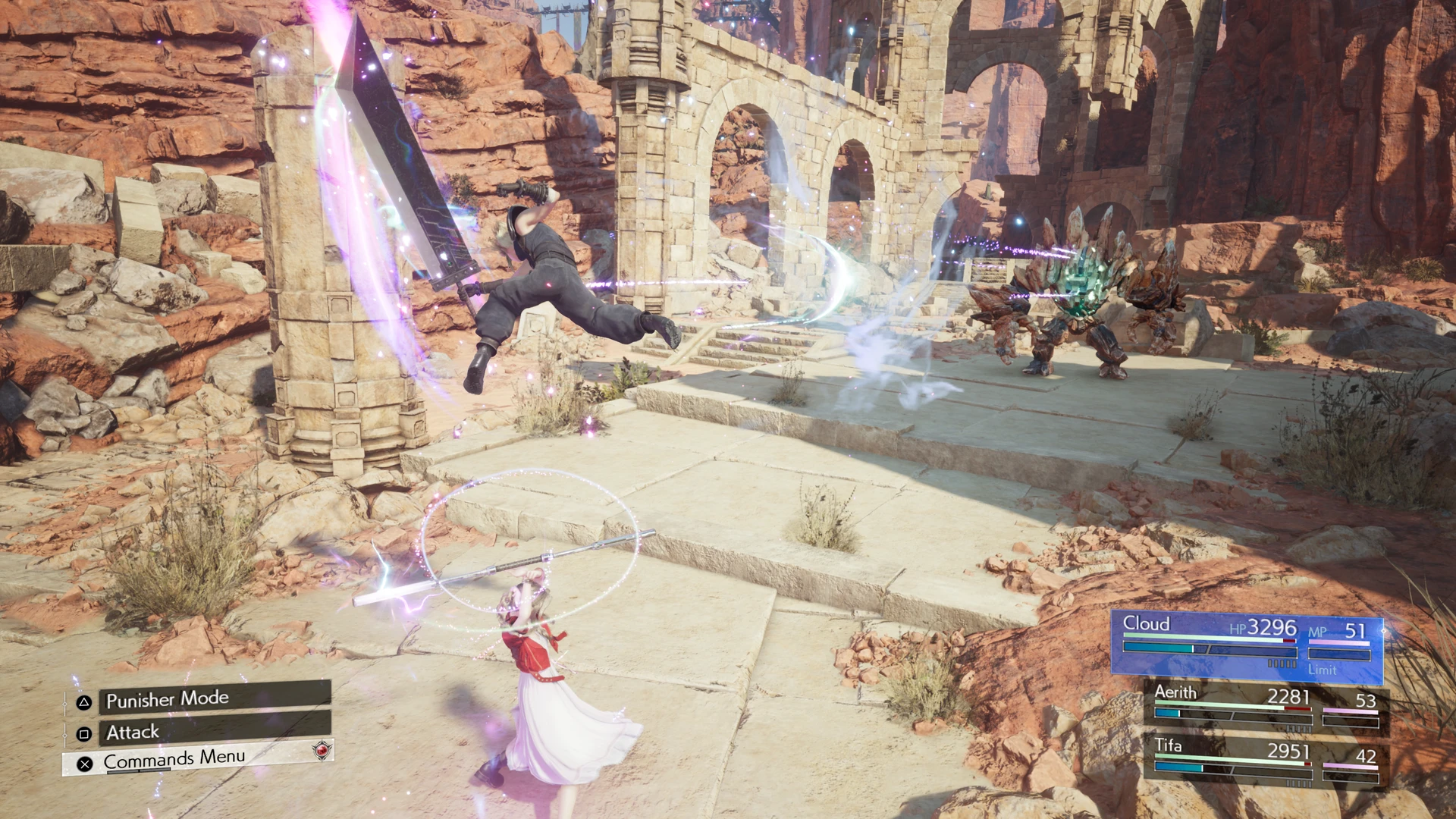
While there are multiple difficulty options to choose from, at the standard level, the challenge level could best be described as “suitable”. There is a good variety of enemies to face in-game, which favour certain Materia and character combinations, and if under-levelled you risk being pummeled. Although the Easy setting is straightforward and the Normal difficulty presents little additional challenge, I liked that they endeavoured to offer a Dynamic difficulty option which made every battle feel fair, but not excessively easy. I would recommend this difficulty setting.
With Chadley making a return early on in Final Fantasy VII Rebirth, the open-world environment is rife with opportunities for exploration and discovery, primarily through the typical affairs of activating scanning towers, discovering points of interest, hunting down unique monsters to defeat while adhering to specific criteria, hunting down shrines to summons in-world to improve summon Materia, and a solid number of side-quests varying in quality. However, the quality of these side activities varied considerably. Where the tasks were a bit more unique, they shone. For example, I enjoyed actively seeking piano scores in various towns and subsequently getting to play them. However, I quickly burnt out and gave up deviating from my path each time a new Lifespring location was pointed out to me, only for the same, three-button-press mini-game to unfold. Many of these activities were seemingly a way for Square Enix to justify the existence of their large open worlds and encourage players to explore what is, genuinely, one of their nicest-looking hand-crafted landscapes to date. But, in my opinion, they should have favoured creating a few dozen additional side quests a player would want to invest time into, rather than the same few activities on repeat which risks leading to burnout.
With Final Fantasy VII Rebirth being the game with the ‘Golden Saucer’, players can look forward to many activities and games enjoyable outside the RPG fundamentals. G-Bike, the 3D Brawler game (complete with retro-style visuals), Chocobo Racing and much more – all of which are fun and worth a couple of hours each. However, from the game’s first few hours, you’ll notice its emphasis on the new card game, Queen’s Blood, which is integrated into the story and becomes virtually inescapable, whether you enjoy it or not. Unfortunately, I am in the latter camp. Throughout Final Fantasy VII Rebirth, you can collect cards representative of different monsters found in-game. Each card provides both a numerical value representing how many points each card is worth, and for typically lower point cards, how they can influence spaces around it or provide some other gameplay boon. Play takes place on a 6×3 grid, based on the concept of ‘owning the lanes’, where players take turns placing cards on the grid (starting at their end), unlocking new spaces and at the end, receiving points based on who had the most points in each of the three lanes. I found it unengaging and with a lot of difficulty spikes, and if there wasn’t a need to play Queen’s Blood – I wouldn’t actively seek out the opportunity to play it. Of course, each to their own. It is a mini-game I would like to sit down and learn from scratch in the future when I have the time to learn it – which is how I came to sort of enjoy Final Fantasy XIV’s comparable Triple Triad game.
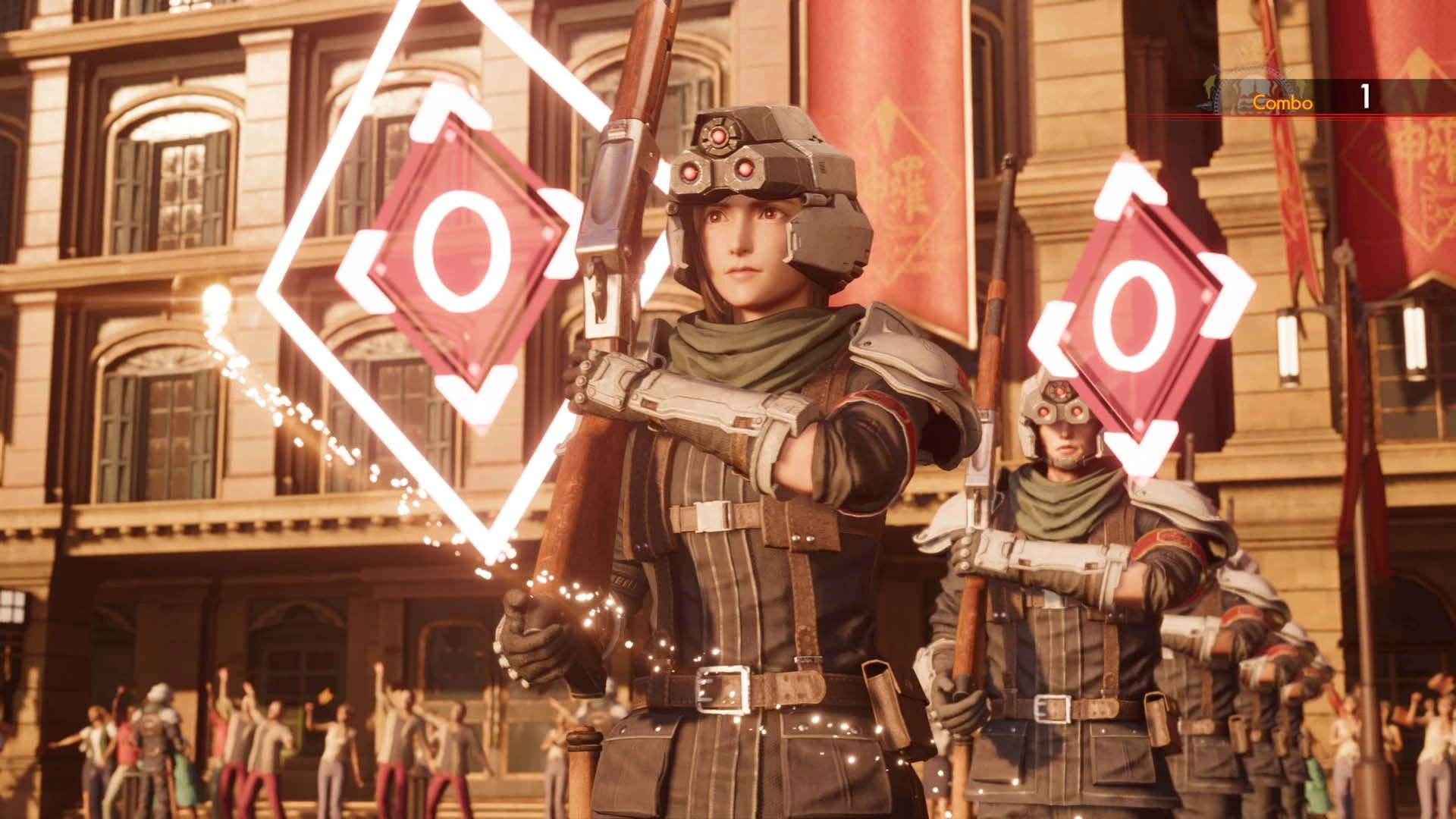
When Final Fantasy VII was released on the PlayStation 1, it was notable in that unlike virtually every other game on the platform, one CD was not enough to contain the entire game. This adventure instead sprawled across three CDs, requiring players to switch discs at specific points throughout the game, with a significant portion of its data dedicated to CGI cutscenes. In a move that could be seen as an unintentional homage to its predecessor, Final Fantasy VII Rebirth comes on two Blu-ray discs or as a massive single digital download. The digital download route requires a significant pre-load period, exceeding the time it takes to play through the entire first chapter. While taking up substantial storage space and a longer than usual install time, what players receive in return is easily one of the greatest-looking games on the PlayStation 5 to date. Flawless? There are some animation quirks, especially around the janky Chocobo navigation, which could benefit from significant refinement and scattered lighting issues. But otherwise, it’s exceptional for just how much is on offer. I also appreciate how they identified some of the nostalgic moments of its predecessor and honed in on them to receive extra special treatment, the parade scene being one such example which is a feast for the eyes.
This high quality extends to the audio department, with a strong line-up of musical tracks, including many catchy battle themes in addition to a remix of the iconic battle theme ‘Let the Battles Begin!‘. The homages to the original soundtrack are wonderful, while the newly introduced tracks all seamlessly integrate into the appropriate situation: combat, cutscene or exploration. With Final Fantasy VII Rebirth being fully voice-acted again, the original Remake cast was retained in addition to a range of new voice actors – including Paul Tinto as Cait Sith, Matthew Mercer as Vincent Valentine, J. Michael Tatum as Sid Highwind, Piper Reese as Elena among many others. All the voice actors deliver remarkable performances, doing justice to their characters in the English version. From playing a couple of chapters with the Japanese voiceovers, from what I have heard, the same can be said for those who enjoy the game’s long-running Japanese voice cast since Final Fantasy VII: Advent Children back in 2005.
There is a lot to Final Fantasy VII Rebirth, with many working components clearly lovingly integrated which gives the impression Square Enix wanted to both do their most iconic RPG justice in the modern-era quality wise, but also do it justice with the narrative through a mix of faithful nostalgia and fresh experiences for all gamers. Square Enix could have easily replicated the more limited, linear, and heavily tailored experience of Final Fantasy VII Remake. Honestly, I wouldn’t have faulted them for this, as Remake was a strong showing from start to finish. But from taking their first 3D open world and going above and beyond with giving it modern polish, even if I would argue they could have been more creative with the ‘open world’ activities, delivered a game that was not only narratively enriching and has me itching for Part III whenever it is released, but provided a strong exemplar for what RPGs could look like quality-wise in the coming decades.
Final Score for Final Fantasy VII Rebirth
This review was conducted on a digital download version of Final Fantasy VII Rebirth for the PlayStation 5. A review code was provided by Australian publisher, Bandai Namco Entertainment Australia to facilitate this review.
Final Fantasy VII Rebirth is available exclusively on the PlayStation 5 as a timed exclusive, via either a physical release or digitally via the PlayStation Store.
This is another example of why 2024 is shaping up to be an incredible year for RPGs, right off the back of SEGA’s offering of Like a Dragon: Infinite Wealth and ATLUS’ Persona 3 Reload. Check out my reviews for both of these games via the links above!

