

Few science fiction franchises have travelled as long as Dune. What began as a single Frank Herbert novel has grown into a sprawling multimedia universe. It spans sequels and prequels penned by his son Brian Herbert and Kevin J. Anderson, big-screen adaptations, HBO’s Dune: Prophecy on the small screen, and even tabletop favourites like Dune: Imperium. Yet across all those lenses, most have asked us to read about, watch, or strategise over Arrakis rather than actually live on it. That is the gap Dune: Awakening sets out to fill. Funcom’s open-world survival RPG launched on PC in June 2025 as a game built around shared servers and player rivalries. This month, the game has arrived on PlayStation 5 and Xbox Series X|S, bringing a dedicated single-player mode for those of us who prefer to go it alone. But does the trek hold up on a controller, and is Arrakis worth calling home when no one else is around? Read on to find out!
Rather than retelling the events of the novels, Dune: Awakening is essentially Dune’s What If…? series. In this timeline, Lady Jessica followed the Bene Gesserit’s wishes and bore a daughter, so Paul Atreides never existed. Duke Leto is alive and well, House Atreides and House Harkonnen are waging a drawn-out shadow war across the sands, and the Fremen appear to have vanished altogether. Your character arrives on Arrakis in chains, and the journey ends in a crash landing rather than a docking bay. Before long, an enigmatic figure named Zantara steps in to show you the ropes and set you on the trail of the missing Fremen. Purists may bristle at a Dune without its most famous son, but it’s an intriguing hook, and the writing clearly respects the source material… though that respect cuts both ways. The script speaks fluent Herbert and rarely pauses to translate, so terminology, factions and political manoeuvring arrive thick and fast. Longtime fans will feel right at home, while newcomers may find themselves reaching for a search engine more than once. The story also takes a back seat to the business of staying alive, nudging you from one outpost to the next rather than demanding your full attention. That suits the genre, even if it takes a while to find its feet.
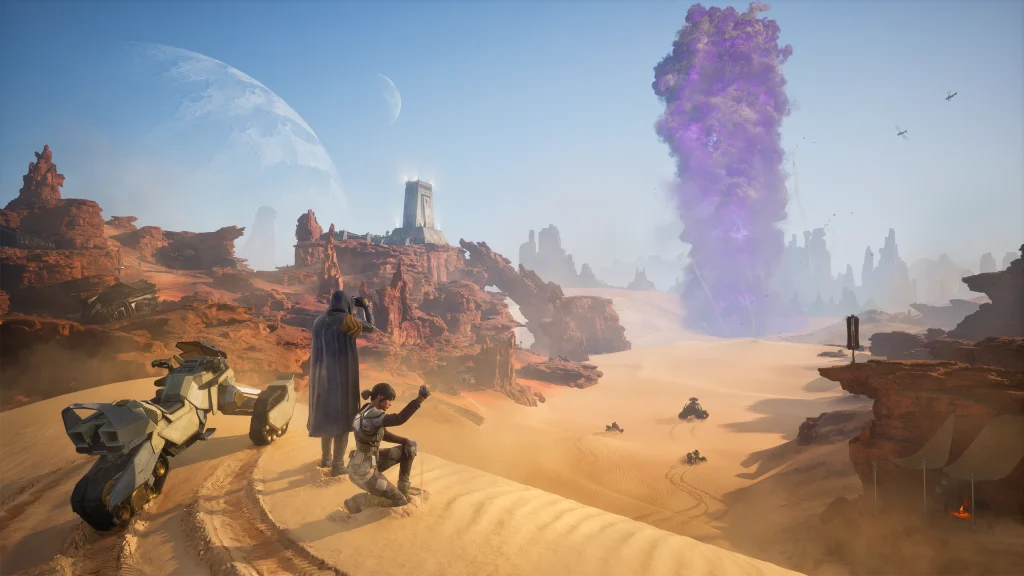
Visually, Arrakis is a triumph. Funcom has taken a setting that could easily have been an endless sea of beige and found genuine variety in it. Jagged cliffs offer precious slivers of shade, dunes take on an entirely different character as the light shifts, and sandstorms swallow the horizon whole. More than once I stopped to admire the view, only for my hydration meter to remind me that sightseeing is a luxury on Arrakis. Denis Villeneuve’s influence is easy to spot, from hulking, slab-like structures to utilitarian stillsuits, and it helps the game sit comfortably alongside the franchise’s modern cinematic identity. Cutscenes are staged with real care, too. Survival games aren’t usually where I go looking for eye candy, but this one is a notable exception, and it really made me wish the PlayStation 5 had screenshot tools that could rival the PC.
The PlayStation 5 version offers both a performance mode targeting 60fps and a Quality mode that caps at 30fps in exchange for extra visual detail. I spent nearly all of my time in the former and would recommend others do the same. It held steady even with vast stretches of desert on screen, and pop-in was rarely noticeable. Beyond the odd texture taking a moment to catch up when stepping from an interior back into the sunlight, nothing pulled me out of the experience.
The soundtrack knows when to step aside and let the desert do the talking. Much of your time is spent with little more than the howl of the wind and the hiss of shifting sand for company, which does wonders for that sense of isolation, particularly when playing solo. When the score does swell, usually during a major story beat or a narrow escape, it lands with real weight. The voice cast are equally impressive, delivering a dense, terminology-heavy script with enough conviction that it rarely sounds like anyone is reading from the novel’s appendix. On PlayStation 5, the DualSense deserves a mention. Its rumble intensifies as a sandworm closes in, and before long I was reading the vibrations in my palms almost as closely as the warning on screen.
At its heart, Dune: Awakening is a game about respecting your surroundings, and it truly shines in its survival systems. Survival meters can feel interchangeable from one game to the next, but here each has a reason to exist that any Dune fan could explain. Water is your lifeline, direct sunlight steadily wears you down, sandstorms punish anyone caught without shelter, and every stretch of open sand carries the risk of attracting a worm. Crossing those stretches reminded me of swimming at an unpatrolled beach: perfectly doable, but you’d be foolish not to keep one eye on the water. The opening hours are slow and, by default, rather punishing. The grim necessity of draining fallen enemies for their water is very much in keeping with Herbert’s world. Stick with it, though, and something falls into place. Arrakis never gets any kinder, but you get smarter, and that growing confidence is what makes the loop genuinely rewarding.
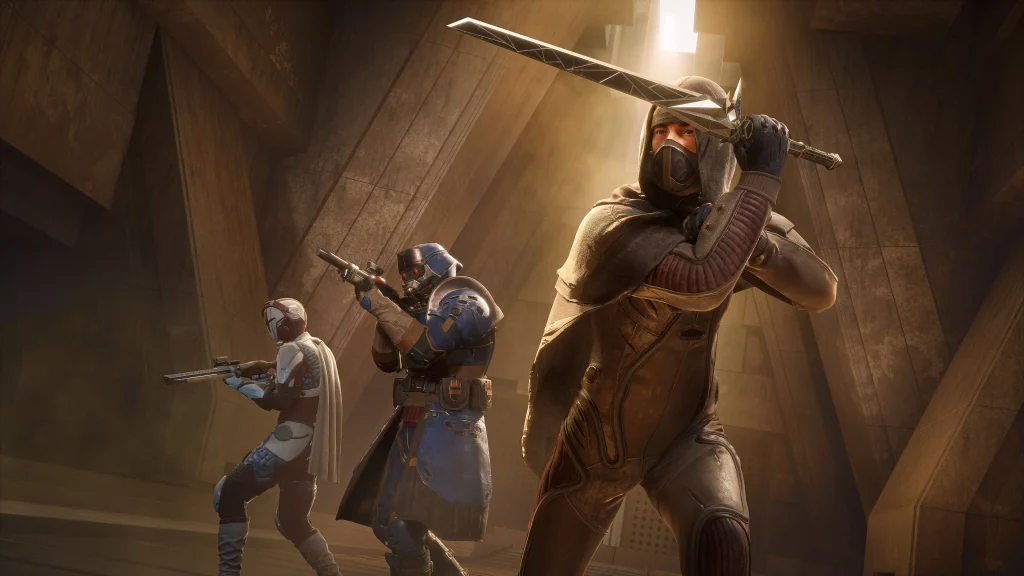
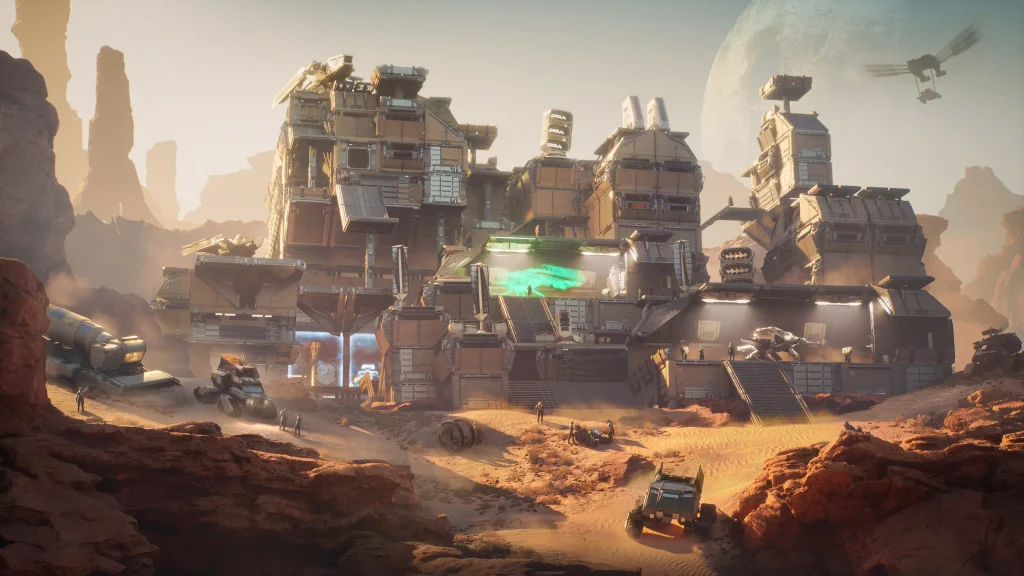
Beyond simply staying alive, there’s plenty of depth to dig into. Base building is a particular joy, and much like my time with Town to City earlier this year, I spent far longer fussing over layouts than survival strictly required. The crafting trees are extensive, though later tiers lean on increasingly specific materials, and resource runs can start to blur together. Piecing together your first vehicle is a project in itself, but the first ride across sand you once sprinted over in a panic is a genuine highlight. Progression is just as broad, with class paths such as the Swordmaster and Bene Gesserit, and skill trees wide enough to support very different builds. Genre newcomers may feel a little overwhelmed by how many systems interlock. Anyone willing to invest, though, could easily lose a good chunk of spring to Arrakis, with plenty of reason to return for a second run with a different build.
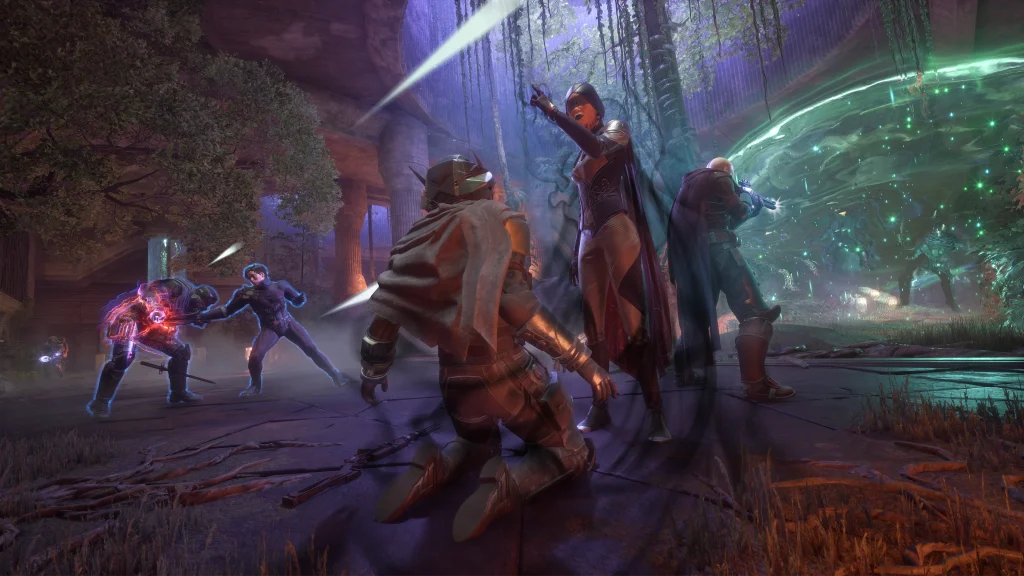
If Arrakis is the main attraction, combat is the supporting actor who still hasn’t mastered their lines. It’s adequate, and the Dune backstory provides a clear justification for close-quarters fighting: since shielded enemies ignore fast projectiles, you’re forced into hand-to-hand combat. The knife fights make up the more exciting part of the action, whereas the shooting feels rather ordinary. Enemy behaviour is simple and, once you’ve taken out a few camps, the encounters fall into a predictable routine. Fortunately, Funcom has improved the game since its release. A wider parry window means that melee encounters don’t seem as much like a matter of luck, and the available abilities bring some much-needed variety. Now, I’m not saying it’s bad at all, but it rarely creates the same level of tension as spotting wormsign in the distance.
Survival games tend to be menu-heavy affairs, so I was keen to see how this one would handle it. The answer is mostly positive. Movement, combat and weapon selection feel natural, and it’s obvious that effort has gone into making the moment-to-moment play feel at home on a controller. The menus are a little more mixed. Many are easy enough to navigate, but every so often a screen feels like it wants you to use a mouse, and building can get fiddly when you’re trying to snap a piece into an exact spot. Quest design has its own niggles, too. Some objectives are vaguer than they ought to be, and the waypoint can lead you to the right place at entirely the wrong elevation. The map also gets crowded quickly when several points of interest sit close together. None of this spoiled my time on Arrakis, but it’s worth knowing going in.
For those who tried the game on PC last year, there’s a lot that’s new. The headline addition is the single-player mode (which has also made its way to PC), and it’s fully its own thing. The faction politics, the conflict between the Atreides and the Harkonnen and the Landsraad all continue in the background, and the footholds you’ve earned in the Deep Desert remain in place. The mode comes with a comprehensive set of sliders, dealing with everything from harvest rates and XP gain to combat difficulty and death penalties, so you can choose exactly how difficult the planet becomes to push back against. Book One of the story is now finished, the base upkeep tax has been dropped, and the endgame has been redesigned around PvE, with PvP now completely optional. Together with the new augmentation and specialisation systems and approximately a year’s worth of patches, console players are now able to start playing on Arrakis with the benefit of a lot of hindsight.

Well, after all those decades of development on Arrakis, is it really worth finally considering the planet as your home? In most respects, the answer is yes. On the console, the experience fares well, and indeed Arrakis reaches its peak when there’s no one else present. The world is breathtaking, the sound design conveys its loneliness effectively, and the survival loop turns each outing into a brief, tense risk. The available single-player mode enhances all these aspects, so you’ll never have to share the screen. There are, however, several flaws: the combat doesn’t quite keep up, the menus and waypoints could do with some refinement, and the script assumes that you’ve read the material. Nevertheless, this is a worthwhile addition to the franchise for Dune fans and for those interested in survival games and willing to learn a new set of terms… or start a fresh multimedia binge.
Final Score for Dune: Awakening
This review was based on the PlayStation 5 version of Dune: Awakening, with all playtesting done on a PlayStation 5 Pro retail console. A review code was provided by Bandai Namco Entertainment Australia to facilitate this review.
Dune: Awakening is now available on PlayStation 5 and Xbox Series X|S, with the PC version receiving an update to offer many features of the console release.

