
Since the early 2000s, the Disgaea series from Nippon Ichi Software has offered memorable tactical RPG experiences, thanks to its breaking of the fourth wall, its abundance of memes, and its cast of unforgettable characters – factors which have secured it a loyal fan base even as the company has made an effort to adapt to current design standards. During the era of the PlayStation Portable, the developer and publisher expanded the franchise into other genres popular at the time, releasing a visual novel as well as a two-part, “Kaizo”-hard platformer/hack-and-slash game featuring its Prinny mascots. Even though it had appeared that the series had come to an end, Nippon Ichi Software is now considering making spin-offs once again: together with the upcoming party board game Prinny Party: Going Overboard!, it has just launched a “1 vs 1000” hack-and-slash game called Disgaea Mayhem. This new title immediately recalls Omega Force’s Warriors series, which has long set the genre’s standard. It raises the question of whether a new entry can truly bring its own RPG characteristics and design style to such a niche, polished and competitive field. To find out how well they do, keep reading.
The concept on which Disgaea Mayhem is based is just as mad as you’d normally expect after twenty years in the series, and let me make that clear as a compliment before going any further. You take on the role of N.A., a mercenary whose name stands for Not Applicable, and he has been engaged by Tichelle, the new Overlord of the Netherworld called Super Duper. Margraf, her father, has recently died, and his greatest accomplishment, a dessert called the Pristine Gleam Flan, has been stolen by six of his former vassals, who have at the same time decided to rebel against his daughter. N.A.’s job is to find these six men and retrieve the flan. That is the main plot and also forms the foundation of the side stories. The humour appears in sudden bursts, particularly at the start. Still, the comedic structure soon becomes fixed and by the halfway point I could tell how a scene would resolve before it had finished setting itself up; the flan obsession only ever has the one volume setting, N.A. is only ever permitted to respond to it, and neither of them surprises the other twice.
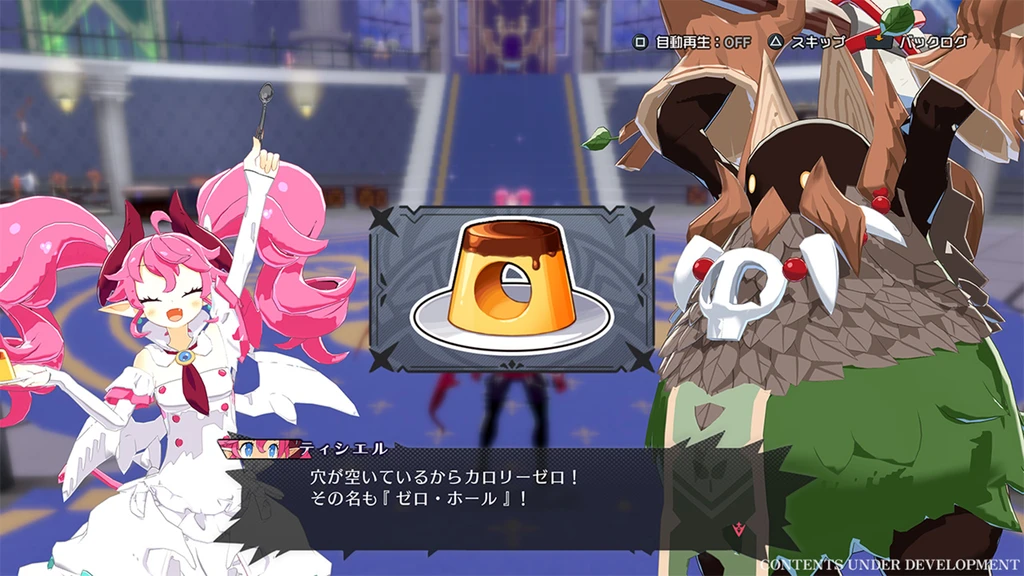
What does work – and in fact works better than I expected – is the pair themselves; they are the usual kind of odd couple found in the Disgaea series and get along well together. This is partly because the story doesn’t interfere; the cutscenes are few, most of the dialogue plays out on static conversation screens rather than in animated scenes, and there is almost no time between missions. The credits start rolling around the six-hour mark, and even though I would normally see that as a drawback, I think the writing is fully conscious of the fact that it has nothing more to say.
In terms of structure, the campaign runs to eight chapters, and the episodes inside them are brief enough that two or three minutes is a normal length for one. The same pattern is followed almost to the letter: you enter a map, fight a set number of enemies, see a new section of the arena appear, carry out this process a few times, and then proceed to the marker which brings on the stage boss. Even though some of the maps have completely different layouts, the game very rarely asks you to interact with them, so their geometry amounts to little more than the ground you cover between one fight and the next. This drawback is increased by level reuse: you meet every member of the enemy roster within the first couple of hours and, from that point on, your progress is made through palette swaps, the more difficult versions having new colours but the same move sets, while most of the stage bosses are enlarged versions of an enemy you’ve already fought.
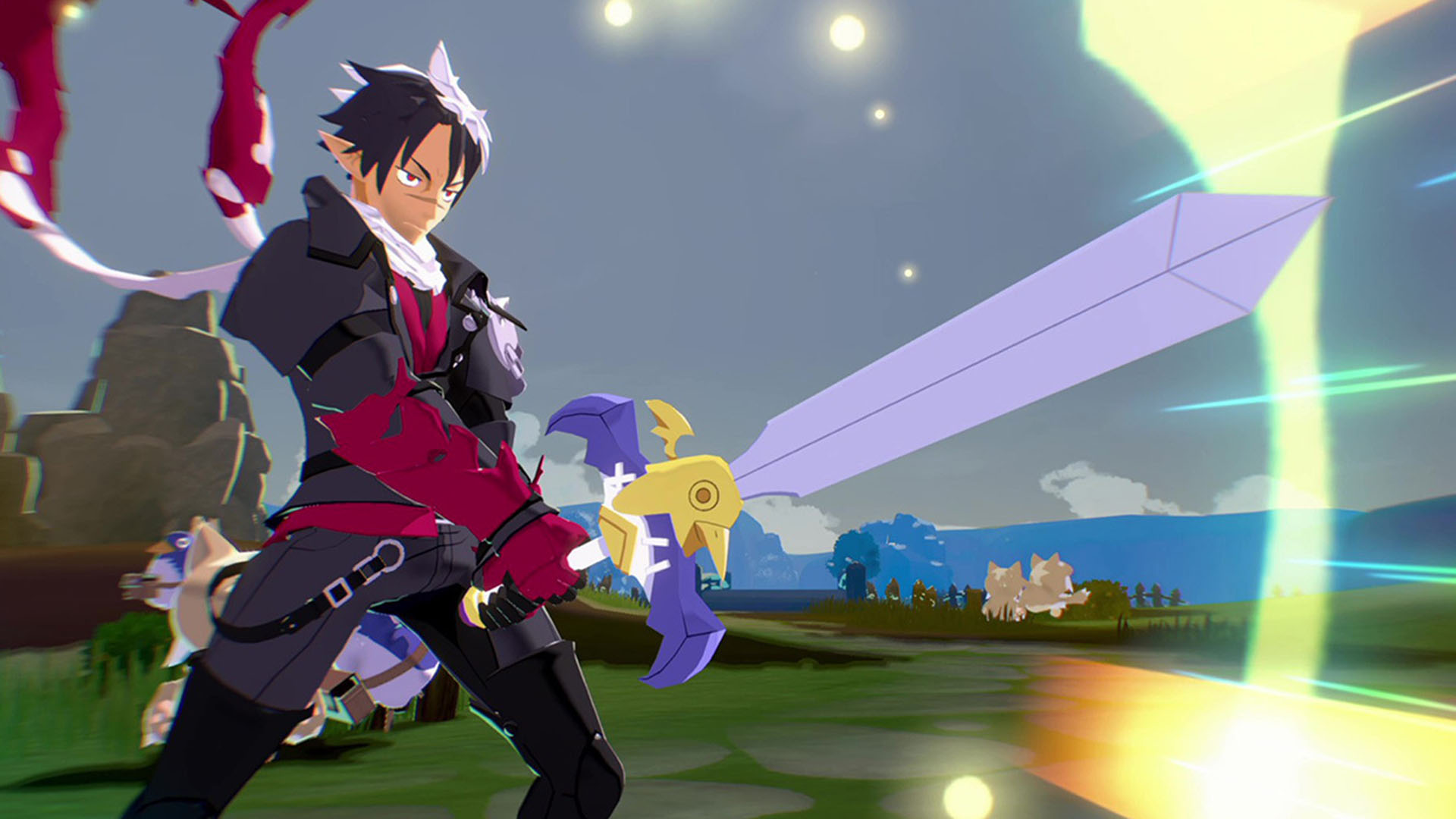
The story bosses are in fact the only real exception and include the game’s most advanced attack patterns, which makes their outcome all the more disappointing. In terms of visuals, there are numerous contrasts: the character models are very good, the monster designs have all the personality that series fans can expect, and the colour scheme is as bright and cheerful as ever, yet the environments are boring and fall well short of what one would reasonably expect from a 2026 release. The skill and Ultimate animations are by far the standout features, flashy and well choreographed, with their own special effects when a Magichange is involved. The feature I missed most, however, was the lack of options: no Geo Panels, no special victory conditions, nothing to encourage you to look around the battlefield. At least the menus are quick, and that’s more than you might imagine given how often you have to go into and out of Item World runs.
Regarding the audio, the voice acting is the most impressive element of the entire presentation, with the cast doing a great deal of the work for a script that lacks substance. The music, by contrast, is very different from what it was at the series’ height. Even though nothing actually annoyed me and nothing stayed with me, my real problem is the impact feedback, since the sound effects don’t match the action on screen. A blow causing four million points of damage sounds the same as one causing four hundred, and in a series whose entire identity rests on increasing the intensity, it’s odd not to deal with that aspect. If a number is taking up half the screen, I should hear it hit.
As far as gameplay goes, Disgaea Mayhem works adequately, and this is the area that causes the least concern. N.A. has both light and heavy attacks that can be linked together into combo sequences, along with the ability to jump, dash, block, and dodge, the latter featuring ample invincibility frames that can be used more than once. The game provides seven types of weapon, or eight if monster weapons are taken into account, each of which supports up to four skills that function on cooldowns instead of drawing from resource pools, thus keeping the action brisk. The weapons are all genuinely different; the fists in particular give up reach for speed, and their combo strings kept me moving in a way the heavier options never did – which is roughly where I have ended up in the mainline games as well.
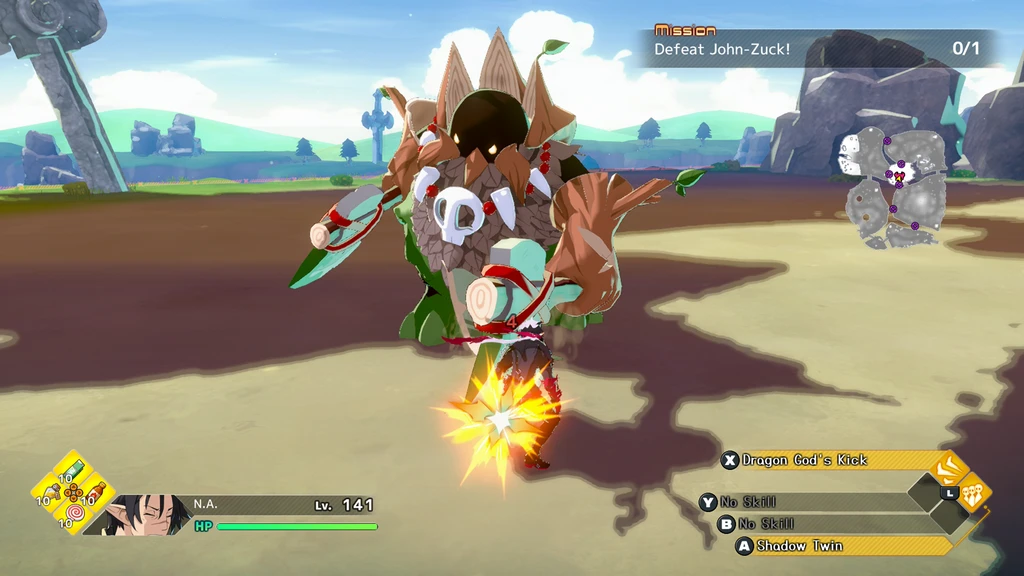
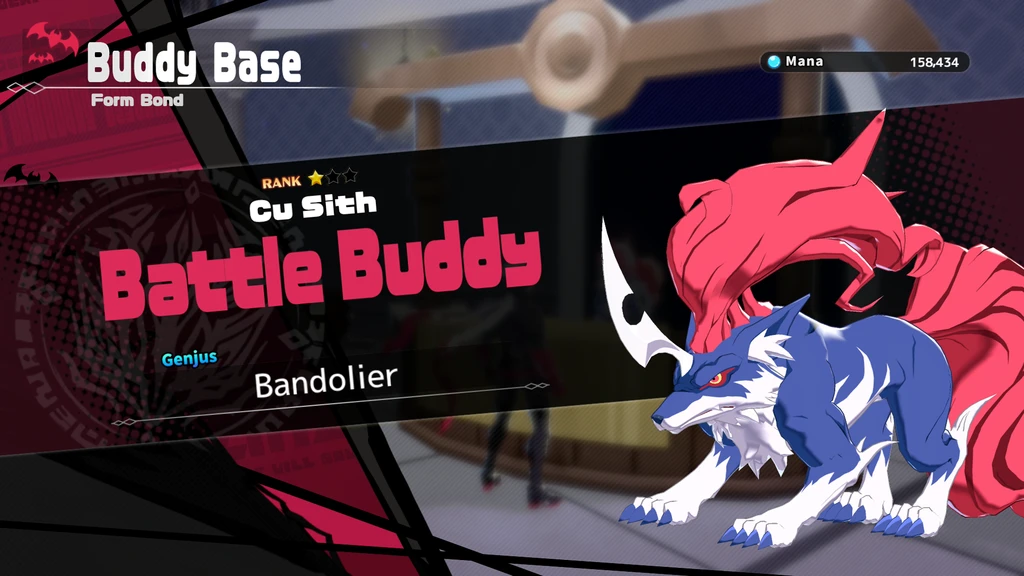
A counter feature enables players to cancel incoming damage and then retaliate by activating a skill at the exact moment the enemy carries out an attack, so effectively bringing over the turn-based counter mechanism from the main series, although I seldom found it necessary. Battle Buddies, monsters obtained after battles, travel with the player but cannot be directly controlled or healed, and their AI is only moderately good. Their main role is Magichange, which lets them transform into temporary weapons with their own move sets. Despite surface-level similarities, this is not a true Warriors (Musou) game. The clearest tell is the headcount: you are rarely dealing with more than a dozen enemies at a time, well short of what the genre’s name promises. Nothing on these maps is contested, either — there is no ground to hold, no second front pulling at your attention, no reason to be anywhere other than wherever the next group spawns. What is left is closer to a single-arena brawler, an acceptable approach, but it does lead people to compare it to a genre it isn’t fully equipped for.
Separate from the battlefield, the Disgaea furniture has also made the trip there, and it is in this area that the game is most clearly itself. The Dark Chocolate Assembly once again allows you to get bills passed through persuasion, bribery, or if neither of those works, by giving them a good beating; Chara World has been reimagined as a tabletop-style track you advance along while your monsters handle the fighting, paying out permanent stat boosts and Evilities; Reincarnation is available for the long term; and the Cheat Shop enables you to adjust the difficulty and reward multipliers directly. Above all else, however, the Item World remains well suited for this genre, as it still makes use of the truly randomised nature of game world building. Each piece of equipment comes with its own dungeon consisting of waves that increase in scale, the number of floors being decided by rarity and a choice between three bonuses being offered between each, and since improving your gear in a single run also raises your own level, it is extremely addictive. It is also, sadly, the feature that ruins the whole game.
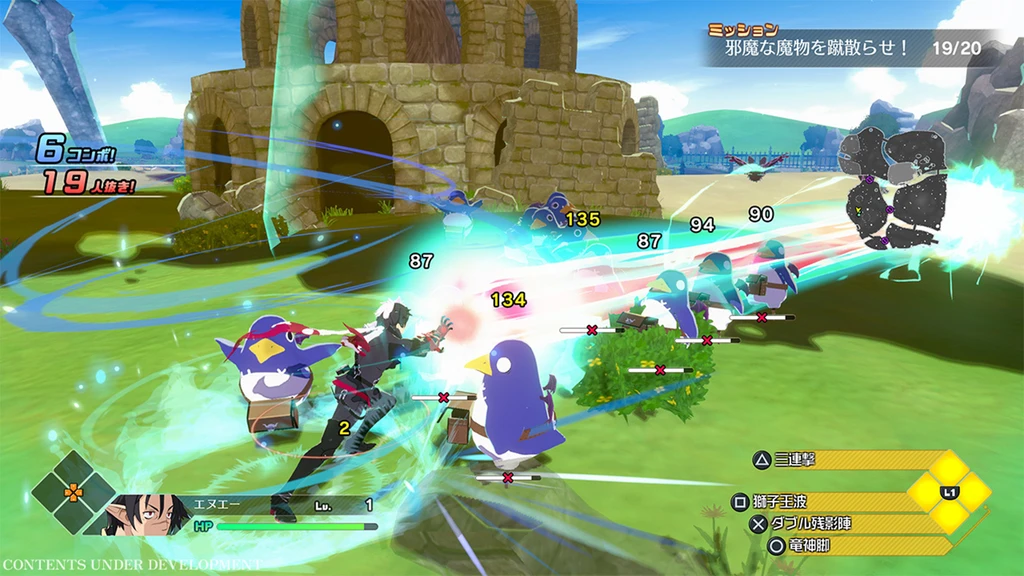
The greatest blow is felt when you decide to base the entire game around a single playable character. What I noticed first wasn’t the combat but the quiet afterwards. Build diversity is very limited, and there’s no personal path to break the systems in any meaningful way different from what other players do, so there is considerably less to discuss than is typical for a Disgaea game. That follows from a constraint rather than a shortage of ideas. Since N.A. has to be capable of doing everything, he is never given any particular distinction in any one area, which means that progression consists solely in the numbers increasing. The main series avoids this by making the grinding process rewarding in terms of mechanics as well as numbers, since it allows you to unlock various classes, weapon specialisations, exclusive passives and completely new ways of approaching a battle, and the satisfaction comes not only from watching your forces defeat enemies but also from putting together your team.
The post-game reinforces this point rather than addressing it. To unlock it, you have to make an expensive and difficult Assembly vote, and what lies on the other side is a short sequence of missions set at approximately 200, 400 and 600 levels respectively, with nothing new behind those barriers other than the same content at a higher entry cost. Especially without the promise of new playable characters to control… there wasn’t much keeping me playing after the main campaign.
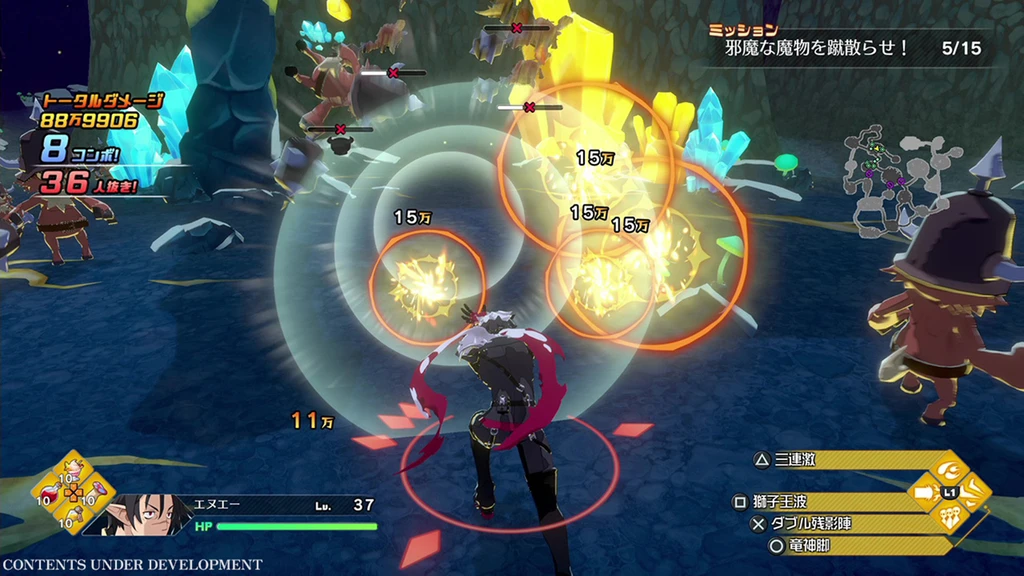
So, returning to where we started: how well does Disgaea Mayhem bring its own RPG quirks and design language into the hack’n’slash genre? The quirks, I am pleased to say, survive the journey almost entirely intact. The Item World, the Dark Chocolate Assembly, Chara World, Magichange and Reincarnation all translate to real-time combat with far less friction than I anticipated, and the moment-to-moment action is responsive, varied across its weapon types and genuinely enjoyable in its own right. What never quite arrives is the design language, because the objective-driven battlefield management is simply absent here, and without it the RPG systems have nothing left to push against and ultimately provide minimal challenge instead. The result is a game I enjoyed, while wishing it were larger, deeper, and more confident in what it wants to be. Unlike the PSP-era experiments that preceded it, Disgaea Mayhem reads like a studio testing whether an idea can hold weight rather than proving it does… and in its current form, I am not sure it does, but is a solid experience nevertheless. For now, though, unless you are already deep enough into the fanbase to enjoy watching a number climb for its own sake, this may be a game worth waiting to turn up on a sale.
Final Score for Disgaea Mayhem
This review was based on the PlayStation 5 version of Disgaea Mayhem, with a review code provided by Nippon Ichi Software America to facilitate this review.
Disgaea Mayhem is now available to purchase on PC, PlayStation 5, Nintendo Switch and Nintendo Switch 2.

