
With the Assassin’s Creed franchise approaching its 18th anniversary, and for a considerable chunk of its lifecycle, being an annual release on behalf of Ubisoft and the growing number of studios taking a crack at the series, the series has never felt like it has overstayed its welcome. Despite some qualms that players have had with the modern instalments, some justified and arguably some considerably less so, they have been able to give gamers hundreds of hours of memorable gameplay from a variety of historical locations – from its origins revolving around Altaïr Ibn-LaʼAhad in the era of the Third Crusade, the trio of games around Ezio Auditore da Firenze, and a variety of other locales from the American and French Revolutions to the age of Vikings. Offering a locale and time very different from those preceding it, in 2025 Ubisoft has chosen to set Assassin’s Creed Shadows in the Sengoku period of Japan. After delays to improve the game’s quality, does this latest instalment in Ubisoft’s flagship action-adventure franchise serve as another memorable instalment, or should it perhaps have been left on the cutting room floor? Read on to find out!
The narrative of Assassin’s Creed Shadows introduces players to a compelling dual-protagonist setup amidst the chaos and political instability of Japan’s Sengoku period. On one side is Yasuke, a physically imposing samurai of foreign descent who stands out starkly in a landscape traditionally dominated by Japanese-born warriors. Yasuke’s arc is one driven largely by his honour and loyalty. In a refreshing contrast, players also control Naoe, a shinobi whose journey begins tragically with the annihilation of her clan. The narratives of these two intertwine as they go up against a new conspiracy. As the storyline progresses through various regions, both Yasuke and Naoe gradually uncover deeper layers of conspiracy, each character bringing a distinct perspective and skillset to the narrative.
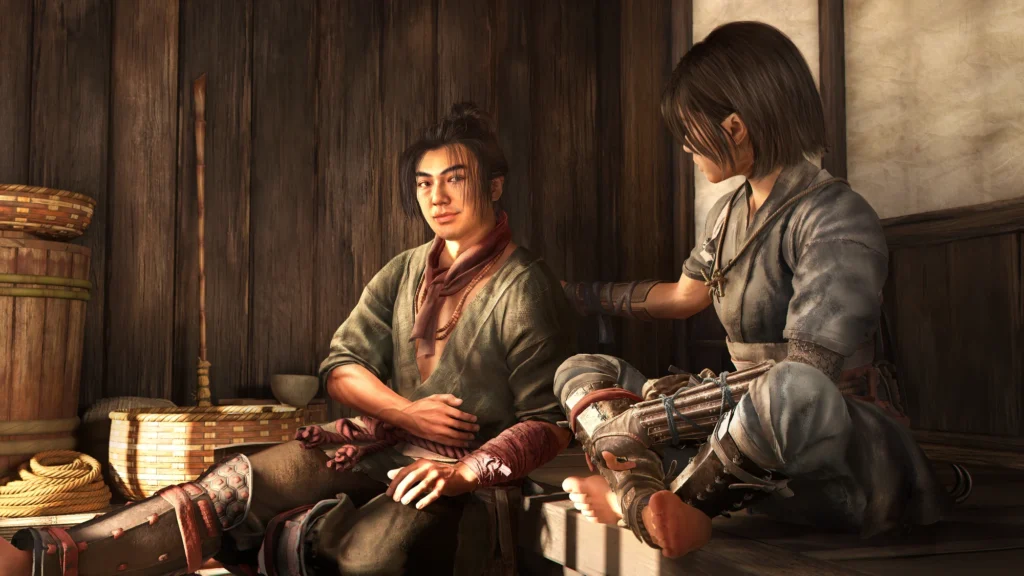
Assassin’s Creed Shadows succeeds admirably in using historical figures and events as a powerful backdrop to craft its intrigue. Appearances by renowned historical figures are tastefully handled so they seamlessly integrate into the tale rather than being forced upon the story for the sake of being so. Furthermore, the ongoing narrative around the Shinbakufu proves intriguing enough to propel players forward in the story, usually keeping players on the edge of what’s to happen next, albeit not fully taking away from what else there is in the world to explore. The narrative effectively explores significant themes such as honour, revenge, and societal divisions, managing to infuse traditional samurai and shinobi tropes with genuine emotional resonance, particularly during pivotal character moments. On the other hand, the tale does occasionally draw a bit too much from cliches or otherwise feel a bit too padded out for a game that already has a solid playtime.
One of the main issues I have with not just Assassin’s Creed Shadows but the overarching Assassin’s Creed narrative is the ongoing plot around Templars and Assassins in the present day. It is a solid basis and allows the creative team to justify providing players with new worlds to explore with each release – but it feels more than a little drawn out now, and it would be nice to see almost two decades of following the strands of it conclude… or at least hit a major juncture worthy of a few hours of gameplay at the very least. There is a point where teasing out small plot points becomes annoying, and for me, that occurred a few releases back.
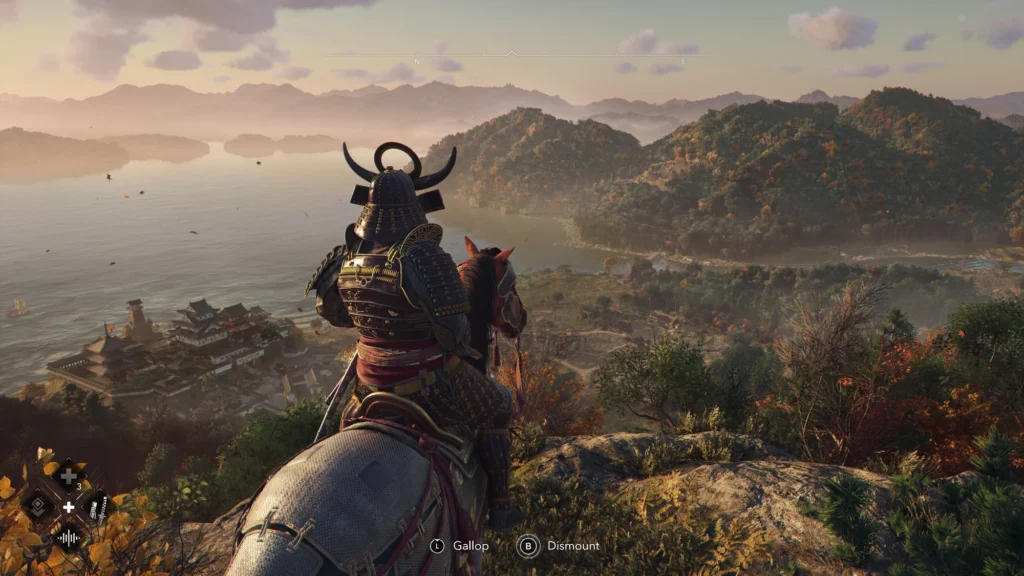
Assassin’s Creed Shadows is Ubisoft’s first entry in the franchise built exclusively for current-generation platforms, and the leap in technical fidelity is immediately noticeable. From the sprawling, meticulously crafted landscapes that capture the dynamic beauty of feudal Japan, to the impressively detailed character models and smooth animations, the game feels like the first substantial graphical leap for the series on this generation of hardware. The decision to abandon older consoles has ultimately paid dividends, particularly in rendering stunning environmental transitions that vividly depict Japan’s seasons, whether it’s cherry blossoms gracefully drifting in the spring wind or heavy snowfall dynamically altering stealth gameplay opportunities in winter. Ubisoft has also refined the User Interface in Assassin’s Creed Shadows, favouring minimalism, refinement and a little more exploration over attempting to do everything that previously could lead to a cluttered experience.
Audio design is another strong point of Assassin’s Creed Shadows, offering an atmospheric, orchestral score, coupled with ambient effects that bring its feudal Japanese setting vividly to life. The musical composition thoughtfully blends traditional Japanese instruments and modern music practices – feeling appropriate for the period but also being versatile when used in almost any scenario. Voice acting is also more than serviceable, with English and Japanese included on-disc and a further five languages available as an extra download. While the authentic route would be to go with the Japanese dub, those who opt to play the game with English audio, can enjoy a culturally diverse cast that shows thought went into who voiced whom. This includes Masumi Tsunoda and Tongayi Chirisa doing the lead roles of Naoe and Yasuke, justice.
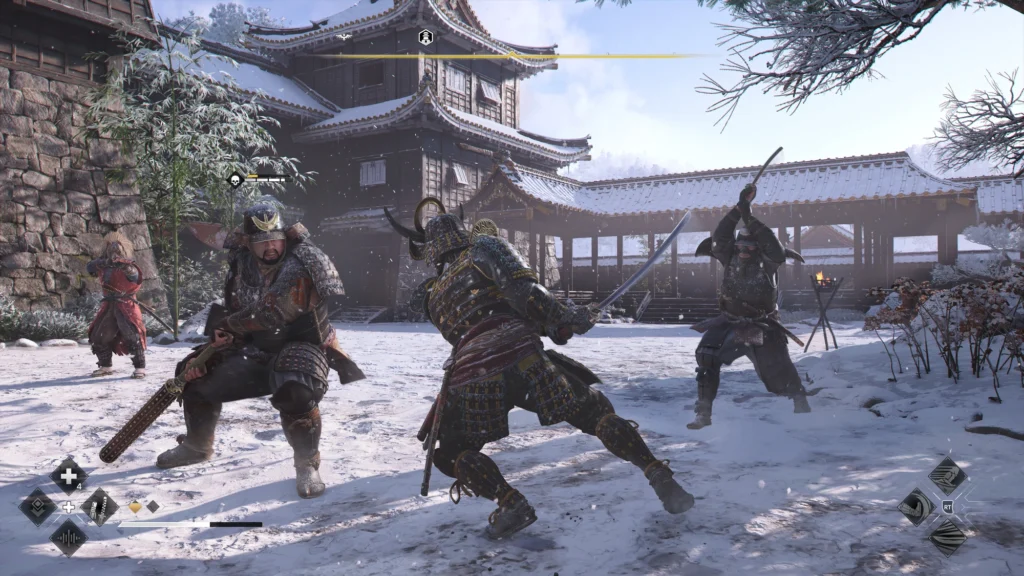
Combat in Assassin’s Creed Shadows presents two distinctly different playstyles with its dual-protagonist system, though occasionally this results in uneven pacing depending on your preferred style. Yasuke offers a brute-force approach, utilising heavy weaponry such as katanas, naginatas, and even ranged weapons like the bow and Teppo gun, which provide satisfying impact and powerful finishing moves at the sacrifice of mobility. Alternatively, Naoe’s nimble and stealth-oriented combat feels more fluid, relying on rapid manoeuvres, less powerful weapons, and shinobi tools like smoke bombs and shuriken to dismantle enemy defences more discreetly. The diversity in gameplay between the two characters ensures encounters rarely grow stale, even if Yasuke’s direct approach occasionally feels overly simplistic or repetitive against less challenging foes. Enemy AI generally provides a solid challenge, particularly in how armoured opponents require tactical adaptation, though there are occasional inconsistencies where opponents inexplicably lose sight of you or fail to coordinate effectively.
While one of Ubisoft’s 2024 games, Star Wars Outlaws, was critiqued around its use of stealth mechanics, I think they struck a really good balance with such mechanics. Environmental lighting and shadows realistically impact your visibility, allowing for creative stealth opportunities such as extinguishing lanterns to remain hidden or exploiting darkness during nighttime infiltrations. The return of double assassinations and strategic use of the grappling hook enhances infiltration sequences, giving the player the freedom to approach scenarios from various angles. Granted, sometimes these mechanics are undermined by strict and even arguably unfair detection rules. Castle sieges stand out as particularly rewarding set-pieces, balancing large-scale battles with meticulously designed infiltration routes, although some fortresses feel overly familiar in their design towards the game’s later hours.
Exploring the landscapes of Assassin’s Creed Shadows is rewarding, thanks to a beautifully recreated Japan that strongly encourages organic exploration rather than rigid icon-chasing. Ubisoft has wisely toned down the overwhelming amount of map clutter typical of previous entries, instead encouraging players to seek out points of interest naturally through scouting, key points raised in the discussions or discovering environmental clues. However, the reduced guidance occasionally translates to frustratingly vague mission objectives, or taking a wrong turn in the dark and spending minutes trying to work one’s way back to the path.
Character progression in Shadows is a pretty standard fare, but serviceable overall. Both protagonists possess distinct skill trees that allow significant gameplay customisation, whether enhancing Yasuke’s combat efficiency or refining Naoe’s stealth capabilities. While unlocking advanced skills such as multi-assassinations or devastating counter-attacks delivers genuine satisfaction, the grind required to obtain enough Knowledge Points to unlock them can feel excessive, particularly if you prefer progressing primarily through main story content. Gear customisation is extensive, encouraging players to experiment with legendary weapons and armour pieces that grant impactful bonuses.
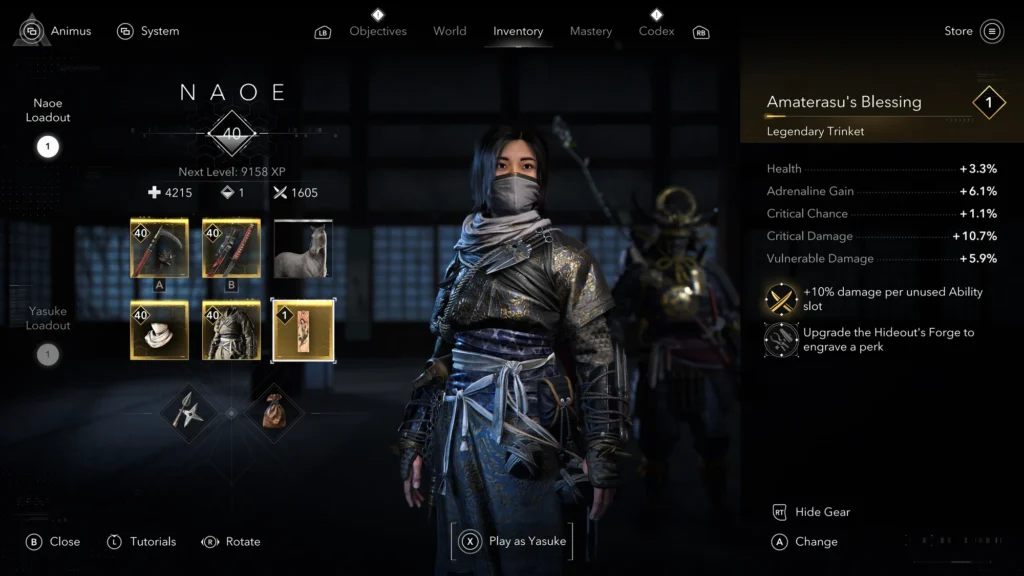
Like every Assassin’s Creed game since the franchise launched, there is an abundance of side activities, mini-games and collectable hunts in Assassin’s Creed Shadows – some better than others. Mini-activities such as horseback archery, poetry writing, and tea ceremonies are thoughtfully designed and culturally immersive diversions, but some feel shallow or overly reliant on quick-time events. The settlement-building mechanic returns in an evolved form, letting you meaningfully customise your hideout by using resources gained during exploration; however, while visually rewarding, this system rarely substantially impacts gameplay. Despite mixed-side content, replayability remains high due to the varied approaches allowed in missions, including optional infiltration routes, alternate character-specific tactics, and hidden endgame bosses or fortresses.
While I feel that Assassin’s Creed Shadows is still confined a bit too much to the systems and gameplay style that has defined the Assassin’s Creed franchise for more than two decades now, I feel that this instalment is a step in the right direction both aesthetically and practically. Its Sengoku-era setting injects some much-needed freshness into the landscape players explore, and the dual-protagonist approach, while not unique to Shadows, is the best implemented due to how they define the gameplay styles of each character. While some mechanics still rely a little too heavily on long-standing formulas and the modern-day narrative continues to feel like dead weight, there’s enough ambition here to suggest that Ubisoft is listening and slowly evolving the series. Assassin’s Creed Shadows might not revolutionise the franchise, but it reinvigorates it just enough to keep longtime fans invested—and leaves the door open for something even bolder next time.
Final Score for Assassin’s Creed Shadows
This review was conducted on a digital PlayStation 5 copy of Assassin’s Creed Shadows, with a code provided by Ubisoft to facilitate this review. Playtesting was conducted on a PlayStation 5 Pro unit.
Assassin’s Creed Shadows is now available to purchase physically and digitally on the PlayStation 5, Xbox Series X|S, Windows PC and Amazon Luna.

