
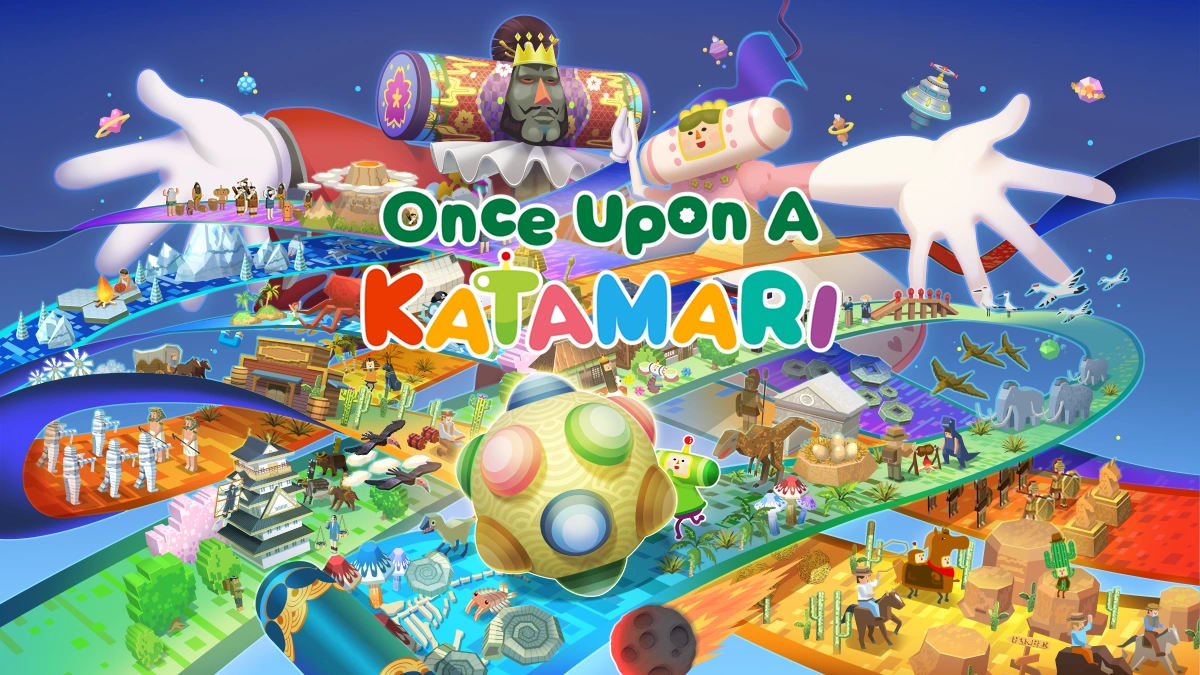
While some PlayStation 2 era games in 2004 were trying to push the limits of storytelling and world building, Katamari Damacy was testing just how much chaos could be crammed onto the screen as you rolled up objects, people and even buildings into one giant ball to appease the King of the Cosmos. The thrill of rolling up everything in sight was a thrill then, and still offers some great experiences nowadays, such as through its remasters in recent years. Is it completely revolutionary? Not anymore. But still provides hours of fun. But in 2025, Bandai Namco Entertainment has decided not simply to remaster the game’s back-catalogue, but instead, for the first time in well over a decade, offer a completely new, original console Katamari experience dubbed Once Upon a Katamari. Set across multiple eras of time rather than the typical modern-day Japan, does this new experience offer the same charm as before, or does the series belong back in its own golden age? Read on to find out!
After finding grander and grander objectives following the destruction of the stars and planets, Once Upon a Katamari changes from an earth-rolling adventure to a time-rolling adventure, this time seeing the King of All Cosmos, Prince and all the latter’s cousins exploring different time periods. Why? Because a whoopsie happened, and the Earth also blinked out of existence. Cue the Prince, hopping aboard the S.S. Prince to zig‑zag through time – starting with Edo-era streets and haunted yokai townships before zig-zagging forwards and backwards through time, from the prehistoric era to the American wild west. The plot isn’t here to twist; it’s here to unlock playful scenarios and new backdrops, arguably some of the best the series has to offer – punctuated by snappy vignettes of the King and Queen being… well… themselves. The localisation keeps the royal bluster buoyant and the tone unmistakably Katamari – although whether the gags land or not is likely to be a matter of personal taste. The narrative itself, meanwhile, is irreverent and moves at a rapid pace, with eras opening quickly and cutscenes keeping you rolling.
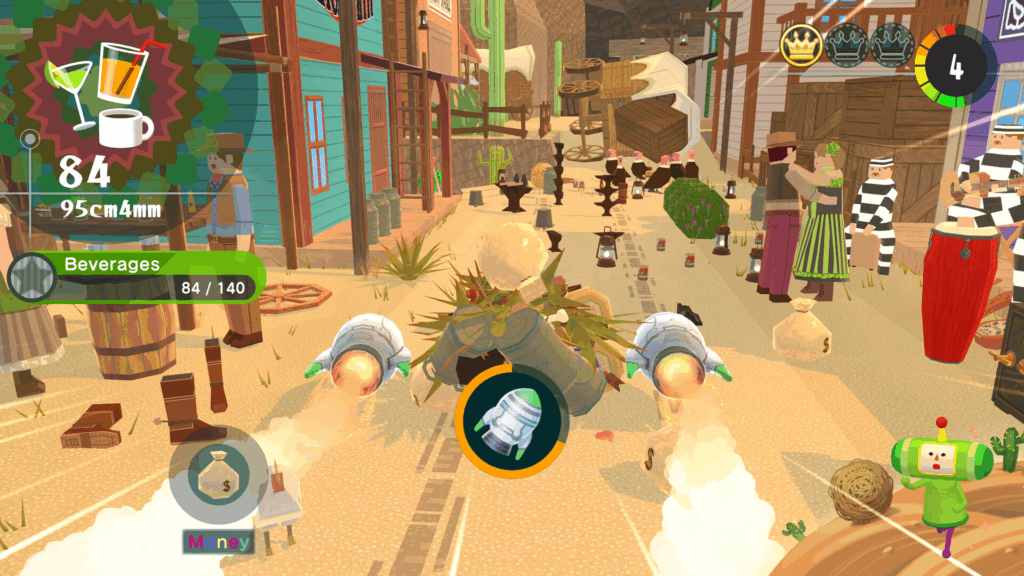
Once Upon a Katamari keeps the series’ low‑poly pop intact (with some high-definition flourishes) and lets it sing on modern screens. Edges are crisp, the frame rate never blinks, and the candy‑box palette makes individual props readable even as your katamari balloons from thumbtacks to bathhouses. Each era brings its own suite of set dressing – from lantern‑lit Edo streets teeming with yokai silhouettes, sun‑bleached agoras where philosophers loiter and a zany cast of characters to go along (and roll up) with them. Innovative UI enhancements keep the chaos legible but faithful to the series’ style guide: rank targets, gate icons, and gentle markers point toward exits or end goals without smothering discovery. If there’s a quirk, it’s distribution: Edo gets the lion’s share while a couple of other eras feel worthy of some extra love.
The Katamari series has always had an eclectic soundscape, offering everything from pop to 8-bit remixes. Once Upon a Katamari is another show-stopper. The new OST pinballs between J-Pop, Funk, Jazz and everything in between to suit the era you find yourself in – complemented by some DLC which offers an ample cornucopia of hits from all past games. Sound and style are set; now let’s get rolling.
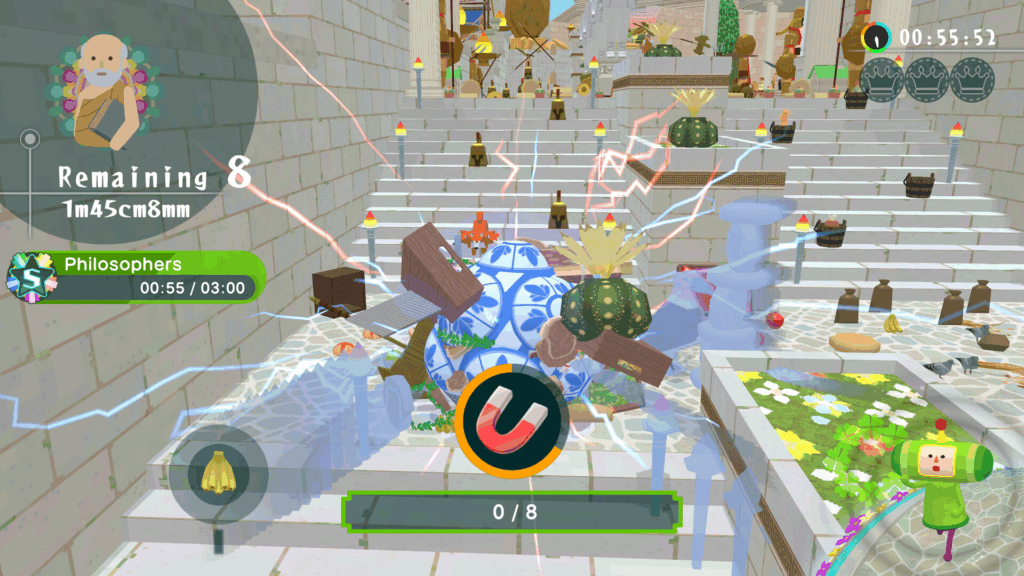
Rolling a Katamari is still as intuitive and “simple yet complex to master” as before. You start by nudging the titular Katamari through a range of clutter to reach a specific size (or another goal). As your ball gets bigger, you can progress from thumbtacks and small bits of litter on the ground to much larger things, racing against the clock or pursuing some other objective. Therefore, the experience can be zen… just not too zen. This time around, there are two control schemes on offer: the classic dual‑stick scheme returns for purists, but a simplified option smooths the learning curve, while a trigger‑based charge roll spares the old stick‑mashing and makes bursts of speed second nature. I’ll be honest and say I preferred the simplified controls, namely that, for whatever reason, the dash movements in the classic dual-stick controls were haphazard at best compared to those in past Katamari games. Meanwhile, collisions feel a shade kinder at awkward sizes, so bumps that once stalled a run now nudge you forward – though this isn’t perfect.
Once Upon a Katamari, like past games, isn’t just about getting the biggest katamari as quickly as possible. Sure, that is the objective for a range of missions. Yet there is a decent variety on offer here – from attaining the largest size with a limited maximum number of items, watering a barren desert, or rolling yourself up historical philosophers, among many others. Adding to the strategic nature of many of the levels are newly introduced ‘Freebies’, single-use items that can assist in a pinch: a magnet for greedy vacuums, rockets for wind‑blasted straights, a stopwatch to steal a few precious seconds, and a radar to sniff out cousins, crowns or targets. With clearly ranked goals and a surprising depth of challenge, you can complete levels without using them, but their strategic use feels weighty as you inch out those extra few seconds or cm.
As mentioned above, with letter ranks for each level (D → S), there is much to keep players returning to their favourite levels time and time again to eke out that higher grade. But that is not the only thing encouraging replayability. Each stage has three hidden crowns, which are occasionally used to gatekeep the next surplus of content and, if you are on a platform that supports trophies/achievements, many of them. Additionally, there are presents to unwrap and 68 cousins to recruit – all complemented by a create‑a‑cousin tool to create your own avatar with a steady stream of cosmetics and emotes. Early S‑ranks come quickly; late missions lean into routing and time management, rewarding tighter lines and well‑timed Freebies. The crown hunt will split players – many will enjoy the treasure‑trail structure, others will bristle when a timed, chaotic run leaves them on their 20th attempt. But all in all, the gameplay loop is generous, layered, and endlessly pick‑up‑and‑play.
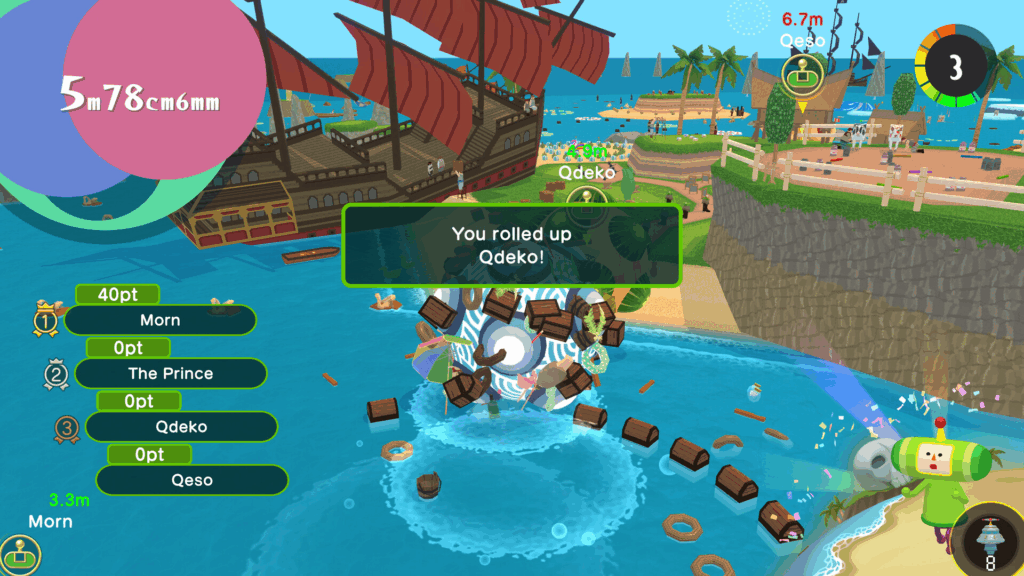
In an attempt to deliver some multiplayer action, Once Upon a Katamari introduces KatamariBall, which turns the katamari-rolling action into a sport, where four rollers scramble to hoard junk, then peel off to beam it into a UFO that randomly appears on the field. Adding to the chaos is that other players can roll you up, decreasing your size, while power-ups and end-of-round bonuses mean that every session doesn’t run the same twice. It’s silly fun, although not something to buy the game for alone. The rough edges live elsewhere: the camera wobbles in tight interiors, the King’s mid‑screen interjections sometimes blot your sightline at the worst moment, and as I mentioned before, the classic controls are not perfect. None of it derails the momentum, but you feel the bumps when the ball outgrows the room.
Ultimately, Once Upon a Katamari feels like a polished return that threads what made the original games so enjoyable, while also making a few attempts to make the experience feel fresh. Ultimately, the user interface is cleaner, the multiplayer is worth spending a little bit of time on, bite‑sized Freebies add flexibility, and, most importantly, there is just more to do. It’s also the most approachable Katamari yet – clearer goals and quality‑of‑life nudges make it easy to recommend to first‑timers without dulling the edge for veterans. Yes, the innovation ceiling shows, crown-gating may leave those avid trophy hunters a little frustrated at times, and the weighting of eras can be a little bit imbalanced – but those caveats are minor compared to the fun on offer. For me, it’s a step forward in accessibility, variety, and refinement – not a reinvention – and it doesn’t need to be; fans will feel right at home, and newcomers will finally get why fans keep rolling all these years later.
Final Score for Once Upon a Katamari
This review is based on the PlayStation 5 version of Once Upon a Katamari, with all testing conducted on a retail PlayStation 5 Pro unit. A digital code was provided by Bandai Namco Entertainment Australia to facilitate this review.
Once Upon a Katamari is now available to purchase on PlayStation 5, Nintendo Switch, Xbox Series X|S and PC via Steam.

