
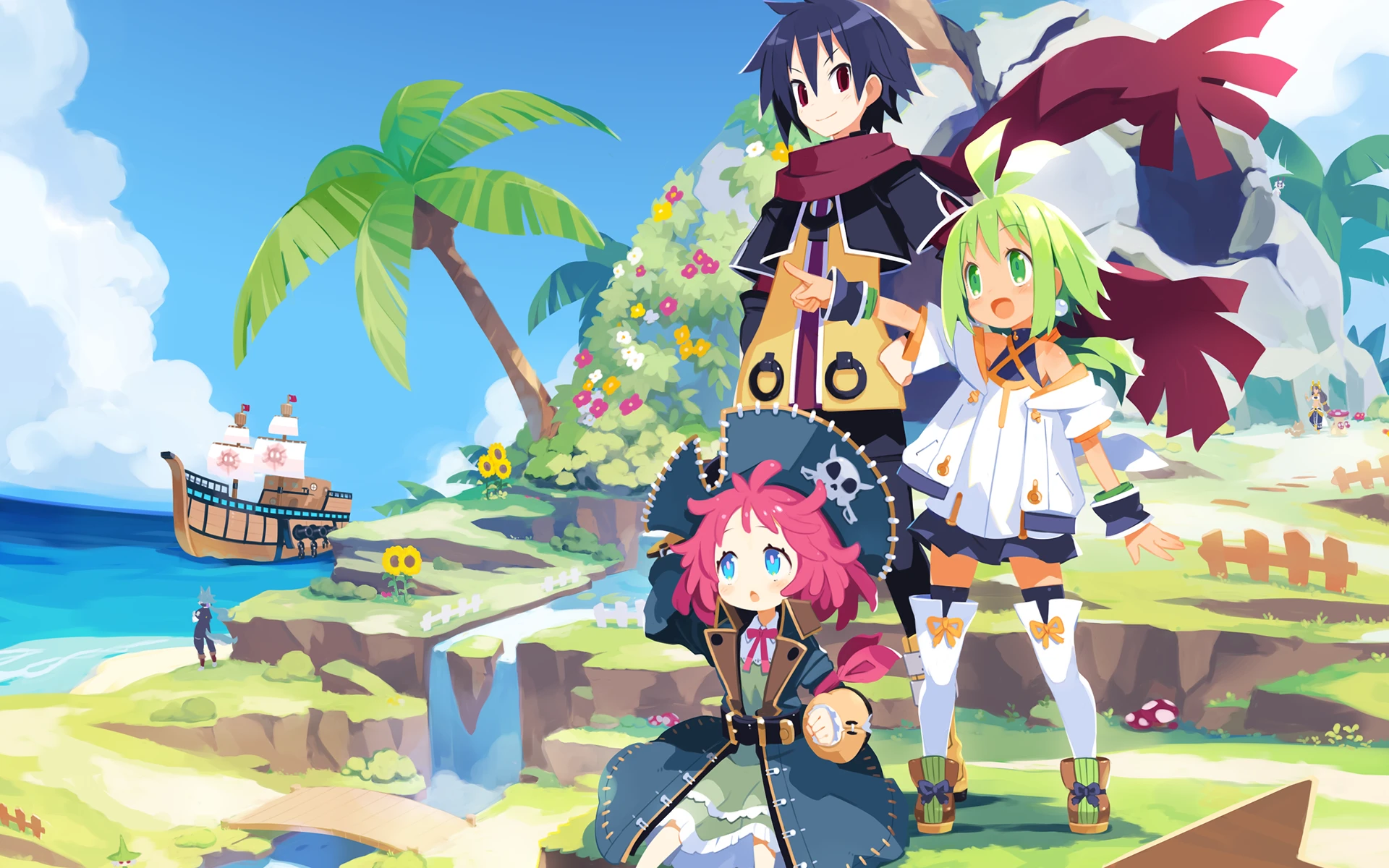
For many, their introduction to the Nippon Ichi Software-developed tactical RPGs would have been through one of their mainline Disgaea titles. Whether this was the original Disgaea before NIS opened their international division or one of their newer titles, it is clear why many fans have become hooked on their semi-regular flagship releases. For me in the early 2000s, and my extended quest to track down a PlayStation 2 copy of Disgaea: Hour of Darkness among the seemingly finite number of copies released in Australia – my first introduction was Phantom Brave. Having completed the game many a time since nabbing myself a copy, the adventures of Marona and Ash have been a defining experience in my journey through the labyrinth of gaming, and I had honestly expected it to stay as a one-off experience, excluding the previously Wii exclusive ‘Alternate Timeline’ chapter. So colour me both surprised and excited when last year, Nippon Ichi Software and Nippon Ichi Software America confirmed that a fully-fledged sequel was in development – Phantom Brave: The Lost Hero. Featuring a range of mod cons developed across other titles over the past two decades, but still being targetted and faithful to the structure of its origin game, I will openly say this is my favourite Nippon Ichi Software game released in some time.
Phantom Brave: The Lost Hero opens by immediately reuniting players with Marona and her ever-reliable guardian phantom and protector Ash. Following the events of the original game, they have sailed further than they ever have before. However, they find themselves ambushed by a formidable crew of pirates – with its leader having the ability to steal Marona’s powers. In a desperate bid to save Marona’s special abilities, Ash sacrifices himself and becomes separated from her, leaving the young Chroma weakened and stranded on a remote island. Through a stroke of fate, she encounters the timid but determined Apricot – another phantom seeking her missing pirate-captain father – and enlists with the Argento Pirate Crew to rebuild their ranks and track down both their lost loved ones. What begins as a straightforward rescue mission soon spirals into something more far-reaching, as Marona and her colourful new allies navigate a tapestry of personal loss, ghostly encounters, and revelations about the Shipwreck Fleet that threaten not only the islands but all phantoms.
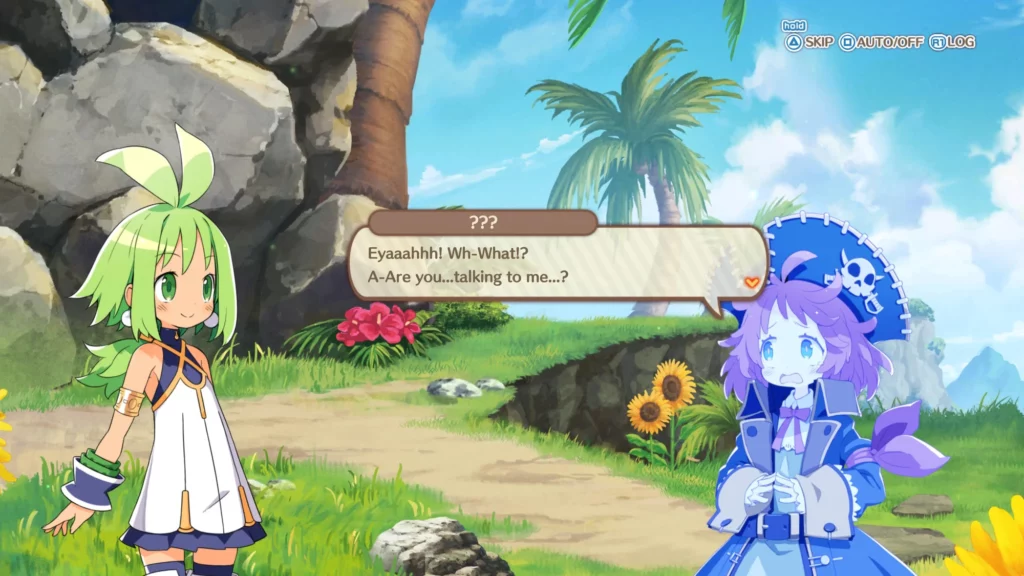
The story builds upon the strengths set by its predecessor and feels like a natural continuation of the original narrative rather than simply being tacked on to justify there being a sequel. Having played the original Phantom Brave would most certainly help newcomers, but they do enough to perhaps let you understand what is taking place if you absolutely want to start with the sequel. The narrative’s greatest strength lies in its celebration of found family and compassion while shifting the focus less on Marona, and more on the nature and constraints of becoming a phantom. Each new ally Marona meets manages to add a spark of energy to the overall narrative, and there’s a generous sprinkling of heartfelt moments that give the more whimsical swashbuckling chapters unexpected depth. By the time all the key players have been introduced, Phantom Brave: The Lost Hero’s cast exhibits a lively chemistry that ensures you won’t feel the absence of Ash quite so sharply.
Though it doesn’t aspire to be a grand, genre-shaking epic, Phantom Brave: The Lost Hero offers a lively, welcoming charm that beautifully complements its ghostly pirate premise. The early chapters allow each newcomer to shine in ways that balance both gentle and comedic aspects and really provide some weight to each character. Although Marona’s sometimes upbeat nature does feel a little bit forced, her unwavering optimism enriches the game’s tone rather than overshadowing it, lending each encounter a warm sense of possibility. But most of all, I think it is a pleasant experience from start to finish. Even when a level stumped me, I felt enchanted by what was taking place, making me want to go for “one more stage” to unlock the next story titbit. This is supported by there being virtually no filler stages, with each level starting and concluding with a cutscene which felt well-paced and contributed to the overall experience.
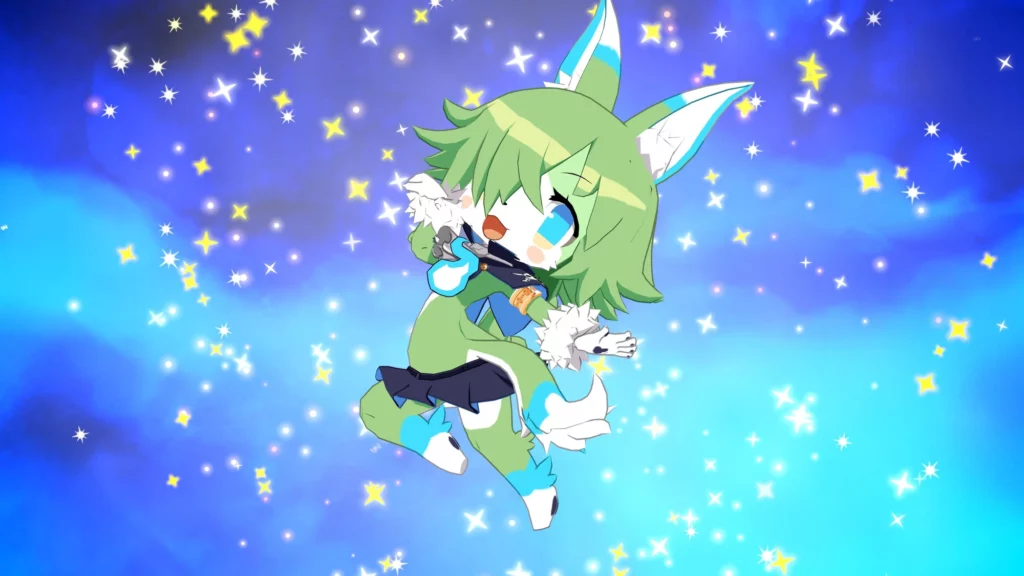
Nippon Ichi Software had, in my opinion, a rough transition from their 2D sprite-based character designs to 3D anime-style models, and even with their most recent Disgaea instalment, it still felt they were refining the process. Phantom Brave: The Lost Hero is their first game in which I feel they have got their design language perfected, and while I cannot help but wish they retained their former 2D sprite art approach, the 3D chibi models work well in retaining a similar style while having the versatility to be more adventurous with 3D cutscenes, and in-battle animations. Environments are typically small islands or compact landscapes, which are nicely structured to suit the phantom summoning mechanics which are the crux of the battle system, but even limited areas tend to be neatly layered, providing enough variety and nuance for combat.
The soundtrack perfectly suits the island-hopping, pirate-meets-phantom premise, balancing breezy melodies with gentle, sometimes whimsical tunes that underscore Marona’s earnest optimism, some incredible vocal tracks and yes, a few kick-ass battle themes that really get you in the mood. Plus, Tenpei Sato returns as composer and it is nice to see that the style he brought audiences back in 2004, still shines just as brightly today.
20 years since the release of Phantom Brave, it wouldn’t have surprised me for any other game if the English voice cast had moved on and Nippon Ichi Software America ended up recasting its lead characters. However, both Sandy Fox as Marona and Lex Lang as Ash were iconic, and I am stoked to see both return to voice their characters. While Lang may be slightly deeper in voicing Ash, it sounds like no time has passed for Fox, her voice fitting Marona perfectly 20 years later. The new English voice cast members also fulfil their roles impressively, from the shy Apricot who struggles to find her way as a Pirate Captain, to the mysterious but kind wolfman, Rouen.
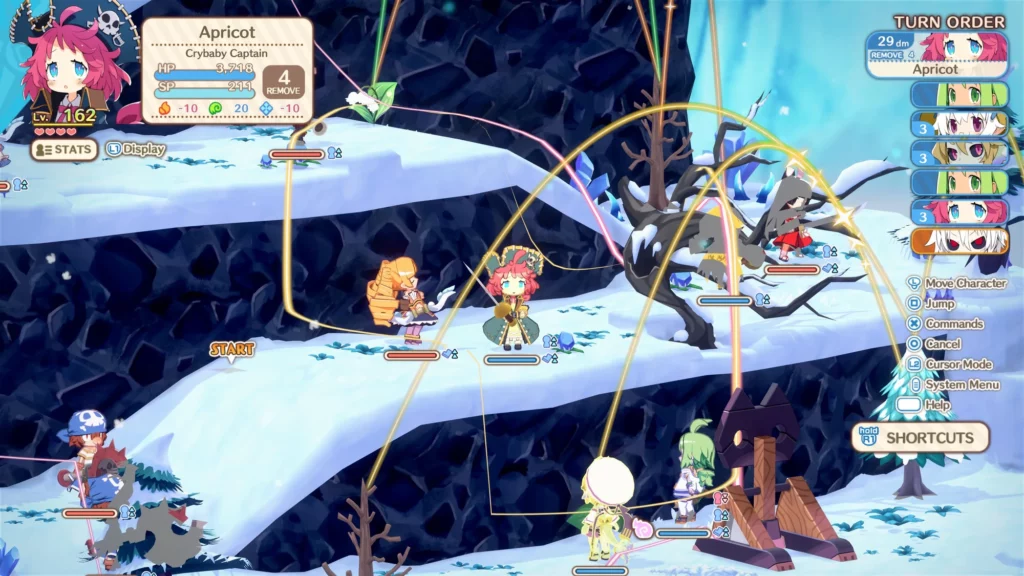
At its core, Phantom Brave: The Lost Hero embraces the same tactical foundations featured in the original Phantom Brave, including its main differences from other Nippon Ichi Software RPGs including a free-roaming approach to the battlefield (based on a circular field of movement rather than a grid system), which opens the door for more inventive positioning strategies, and the confinement system. Regarding the former, stages typically revolve around compact, multi-layered terrains, so even small-scale maps can pack surprising depth. Objectives often call for a balance of enemy elimination and careful resource gathering, encouraging you to analyze each layout rather than just rushing forward.
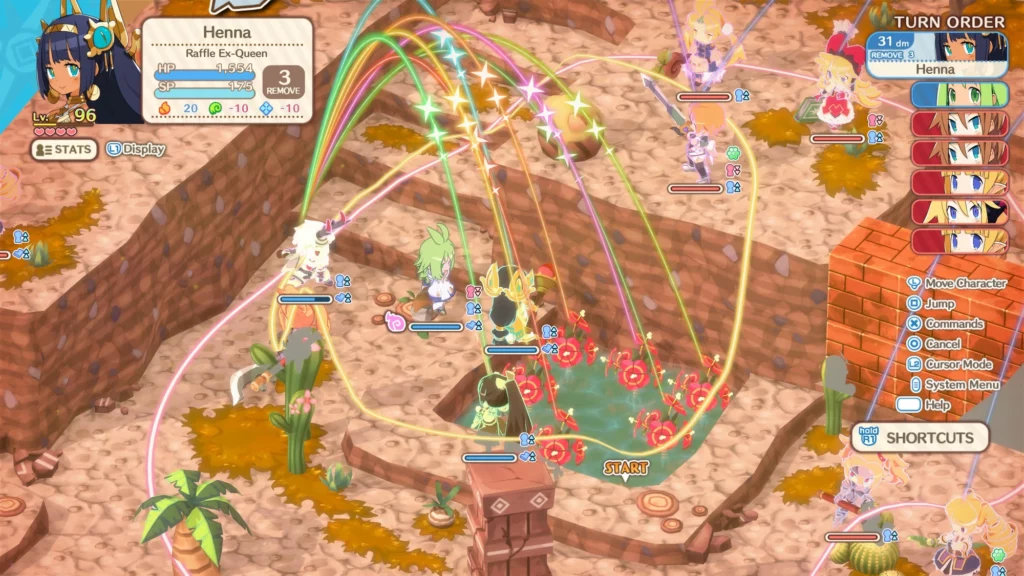
The other returning feature is the Confine system, which sees Marona binding spirit allies to physical items scattered across the map. All the items littering the battlefield, from a barrel to a weapon can be used as a vessel, temporarily granting a phantom a physical presence – and if your STEAL stat is high enough, add the item to your inventory as well (with virtually every item obtainable usable as a weapon). This approach forces you to consider not only who you bring out from your party, but when and associated with what item. Each phantom also has a limited number of turns, making deployment order crucial. Summon your most powerful fighters too soon? They’ll vanish before the real challenges arrive. Summon a mage or other short-range small-turn count character too far away from the action? You may not even get a single hit in. It adds quite a bit to the difficulty level at first while you find your feet, but the levels are all properly designed to factor in different strategic approaches and provide you with a few extra boons such as Marona (the only unit that doesn’t have a turn limit) being able to surrender a turn to get one nearby ally an extra turn.
Complementing this is the newly introduced Confriend mechanic, where Marona fuses with one of her allies for a burst of extra actions. This synergy effectively transforms Marona into a powerhouse for a few turns—potentially turning the tide of battle in a pinch. Complemented by a magical girl transformation sequence, this results in some very creative redesigns of Marona from a graphical perspective allows the sharing of superior stats, and some impressive skills. My only qualm is that outside of the main cast, each class doesn’t have their own distinct Confriend design, typically transforming into a singular type based on the type of approach to combat they use. This is particularly prominent in the postgame characters as well, where you can transform into a unique confriend unit with any of the crossover characters. In a similar vein also comes the Confire system, allowing phantoms to take control of specialised devices and vehicles, granting you access to everything from cannon-fire to take-out blocks, to fans that blow enemies in either direction – hopefully out-of-bounds and potentially out-of-mind. Not only does it add flair by letting you blast away with outlandish artillery, but it also brings refreshing variety to the typical “move-and-attack” flow.
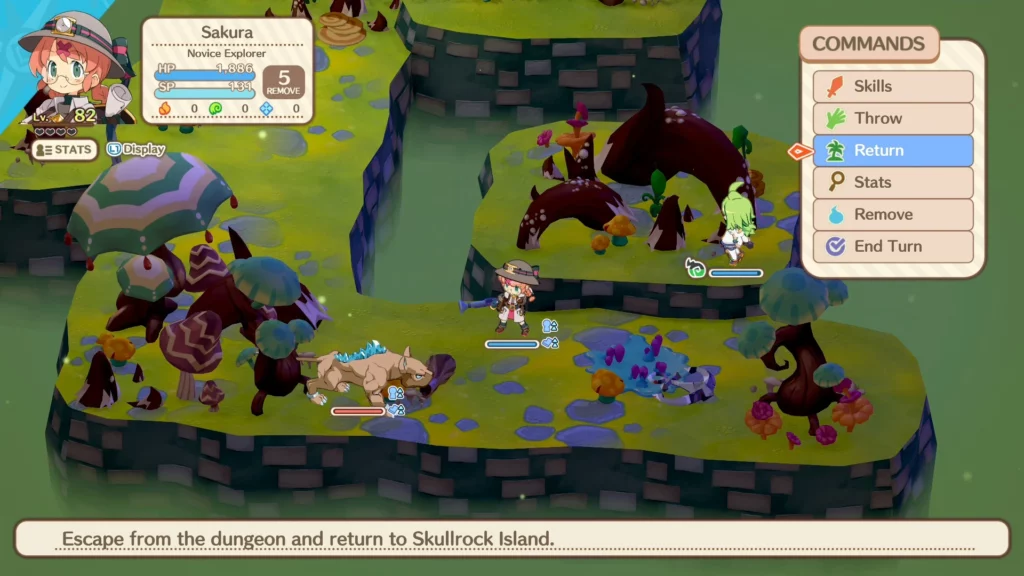
Beyond story-based combat, Phantom Brave: The Lost Hero presents a range of modes to level up your characters and provide access to rare items. A simplified version of the randomly generated dungeons, somewhat on par with the original Phantom Brave with a few extra perks, returns, allowing you to test your squad’s mettle while acquiring stronger loot and titles that augment characters or weapons. Introduced from more recent Disgaea games is the ‘Juice Bar’ enabling you to collect and redistribute a chosen portion of experience obtained through battle across other party members. Furthermore, an item fusion/upgrade system allows you to combine the properties of multiple weapons to craft monstrous stat boosts. These are just some of the systems, with others such as the Marina (Upgrading your ship to provide various boons) and Salvaging (Collecting items from the deep sea) systems providing a nautical theme to some of the facilities on offer.
All these customization layers feed into the game’s hallmark sense of discovery. It’s easy to lose hours fiddling with party setups and forging absurdly powerful equipment, which is precisely where Phantom Brave: The Lost Hero finds its stride. Even as someone who is not a min-maxer like some players, and someone who doesn’t always get the luxury to spend hours upon hours in games, I easily found time fluttering away that I netted a solid 30 hours of gameplay and still wanting to do one more random dungeon run.
This review was conducted on the original Version 1.0 of Phantom Brave: The Lost Hero and I would strongly advise downloading the Day One patch before diving into the game. While I was able to get to the end of the game, and on the PlayStation 5 I encountered no issues with lag, both AI pathfinding and even where your party members stood could cause the game to glitch out, sometimes taking 10-20+ seconds to sort itself out, and on other occasions requiring a full reboot of the game. While this occurred during story missions semi-regularly, the ones requiring full reboots tended to occur frequently during the randomly generated dungeons. So yes, please take a few moments to update the game.
Phantom Brave: The Lost Hero was truly worth every day of its two-decades-long wait, serving as a rewarding and purposeful sequel inviting to long-time fans and newcomers to the series alike. The game captures that perfect blend of wonder and strategy — where every island is a promise of adventure, every cutscene leaves you gripped and waiting for what happens next, and every battle genuinely sparks your noggin with ideas of new approaches. It’s as if the game knew exactly when to tug at my nostalgic and emotional heartstrings, and when to push me into devilishly fun challenges, ensuring I was always left wanting to do just one more battle. Through all the swashbuckling chaos and heartfelt reunions and friendships, this sequel confidently honours its roots while offering a surprisingly fresh experience, reminding me why I fell in love with Nippon Ichi Software’s spirited worlds in the first place. While undoubtedly NIS wants to move forward with new chapters and instalments, Phantom Brave: The Lost Hero, in my opinion, sets a standard for what much-needed returns to some of their earlier works should be. Overall, a delight from start to finish!
Final Score for Phantom Brave: The Lost Hero
To facilitate this review, a digital PlayStation 5 code of Phantom Brave: The Lost Hero was provided by Nippon Ichi Software America.
Phantom Brave: The Lost Hero will be launching starting 30 January 2025 in North America and Europe, and 7 February 2025 in Australia and New Zealand, for the PlayStation 4, PlayStation 5 and Nintendo Switch. A PC version is set for release sometime on Steam later in 2025.
A demo of Phantom Brave: The Lost Hero is now available to download via the PlayStation Store and Nintendo eShop.

