

Who here remembers White Knight Chronicles, the short-lived RPG franchise from Level-5 and Sony Interactive Entertainment from back in the PlayStation 3’s life cycle, which balanced delivery of a main storyline with a fun and approachable quest system that drew players into it with the promise of dozens if not hundreds of hours. While a convoluted, clunky RPG battle system, slow pacing and overreliance on online play for post-game was, unfortunately, what saw the series end before its prime, the framework for a better-balanced, more appropriately structured game was there ready for a development team to do right. In 2024, we finally have the game that takes the concepts of what White Knight Chronicles failed to deliver and does it better in almost every possible way – with Granblue Fantasy: Relink now available on the PlayStation 4, PlayStation 5 and Windows PC. While initially in development limbo, announced in August 2016 as a co-development between CyGames and PlatinumGames, before being brought exclusively in-house, it takes almost a full decade’s worth of ideas and world-building created for the mobile RPG Granblue Fantasy, and delivers it in an appealing, aesthetically pleasing and immersive experience that handles well online and offline (I would argue even better offline), and well worth the wait, even if its release date was five to six years past its originally planned 2018 release window.
One of the limiting factors around any game involving Granblue Fantasy in the West is that, despite the original mobile game having a fully English-localised experience, it is not readily available everywhere. Therefore my residing in Australia means that, without bypassing region locks, I can’t enjoy the original experience. Fortunately, the original game is not a mandatory play to appreciate Granblue Fantasy: Relink, but it most certainly helps, given players are thrown in the deep end, not at the start of the game, but amid Gran or Djeeta’s exploits as a Skyfarer – leaving their backstory to be told through minimalistic character backstory events. In this game, your chosen protagonist is travelling the skies alongside Lyria (Whose life force is bound to yours), mascot dragon Vyrn, and a small group of characters from the mobile game who serve as your main companions throughout the journey: Katalina, Rackam, Io, Eugen and Rosetta – a nice mixing pot of personalities and playstyles. However, their journey turns for the worse when Lyria’s ability to control primal beasts is seemingly interrupted by an external force, and ultimately, she’s captured by the mysterious ‘Church of Avia’, leading her friends to rescue her.
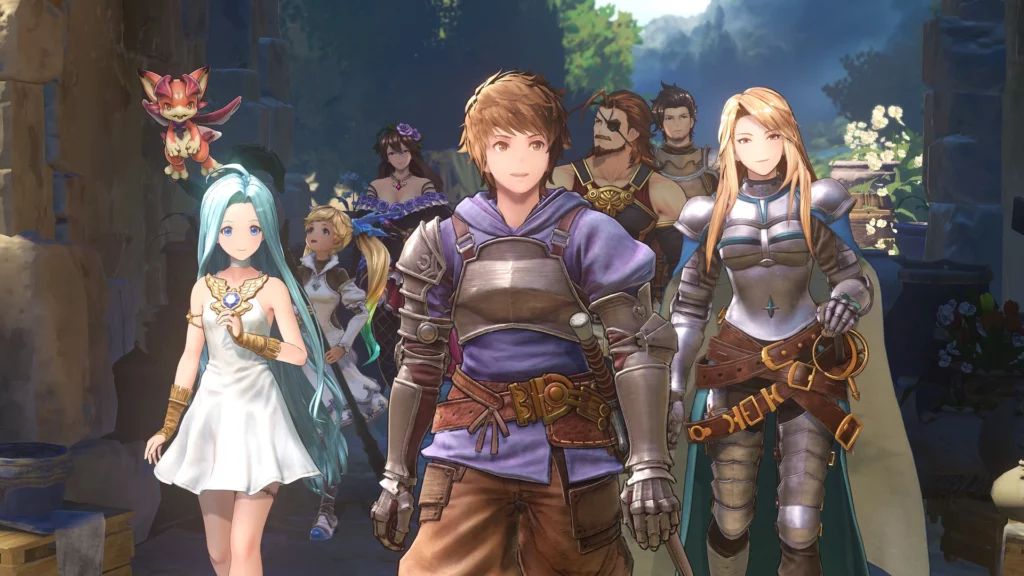
The narrative is reasonably short and can be finished in approximately 10-15 hours. However, despite being on the shorter end, it is well structured, keeping the intensity high from start to finish, rolling out surprises, new environments to explore and challenges to face. Boss battles are not usually just simple hack-n-slash battles either, often with clever mechanics or articulately crafted to be intense experiences in their own right. In the end, the story leaves you satisfied but also hoping for more to come. With the promise of updates starting later this year, here’s hoping to see extra chapters published or new fully-fledged story arcs as DLC using the game’s existing structure, which seems to be crafted with expandability and versatility in mind.
As mentioned above, the main character cast featured in Granblue Fantasy: Relink is “a nice mixing pot of personalities and playstyles”. But, drawing from the game’s origins as a gacha game with dozens upon dozens of playable characters, they have worked an additional dozen or so selected characters across and somewhat incorporating them into story events. Through completing stages of the story and quests, you can occasionally obtain Character Cards, which are redeemable for one of a selection of characters – most of whom previously featured in Granblue Fantasy Versus, from Charlotta and Cagliostro to Ferry and Narmaya. The assortment is pretty good, even if the favourite characters of many likely didn’t make the cut. However, there is the possibility of more being added in future updates. The major downside of structuring the unlock of additional characters this way is that due to obtainment at different points in the story based on player demand, they have minimal narrative presence. The lines they speak are mostly one-liners based on the party member you have active in combat. In the end, there is the real possibility that the characters doing the combat in your party are completely expunged from the majority of the story.
Combat is your standard hack-n-slash affair, with each party member having access to a different weapon, a range of attack combos/skills and offering both the ability to button-mash your way to victory or more eloquently use a combination of quicker weak attacks, slower power attacks and special skills (up to four equipable on party members at any one time) to dish out combos and optimal damage. You only control one party member during a battle, although switching between members is possible between battles. Depending on the weapon your respective character uses and the skills at their disposal, the experience in using each character differs considerably – ultimately meaning you might enjoy using them all, or find comfort in one or two characters (in my case, the pint-sized Charlotta) and leave the magic and ranged attacks to the AI. Irrespective of your approach, each character handles well and generally leads to a seamless combat experience whether they are controlled by the AI or directly by you.
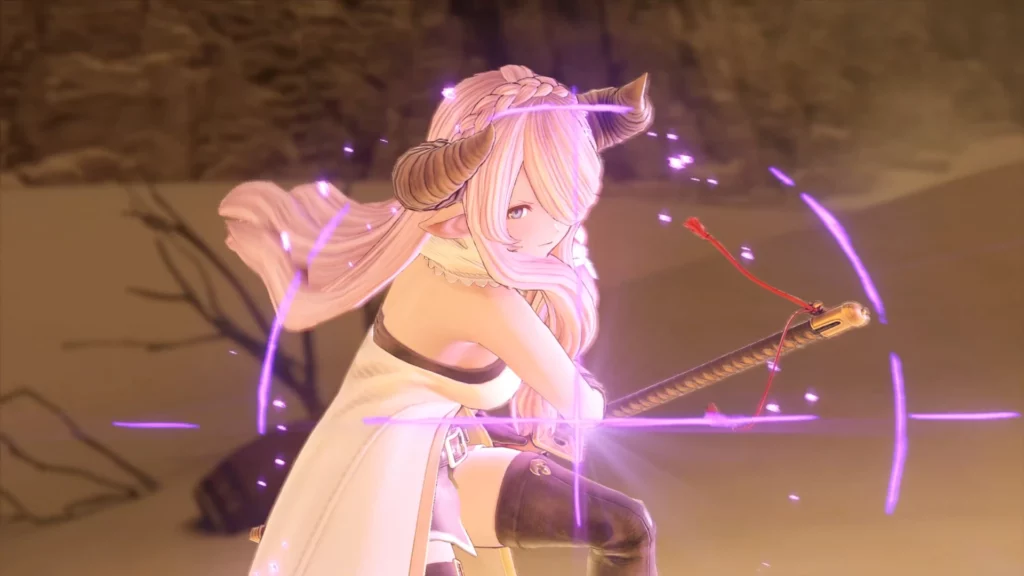
One of the more unique aspects of the combat system is the Arts Level system, whereby by building combos, you increase your Arts Level, making your next skill more powerful. Sure, with most random mobs you can go in and out quickly, and not need to worry about the system – but for the many boss battles you encounter, it can stand between success or failure. Dare you only eke out standard damage, healing or buffs through rapid usage of your skills, or do you bide your time and use them more sparingly but effectively? Adding to that element of short-term boons vs long-term gains are each character’s respective Skybound Arts, ultimate character-specific skills that can be used by filling up the ‘Chain Burst’ gauge until it reaches 100%. Upon each party member reaching the 100% mark in their respective gauge, they can unleash their special, visually stunning attack that typically deals immense damage, befitting the time it takes for the gauge to fill. Granblue Fantasy: Relink provides options to determine whether the AI decides to use these skills for each character it controls, or use them upon your command. Unleashing these attacks out of sync can bring a quicker end to a battle or even break the enemy, but doing them together unleashes an even more powerful ‘Chain Burst’ skill, good at whittling that enemy’s HP even further.
Combat in Granblue Fantasy: Relink is satisfying, as unless you are over levelled, you will never find yourself in a position where you are taking foes down too quickly, and especially in boss battles you are often forced to implement some strategy for combat else there will be mechanics that will take you down for the count. Complemented by link attacks (full party attacks) which occur by taking down the enemy’s stun gauges, link level gauges that slow down time upon reaching 100%, and the different dynamics between different party compositions all make for a rewarding experience. Furthermore, the different states of the enemy, namely the Overdrive, provide a simple approach to shifting battle mechanics from one that players can be more offensive towards, to one that requires a more defensive, strategic approach.
Going back to my analogy towards White Knight Chronicles at the start of this review, here is where Granblue Fantasy: Relink makes its first substantial difference – it features a simple hack-n-slash battle system that enables strategy but flows well and keeps the pace up from start to finish. However, the biggest reason for that comparison was its content outside of the main storyline. From the early moments of the game, through to post-game, players gain access to over 100 different missions, unlockable through a dedicated Mission Giver in each town. The missions are a mixed bag from simple endurance gauntlets to taking down some genuinely tough bosses, to some of the experiences found in the main storyline but amped up. From a narrative perspective, I wouldn’t have minded more to tie them into the world-building, even if on the first run of each mission only. However, they were enjoyable bite-sized experiences for both solo players and those who dabble in the co-op play experience alike.
Unfortunately, this is where the game’s arguably biggest weakness comes in, Online Multiplayer. Now in saying this, I don’t refer to co-op play with friends, as the process is fleshed out appropriately to facilitate that – from inviting friends into the lobby and going from there. Instead, there is no ‘Rooms’ system or the like to bring random online players together, the only way is to undertake a quest and hope someone joins you – a feat I sadly never had happened once. A proper matchmaking system, similar to that of online games that allowed likeminded or like-levelled players to come together at the start would be a welcome addition, and allow more than spaced-out encounters, than hoping someone is wanting to do the same mission at the same time.
As with any action RPG, building your character to suit your playstyle is crucial to surviving on the battlefield. Players take to missions in teams of up to four characters, with Gran or Djeeta being the only mandatory character through most of the story. At its core, your stats are influenced by four key components – your weapon (which you can forge and upgrade through trading in resources and gold), special ‘Sigils’ to grant traits when applied to the character, the character’s respective level and, most importantly, their mastery level which is more unique to Granblue Fantasy: Relink. By completing tasks in-game, players acquire Mastery Points, which are shared amongst all characters you possess. You can trade these in to acquire attack-oriented skills/stat increases, defensive-oriented skills/stat increases, special boons associated with the weapons you have levelled up, and special ‘over mastery’ skills. It is a minimalistic character growth system akin to Final Fantasy X’s Sphere Grid system, which may lead players to question whether they spend all their MP on their chosen character, or evenly distribute the points among at least their main party members to ensure even distribution of stats. I would have loved more depth to this system, as it does come across as more ‘levelling towards a pre-determined outcome’ instead of giving each character multiple potential playstyles.
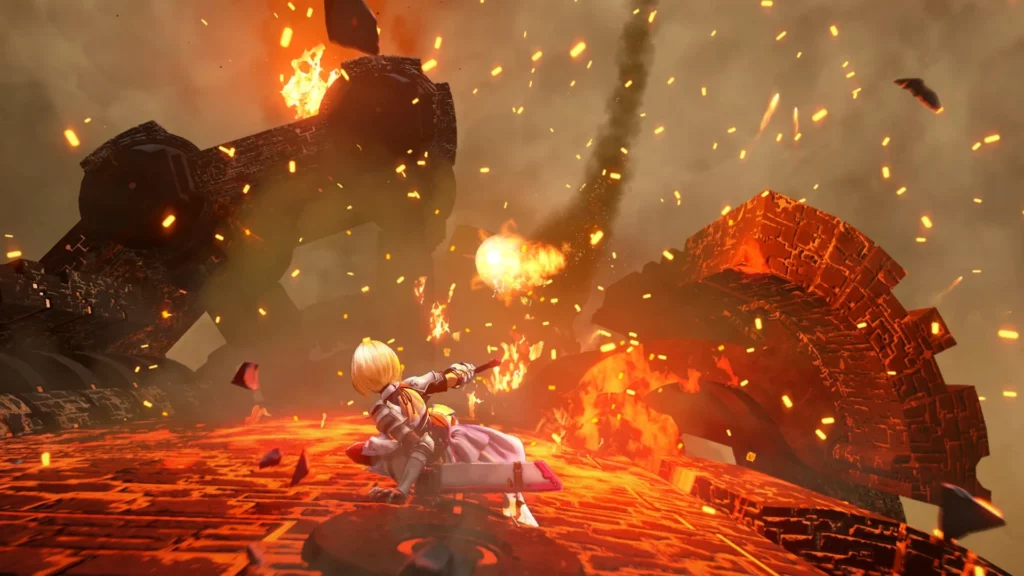
For a minimalistic social-oriented action RPG such as Granblue Fantasy, one that can be played on virtually any smartphone device without too much of an issue, Granblue Fantasy: Relink showcases the artistic style and flair of its source game, against the backdrop of a fully 3D semi-open-world action-RPG hack-n-slash experience. The character designs, all the small attention to detail works, and most notably the world design are all picturesque. It is clear that the game’s creative team took much pride in crafting this small section of the Granblue Fantasy world in 3D for the first time, and it paid off. Additionally, the PlayStation 5 release offers both Performance and Quality settings, and while always a personal preference, the Quality mode looked nice with no major dips in frame rate or general patchiness.
There was no need to question who served as composer of Granblue Fantasy: Relink, with Nobuo Uematsu and Tsutomu Narita continuing to feature as the series’ composers. Both, especially Nobuo Uematsu have a vast history of providing music for RPGs, from Final Fantasy, to Blue Dragon to easily one of my favourites – the Xbox-exclusive Lost Odyssey. The soundtrack they’ve composed is top-notch and really captures the pivotal moments of the narrative while not being overly intrusive. Similar to Granblue Fantasy Versus, the Granblue Fantasy: Relink features Japanese and English voice-overs, and again go with your personal preference as you honestly cannot go wrong. Seasoned veterans and newer faces in the English video game voice-acting scene have united to create something amazing.
While hampered by the need for some improvements to its online matchmaking functionality, Granblue Fantasy: Relink is a solid, first 3D entry into the wider Granblue Fantasy universe, which has for the last decade been deserving of opportunities to expand outside the confines of its mobile game release. It features a meticulously crafted 15-ish hour-long main story campaign, some solid mission-based during and post-game content, and is audiovisually a delight for the eyes and ears. I think CyGames has the strong foundations of a game project that could last the remainder of the year if not further. Moreover, and tying into the analogy I gave at the beginning of this review. I have always loved the idea of a game that contained a full main scenario and a post-game that could bring players together to tackle missions casually without the limitations of a fully online, live-service game. WKC didn’t live up to the hype originally, but I have hope that with some tweaks and further content, this could be the game that 20-year-old me had hoped for.
Final Score for Granblue Fantasy: Relink
This review was conducted on a PlayStation 5 Disc-Based Copy of Granblue Fantasy: Relink.
Developed by CyGames, Granblue Fantasy: Relink is now available on the PlayStation 4, PlayStation 5 and Windows PC platforms.

